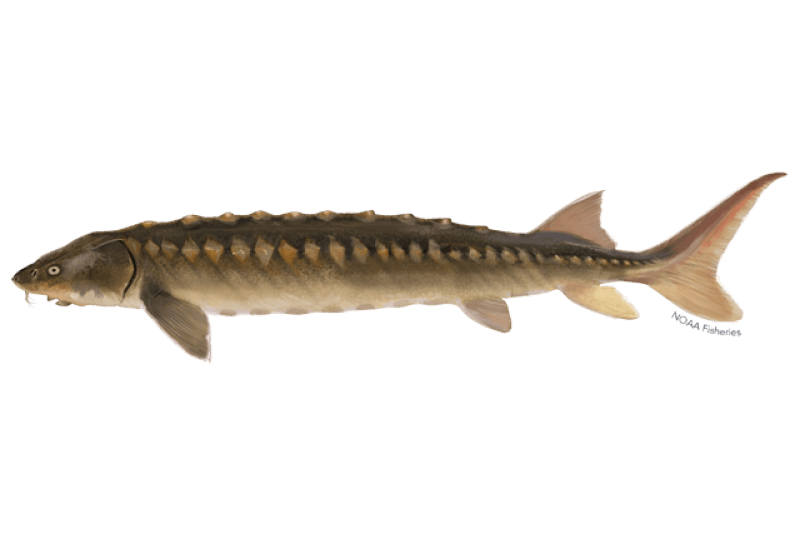
Acipenser brevirostrum . Shortnose sturgeon live in rivers and coastal waters from Canada to Florida. They hatch in the freshwater of rivers and spend most of their time in the river estuaries (areas where
Source: Species facts, status language, and imagery adapted from the NOAA Fisheries species profile (last updated 04/07/2026). Ocean City charter and Maryland
record notes are editorial orientation for OCEANCITY.MD readers. Always confirm current seasons, sizes, and
bag limits before you fish—rules change.
Lifespan: Average of 30 years but may live up to 67
Region: New England/Mid-Atlantic,
Southeast
Category: Fish · Mid-Atlantic
Maryland likelihood: 2★ out of 5
About the species
Shortnose sturgeon live in rivers and coastal waters from Canada to Florida. They hatch in the freshwater of rivers and spend most of their time in the river estuaries (areas where rivers meet the sea). New information shows that some shortnose sturgeon move between coastal estuaries and spawn in one river system but spend most of their time in another. Shortnose sturgeon transit nearshore ocean waters for these coastal movements but do not spend as much time in the ocean environment as Atlantic sturgeon . In the spring, adults move far upstream and away from saltwater to spawn. After spawning, the adults move rapidly back downstream to the estuaries, where they feed, rest, and spend most of their time.
Shortnose sturgeon have five rows of external, bony plates along the length of their body known as scutes, giving them the appearance they are covered in armor. Shortnose sturgeon are slow-growing and late-maturing, and they have been recorded to reach up to 4.5 feet in length and live 30 years or more.
Native American fishermen harvested shortnose and Atlantic sturgeon for their meat and eggs (roe) beginning some 4,000 years ago, and sturgeon are credited as the primary food source that saved the Jamestown settlers in 1607. In the mid-1800s, Atlantic and shortnose sturgeon began to support a thriving and profitable fishery for caviar, smoked meat, and oil. For the most part, historical landings records failed to differentiate between shortnose sturgeon and the larger Atlantic sturgeon, making it difficult to determine historical trends in abundance for populations of either species. By the late-1800s, sturgeon were being over-exploited and abundance was declining. In 1890, over 7 million pounds of sturgeon were caught in 1 year alone. By 1920, only 23,000 pounds of sturgeon were caught; a decline of more than 99 percent.
Although shortnose sturgeon are no longer fished, threats remain that continue to affect recovery efforts. Bycatch in commercial fisheries and increased industrial uses of the nation’s large coastal rivers during the 20th century (e.g., hydropower, nuclear power, treated sewage disposal) became the primary barriers to shortnose sturgeon recovery.
Maryland record catch
Confirm whether Maryland DNR publishes an Atlantic state-record category for Shortnose Sturgeon on the current sport-fish record board.
Maryland’s Atlantic recreational seasons/sizes/creel summary does not publish a dedicated line for Shortnose Sturgeon. Verify COMAR, DNR public notices, and federal rules for your exact waters before you keep fish.
Rule
Maryland / applicable detail
Maryland minimum size
Not listed — no dedicated Shortnose Sturgeon line on the MD Atlantic recreational table
Maryland daily creel (bag)
Not listed — no MD species-specific bag for Shortnose Sturgeon
Maryland open season
Not listed on the MD Atlantic Ocean / Coastal Bays summary table
Verify
Check DNR eRegulations, COMAR, and NOAA for your date and coordinates before you keep fish.
Shortnose sturgeon can grow to approximately 4.5 feet long and weigh up to 50 pounds. They are yellowish-brown and generally have a black head, back, and sides. Their bellies are white to yellow. They have five major rows of scutes (external, bony plates) along the length of their body and a protruding snout with four barbels (fleshy, whisker-like projections).
Shortnose sturgeon are similar in appearance to Atlantic sturgeon , but can be distinguished by their smaller size, larger mouth, smaller snout shape, and tail scute pattern.
Behavior and Diet Spawning adults generally migrate upriver in spring, from January to April in the South, April to May in the Mid-Atlantic, and May to June in Canadian waters. After spawning, the adults typically move quickly back downstream to the lower river and estuaries. In most rivers, juveniles and adults show similar patterns of non-spawning habitat use. For example, in the Southeast, juveniles make seasonal migrations like adults, moving upriver into relatively freshwater during warmer months where they shelter in deep holes, before returning to the fresh/saltwater interface when temperatures cool.
Shortnose sturgeon use their four barbels to search for food in the sandy, muddy bottom of rivers. They use a vacuum-like mouth to suck up a variety of prey from the substrate, typically invertebrates such as insects, crustaceans, worms, and mollusks.
Where They Live Historically, shortnose sturgeon were found in the coastal rivers along the East Coast of North America from the Saint John River, New Brunswick, Canada, to the St. Johns River, Florida, and perhaps as far south as the Indian River in Florida. Currently, shortnose sturgeon occur in at least 41 bays and rivers along the East Coast, reproducing in 19 of them.
For the most part, shortnose sturgeon are amphidromous fish—meaning they are born in freshwater, then live in their birth (natal) river, make short feeding or migratory trips into salt water, and then return to freshwater to feed and escape predation. All sturgeon, including shortnose sturgeon, spawn in freshwater.
Appearance
Spawning adults generally migrate upriver in spring, from January to April in the South, April to May in the Mid-Atlantic, and May to June in Canadian waters. After spawning, the adults typically move quickly back downstream to the lower river and estuaries. In most rivers, juveniles and adults show similar patterns of non-spawning habitat use. For example, in the Southeast, juveniles make seasonal migrations like adults, moving upriver into relatively freshwater during warmer months where they shelter in deep holes, before returning to the fresh/saltwater interface when temperatures cool.
Shortnose sturgeon use their four barbels to search for food in the sandy, muddy bottom of rivers. They use a vacuum-like mouth to suck up a variety of prey from the substrate, typically invertebrates such as insects, crustaceans, worms, and mollusks.
Where They Live Historically, shortnose sturgeon were found in the coastal rivers along the East Coast of North America from the Saint John River, New Brunswick, Canada, to the St. Johns River, Florida, and perhaps as far south as the Indian River in Florida. Currently, shortnose sturgeon occur in at least 41 bays and rivers along the East Coast, reproducing in 19 of them.
For the most part, shortnose sturgeon are amphidromous fish—meaning they are born in freshwater, then live in their birth (natal) river, make short feeding or migratory trips into salt water, and then return to freshwater to feed and escape predation. All sturgeon, including shortnose sturgeon, spawn in freshwater.
World map providing approximate representation of the shortnose sturgeon range. Lifespan & Reproduction Shortnose sturgeon growth and lifespan is correlated with water temperature. In general, the colder the water in which they live, the slower their growth, the later their age to maturity, and the longer their lifespan. For example, shortnose sturgeon from the Saint John River, Canada, population mature at 12 to 18 years old and live up to 60 years. Shortnose sturgeon from the South Carolina and Georgia populations mature at 2 to 5 years of age and likely have a lifespan of about 10 to 20 years.
Male shortnose sturgeon usually spawn every 1 to 2 years once they mature, while females typically spawn every 3 to 5 years. The number of eggs females can produce is correlated with age and body size and ranges from 30,000 to 200,000 per year.
Threats The most significant threats to the species are dams that block access to spawning areas or lower parts of rivers, poor water quality, dredging, water withdrawals from rivers, unintended catch in some commercial fisheries (i.e., bycatch), and changing environmental conditions.
Habitat Impediments Locks and dams on the Cape Fear River, North Carolina; Santee-Cooper River, South Carolina; Savannah River, South Carolina/Georgia; and the Connecticut River impede access to upstream spawning habitat. The dams on the Santee-Cooper system also prevent the dam-locked population of shortnose sturgeon from consistently traveling downstream, below the dams, to areas with better food sources.
For the past several years, NOAA Fisheries has been working with Holyoke Gas and Electric to improve fish passage on the Holyoke Dam on the Connecticut River. In 2017, the station opened a modified fishway, which consists of two “lifts” that carry migrating fish up and over the dam. For the first time in 20 years, shortnose sturgeon passed upstream of the dam. Prior to this effort, from 1996 to 2015, the greatest number of shortnose sturgeon passed by the lift was 16 in 1996. Since the modified fishway became operational, the number of shortnose sturgeon passing upstream at the lift has increased. From 2016-2019, the number of shortnose sturgeon passed at the dam ranged from 20 (2019) to 94 (2016). Many sturgeon also approach the dam but do not enter the lift.
Habitat Degradation Habitats can be altered, degraded, or destroyed because of various human activities, such as dredging, damming, groundwater pumping. Industrialization and development has also impacted water quality through introduction of nutrients and other contaminants.
Fisheries Interactions and Bycatch Shortnose sturgeon bycatch primarily occurs in gillnet fisheries. Shortnose sturgeon have also been captured in pound nets, fyke/hoop nets, catfish pots, shrimp trawls, and even recreational hooks and lines.
The likelihood of sturgeon bycatch is influenced by environmental factors, the abundance of shortnose sturgeon in the fishing area, and the gear characteristics (e.g., mesh size). Survival of the fish that are caught is influenced by factors such as the water temperature and the length of time that the fish is captured in the gear. Fisheries conducted in rivers where shortnose sturgeon spawn may intercept any life stage, while fisheries conducted in nearshore and ocean areas are more likely to capture older juveniles and adults.
A changing environment poses several risks to shortnose sturgeon including saltwater intrusion into rivers where the development of shortnose sturgeon larvae rely on freshwater. Changes in precipitation and water temperature may also affect riverine habitat and alter spawning cues. For example, reduced river flows can increase the concentration of nutrients and toxic chemicals due to a reduced flushing rate and decrease dissolved oxygen concentrations in surface waters, particularly when combined with warmer water temperatures. Both of these can reduce survival of juveniles. A warmer, wetter climate could ameliorate poor water quality conditions in places where human-caused concentrations of nutrients and pollutants currently degrade water quality. However, significantly higher river flows could impede spawning by affecting spawning cues or making traversing up river too difficult to attempt. A warming ocean can also alter the growth rates of shortnose sturgeon which in turn influence age to maturity and lifespan.
Learn more about how to report an injured or dead sturgeon
Scientific Classification Kingdom Animalia Phylum Chordata Class Actinopterygii Order Acipenseriformes Family Acipenseridae Genus Acipenser Species brevirostrum Last updated by NOAA Fisheries on 04/07/2026
Biology
Historically, shortnose sturgeon were found in the coastal rivers along the East Coast of North America from the Saint John River, New Brunswick, Canada, to the St. Johns River, Florida, and perhaps as far south as the Indian River in Florida. Currently, shortnose sturgeon occur in at least 41 bays and rivers along the East Coast, reproducing in 19 of them.
For the most part, shortnose sturgeon are amphidromous fish—meaning they are born in freshwater, then live in their birth (natal) river, make short feeding or migratory trips into salt water, and then return to freshwater to feed and escape predation. All sturgeon, including shortnose sturgeon, spawn in freshwater.
World map providing approximate representation of the shortnose sturgeon range. Lifespan & Reproduction Shortnose sturgeon growth and lifespan is correlated with water temperature. In general, the colder the water in which they live, the slower their growth, the later their age to maturity, and the longer their lifespan. For example, shortnose sturgeon from the Saint John River, Canada, population mature at 12 to 18 years old and live up to 60 years. Shortnose sturgeon from the South Carolina and Georgia populations mature at 2 to 5 years of age and likely have a lifespan of about 10 to 20 years.
Male shortnose sturgeon usually spawn every 1 to 2 years once they mature, while females typically spawn every 3 to 5 years. The number of eggs females can produce is correlated with age and body size and ranges from 30,000 to 200,000 per year.
Threats The most significant threats to the species are dams that block access to spawning areas or lower parts of rivers, poor water quality, dredging, water withdrawals from rivers, unintended catch in some commercial fisheries (i.e., bycatch), and changing environmental conditions.
Habitat Impediments Locks and dams on the Cape Fear River, North Carolina; Santee-Cooper River, South Carolina; Savannah River, South Carolina/Georgia; and the Connecticut River impede access to upstream spawning habitat. The dams on the Santee-Cooper system also prevent the dam-locked population of shortnose sturgeon from consistently traveling downstream, below the dams, to areas with better food sources.
For the past several years, NOAA Fisheries has been working with Holyoke Gas and Electric to improve fish passage on the Holyoke Dam on the Connecticut River. In 2017, the station opened a modified fishway, which consists of two “lifts” that carry migrating fish up and over the dam. For the first time in 20 years, shortnose sturgeon passed upstream of the dam. Prior to this effort, from 1996 to 2015, the greatest number of shortnose sturgeon passed by the lift was 16 in 1996. Since the modified fishway became operational, the number of shortnose sturgeon passing upstream at the lift has increased. From 2016-2019, the number of shortnose sturgeon passed at the dam ranged from 20 (2019) to 94 (2016). Many sturgeon also approach the dam but do not enter the lift.
Habitat Degradation Habitats can be altered, degraded, or destroyed because of various human activities, such as dredging, damming, groundwater pumping. Industrialization and development has also impacted water quality through introduction of nutrients and other contaminants.
Fisheries Interactions and Bycatch Shortnose sturgeon bycatch primarily occurs in gillnet fisheries. Shortnose sturgeon have also been captured in pound nets, fyke/hoop nets, catfish pots, shrimp trawls, and even recreational hooks and lines.
The likelihood of sturgeon bycatch is influenced by environmental factors, the abundance of shortnose sturgeon in the fishing area, and the gear characteristics (e.g., mesh size). Survival of the fish that are caught is influenced by factors such as the water temperature and the length of time that the fish is captured in the gear. Fisheries conducted in rivers where shortnose sturgeon spawn may intercept any life stage, while fisheries conducted in nearshore and ocean areas are more likely to capture older juveniles and adults.
A changing environment poses several risks to shortnose sturgeon including saltwater intrusion into rivers where the development of shortnose sturgeon larvae rely on freshwater. Changes in precipitation and water temperature may also affect riverine habitat and alter spawning cues. For example, reduced river flows can increase the concentration of nutrients and toxic chemicals due to a reduced flushing rate and decrease dissolved oxygen concentrations in surface waters, particularly when combined with warmer water temperatures. Both of these can reduce survival of juveniles. A warmer, wetter climate could ameliorate poor water quality conditions in places where human-caused concentrations of nutrients and pollutants currently degrade water quality. However, significantly higher river flows could impede spawning by affecting spawning cues or making traversing up river too difficult to attempt. A warming ocean can also alter the growth rates of shortnose sturgeon which in turn influence age to maturity and lifespan.
Learn more about how to report an injured or dead sturgeon
Scientific Classification Kingdom Animalia Phylum Chordata Class Actinopterygii Order Acipenseriformes Family Acipenseridae Genus Acipenser Species brevirostrum Last updated by NOAA Fisheries on 04/07/2026
Where they live
Range
Historically, shortnose sturgeon were found in the coastal rivers along the East Coast of North America from the Saint John River, New Brunswick, Canada, to the St. Johns River, Florida, and perhaps as far south as the Indian River in Florida. Currently, shortnose sturgeon occur in at least 41 bays and rivers along the East Coast, reproducing in 19 of them.
For the most part, shortnose sturgeon are amphidromous fish—meaning they are born in freshwater, then live in their birth (natal) river, make short feeding or migratory trips into salt water, and then return to freshwater to feed and escape predation. All sturgeon, including shortnose sturgeon, spawn in freshwater.
Habitat
See the NOAA species profile for habitat detail for this entry.
Ocean City & Mid-Atlantic context
From Ocean City, Maryland, use this Shortnose Sturgeon profile as NOAA Mid-Atlantic directory context—not a promise you will meet the species on every charter.
Always verify current Maryland and federal size, season, and bag rules for your exact date and coordinates before you keep any catch.
Source facts and imagery are adapted from the NOAA Fisheries species profile for Shortnose Sturgeon.
What charter to book from Ocean City
Shortnose Sturgeon may appear on Ocean City trips depending on season and habitat—use the NOAA biology below and book the charter archetype that matches how you will actually fish.
Possible / related
Bay guide — Possible overlap depending on season, water, and boat program.
Inshore charter — Possible overlap depending on season, water, and boat program.