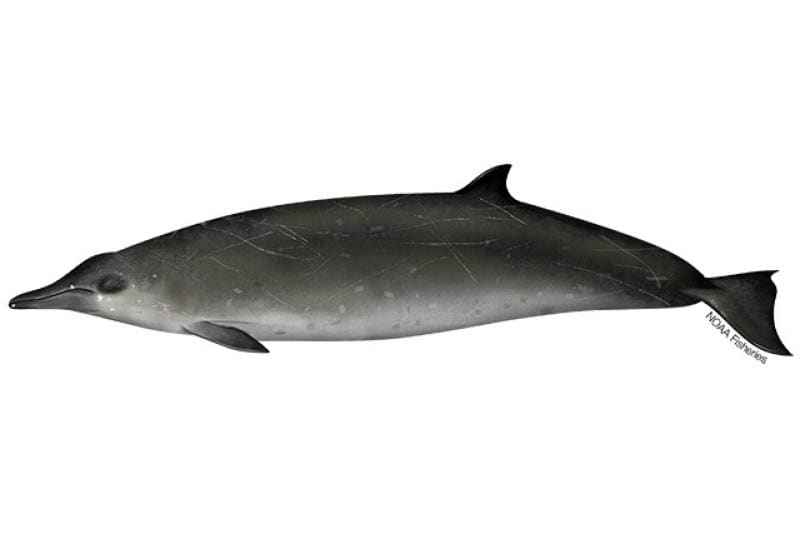
Mesoplodon bidens . Sowerby's beaked whales, sometimes known as the "North Atlantic beaked whale," are little known members of the beaked whale family, Ziphiidae. The first beaked whale to be discover
Source: Species facts, status language, and imagery adapted from the NOAA Fisheries species profile (last updated 04/03/2026). Ocean City charter and Maryland
record notes are editorial orientation for OCEANCITY.MD readers. Always confirm current seasons, sizes, and
bag limits before you fish—rules change.
Sowerby's beaked whales, sometimes known as the "North Atlantic beaked whale," are little known members of the beaked whale family, Ziphiidae. The first beaked whale to be discovered, this species prefers the deep, cold, temperate and subarctic waters throughout the North Atlantic Ocean, but has also been reported near the ice pack. Their scientific name, bidens , is derived from the Latin words bi for "two" and dens for "teeth" and refers to the pair of visible teeth that erupt from the lower jaw of mature males.
The beaked whale family is cryptic and skittish. Due to the rarity of sightings at sea, there is little information on the abundance of Sowerby’s beaked whales worldwide.
Like all marine mammals, Sowerby’s beaked whales are protected under the Marine Mammal Protection Act . They face threats from entanglement in fishing gear and human-caused noise.
Maryland record catch
Confirm whether Maryland DNR publishes an Atlantic state-record category for Sowerby's Beaked Whale on the current sport-fish record board.
Sowerby's Beaked Whale is a protected marine species in U.S. waters. Do not harvest. This guide is biology and Ocean City context only—not a fishing target.
As adults, Sowerby's beaked whales can reach estimated lengths of 14.5 to 21 feet and weigh 2,200 to 2,900 pounds. Males, which are generally larger, can be distinguished from females and juveniles by a pair of visible teeth that erupt from their slightly arched lower jaw. Females and juveniles also have teeth, but they remain hidden beneath the gum tissue, and their jawline is straight.
Sowerby's beaked whales have a small- to medium-sized body with a very long, slender beak relative to other beaked whales, as well as a bulge on the forehead area. The beak often emerges at a steep angle when surfacing. They have a small, wide-based, slightly hooked dorsal fin located about two-thirds down their back. Most of their body is charcoal gray with a pale underside, and calves are generally darker than adults. The lower jaw is usually light gray or white. This species has less visible scarring than most other beaked whale species.
Behavior and Diet Sowerby's beaked whales are usually found individually or in small, closely associated groups averaging between three and 10 individuals. Regular dives range from 10 to 15 minutes, but dives of at least 28 minutes and reaching depths up to 4,920 feet have been recorded. While diving, they use suction to feed on small, deep-sea fish and cephalopods (e.g., squid) in deep waters. When surfacing, this species often lifts its head up out of the water at a 45-degree angle.
Many species of beaked whales (especially those in the genus Mesoplodon ) are very difficult to distinguish from one another (even when dead) because they lack easily discernible or apparent physical characteristics. At sea, they are challenging to observe and identify to the species level because of their cryptic, skittish behavior; low profile; and a small, inconspicuous blow at the water’s surface. Therefore, much of the available characterization for beaked whales is to the genus level only, and there is relatively little information about most individual species.
Where They Live Sowerby's beaked whales prefer the deep, cold temperate and subarctic waters off the continental shelf edge of the North Atlantic Ocean but have also been reported near the ice pack. They are distributed throughout the North Atlantic Ocean (30° to 71° North), ranging from the Norwegian Sea, Labrador Sea, Iceland, and Baltic Sea to the north, and waters off the northeast United States, Madeira, and the Canaries to the south.
Sowerby’s beaked whales may be more common in the eastern than the western North Atlantic Ocean. However, they rarely occur in the Mediterranean Sea. Strandings have occurred in Florida and Italy, but these areas are considered outside their normal range. Their distribution may vary depending on the movements of oceanographic currents. It is unknown whether they undertake seasonal movements or migrations.
Appearance
Sowerby's beaked whales are usually found individually or in small, closely associated groups averaging between three and 10 individuals. Regular dives range from 10 to 15 minutes, but dives of at least 28 minutes and reaching depths up to 4,920 feet have been recorded. While diving, they use suction to feed on small, deep-sea fish and cephalopods (e.g., squid) in deep waters. When surfacing, this species often lifts its head up out of the water at a 45-degree angle.
Many species of beaked whales (especially those in the genus Mesoplodon ) are very difficult to distinguish from one another (even when dead) because they lack easily discernible or apparent physical characteristics. At sea, they are challenging to observe and identify to the species level because of their cryptic, skittish behavior; low profile; and a small, inconspicuous blow at the water’s surface. Therefore, much of the available characterization for beaked whales is to the genus level only, and there is relatively little information about most individual species.
Where They Live Sowerby's beaked whales prefer the deep, cold temperate and subarctic waters off the continental shelf edge of the North Atlantic Ocean but have also been reported near the ice pack. They are distributed throughout the North Atlantic Ocean (30° to 71° North), ranging from the Norwegian Sea, Labrador Sea, Iceland, and Baltic Sea to the north, and waters off the northeast United States, Madeira, and the Canaries to the south.
Sowerby’s beaked whales may be more common in the eastern than the western North Atlantic Ocean. However, they rarely occur in the Mediterranean Sea. Strandings have occurred in Florida and Italy, but these areas are considered outside their normal range. Their distribution may vary depending on the movements of oceanographic currents. It is unknown whether they undertake seasonal movements or migrations.
Lifespan & Reproduction Sowerby's beaked whales may reach sexual maturity at about age 7, and their breeding season may be from late winter to spring. A sexually mature female will give birth to a single newborn calf that is about 8 to 9 feet long and weighs about 375 pounds. The estimated lifespan of this species is unknown.
Threats Entanglement in Fishing Gear Sowerby’s beaked whales have become entangled or captured in commercial fishing gear, such as driftnets and gillnets, off the U.S. Atlantic and Canadian coasts.
Ocean Noise Deep-diving cetaceans like Sowerby's beaked whales rely on sound to feed, communicate, and navigate in the ocean. Sound pollution threatens them by interrupting their normal behavior and driving them away from areas important to their survival.
Scientific Classification Kingdom Animalia Phylum Chordata Class Mammalia Order Cetacea Family Ziphiidae Genus Mesoplodon Species bidens Last updated by NOAA Fisheries on 04/03/2026
Biology
Sowerby's beaked whales prefer the deep, cold temperate and subarctic waters off the continental shelf edge of the North Atlantic Ocean but have also been reported near the ice pack. They are distributed throughout the North Atlantic Ocean (30° to 71° North), ranging from the Norwegian Sea, Labrador Sea, Iceland, and Baltic Sea to the north, and waters off the northeast United States, Madeira, and the Canaries to the south.
Sowerby’s beaked whales may be more common in the eastern than the western North Atlantic Ocean. However, they rarely occur in the Mediterranean Sea. Strandings have occurred in Florida and Italy, but these areas are considered outside their normal range. Their distribution may vary depending on the movements of oceanographic currents. It is unknown whether they undertake seasonal movements or migrations.
Lifespan & Reproduction Sowerby's beaked whales may reach sexual maturity at about age 7, and their breeding season may be from late winter to spring. A sexually mature female will give birth to a single newborn calf that is about 8 to 9 feet long and weighs about 375 pounds. The estimated lifespan of this species is unknown.
Threats Entanglement in Fishing Gear Sowerby’s beaked whales have become entangled or captured in commercial fishing gear, such as driftnets and gillnets, off the U.S. Atlantic and Canadian coasts.
Ocean Noise Deep-diving cetaceans like Sowerby's beaked whales rely on sound to feed, communicate, and navigate in the ocean. Sound pollution threatens them by interrupting their normal behavior and driving them away from areas important to their survival.
Scientific Classification Kingdom Animalia Phylum Chordata Class Mammalia Order Cetacea Family Ziphiidae Genus Mesoplodon Species bidens Last updated by NOAA Fisheries on 04/03/2026
Where they live
Range
Sowerby's beaked whales prefer the deep, cold temperate and subarctic waters off the continental shelf edge of the North Atlantic Ocean but have also been reported near the ice pack. They are distributed throughout the North Atlantic Ocean (30° to 71° North), ranging from the Norwegian Sea, Labrador Sea, Iceland, and Baltic Sea to the north, and waters off the northeast United States, Madeira, and the Canaries to the south.
Sowerby’s beaked whales may be more common in the eastern than the western North Atlantic Ocean. However, they rarely occur in the Mediterranean Sea. Strandings have occurred in Florida and Italy, but these areas are considered outside their normal range. Their distribution may vary depending on the movements of oceanographic currents. It is unknown whether they undertake seasonal movements or migrations.
Habitat
See the NOAA species profile for habitat detail for this entry.
Ocean City & Mid-Atlantic context
From Ocean City, Maryland, use this Sowerby's Beaked Whale profile as NOAA Mid-Atlantic directory context—not a promise you will meet the species on every charter.
Sowerby's Beaked Whale is protected. Do not harvest. Report unusual strandings or entanglements through official channels.
Source facts and imagery are adapted from the NOAA Fisheries species profile for Sowerby's Beaked Whale.
What charter to book from Ocean City
Sowerby's Beaked Whale is not a standard Ocean City charter harvest target. Use this profile for NOAA biology and Mid-Atlantic context only.
Not typical from OC
Bay guide — Not a typical Ocean City bay guide target for Sowerby's Beaked Whale.
Inshore charter — Not a typical Ocean City inshore charter target for Sowerby's Beaked Whale.
Casting / light tackle — Not a typical Ocean City casting / light tackle target for Sowerby's Beaked Whale.
Trolling charter — Not a typical Ocean City trolling charter target for Sowerby's Beaked Whale.
Nearshore wreck / bottom — Not a typical Ocean City nearshore wreck / bottom target for Sowerby's Beaked Whale.
Offshore charter — Not a typical Ocean City offshore charter target for Sowerby's Beaked Whale.
Head / party boat — Not a typical Ocean City head / party boat target for Sowerby's Beaked Whale.
Start with the charter directory trip-type picker so you compare boats inside the right
archetype—not a bay-guide quote against a canyon invoice.
Reducing Interactions with Fishing Gear Sowerby’s beaked whales are caught as bycatch in fishing gear, such as driftnets and gillnets, off the U.S. Atlantic coast. NOAA Fisheries is committed to minimizing bycatch in U.S. fisheries to ensure that fisheries remain sustainable and to protect species such as the Sowerby’s beaked whale.
Learn more about bycatch and fisheries interactions
Overseeing Marine Mammal Health and Stranding Response We work with volunteer networks in all coastal states to respond to marine mammal strandings including all whales. When stranded animals are found alive, NOAA Fisheries and our partners assess the animal’s health and determine the best course of action. When stranded animals are found dead, our scientists work to understand and investigate the cause of death. Although the cause often remains unknown, scientists can sometimes attribute strandings to disease, harmful algal blooms, vessel strikes, fishing gear entanglements, pollution exposure, and underwater noise. Some strandings can serve as indicators of ocean health, giving insight into larger environmental issues that may also have implications for human health and welfare.
Learn more about the Marine Mammal Health and Stranding Response Program
Marine Mammal Unusual Mortality Events Sowerby’s beaked whales have been part of a declared unusual mortality event in the past . Under the Marine Mammal Protection Act , an unusual mortality event is defined as "a stranding that is unexpected; involves a significant die-off of any marine mammal population; and demands immediate response." To understand the health of marine mammal populations, scientists study unusual mortality events.
Addressing Ocean Noise NOAA Fisheries is investigating all aspects of acoustic communication and hearing in marine animals, as well as the effects of sound on beaked whale behavior and hearing. For example, the use of at least some types of shipboard echosounders decreases the acoustic detection rates of multiple species of beaked whales, indicating that they change their behavior when they hear these echosounders. In 2018, we revised the technical guidance for assessing the effects of anthropogenic sound on marine mammal hearing.
Regulatory History Sowerby’s beaked whales are protected under the MMPA.
Harvest
See the NOAA wild-caught fishery section for landings and gear notes when published for this species.
Landings and management details matter most for the waters where Sowerby's Beaked Whale is actually fished—see the
NOAA species profile
.