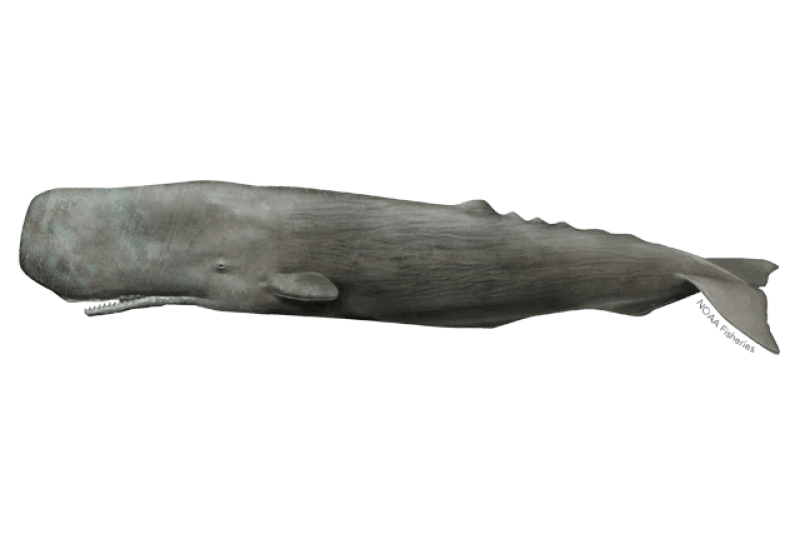
Physeter macrocephalus . Sperm whales are the largest of the toothed whales and have one of the widest global distributions of any marine mammal species. They are found in all deep oceans, from the equator
Source: Species facts, status language, and imagery adapted from the NOAA Fisheries species profile (last updated 02/12/2026). Ocean City charter and Maryland
record notes are editorial orientation for OCEANCITY.MD readers. Always confirm current seasons, sizes, and
bag limits before you fish—rules change.
Region: Alaska,
New England/Mid-Atlantic,
Pacific Islands,
Southeast,
West Coast
Category: Protected species · Mid-Atlantic
Maryland likelihood: 2★ out of 5
About the species
Sperm whales are the largest of the toothed whales and have one of the widest global distributions of any marine mammal species. They are found in all deep oceans, from the equator to the edge of the pack ice in the Arctic and Antarctic.
They are named after the waxy substance—spermaceti—found in their heads. The spermaceti is an oil sac that helps the whales focus sound. Spermaceti was used in oil lamps, lubricants, and candles. Sperm whales were a primary target of the commercial whaling industry from 1800 to 1987, which nearly decimated all sperm whale populations. While whaling is no longer a major threat, sperm whale populations are still recovering. The sperm whale is listed as endangered under the Endangered Species Act and depleted under the Marine Mammal Protection Act .
NOAA Fisheries and our partners are dedicated to conserving and rebuilding sperm whale populations. We use a variety of innovative techniques to study, protect, and rescue these endangered whales. We engage our partners as we develop regulations and management plans that encourage recovery, foster healthy fisheries, reduce the risk of entanglements, create whale-safe shipping practices, and reduce ocean noise.
Maryland record catch
Confirm whether Maryland DNR publishes an Atlantic state-record category for Sperm Whale on the current sport-fish record board.
Sperm whales are mostly dark grey, though some whales have white patches on the belly. They are the only living cetacean that has a single blowhole asymmetrically situated on the left side of the crown of the head. Their heads are extremely large, accounting for about one-third of their total body length. The skin just behind the head is often wrinkled. Their lower jaw is narrow and the portion of the jaw closest to the teeth is white. The interior of the mouth is often bright white as well. There are between 20 and 26 large teeth on each side of the lower jaw. The teeth in the upper jaw rarely break through the gums.
Sperm whale flippers are paddle-shaped and small compared to the size of the body, and their flukes are triangular. They have small dorsal fins that are low, thick, and usually rounded.
Behavior and Diet Sperm whales hunt for food during deep dives that routinely reach depths of 2,000 feet and can last for 45 minutes. After long, deep dives, individuals come to the surface to breathe and recover for several minutes before initiating their next dive.
Because sperm whales spend most of their time in deep waters, their diet consists of species such as squid, sharks, skates, and fish that also occupy deep ocean waters. Sperm whales can consume about 3 to 3.5 percent of their body weight per day.
Where They Live Sperm whales inhabit all of the world’s oceans. Their distribution is dependent on their food source and suitable conditions for breeding, and varies with the sex and age composition of the group. Sperm whale migrations are not as predictable or well understood as migrations of baleen whales. Some populations appear to have different migration patterns by life history status, with adult males making long oceanographic migrations into temperate waters and females and young staying in tropical waters year-round.
World map providing approximate representation of the sperm whale's range. Lifespan & Reproduction Female sperm whales reach sexual maturity around 9 years of age when they are roughly 29 feet long. At this point, growth slows and they produce a calf approximately once every five to seven years. After a 14 to 16-month gestation period, a single calf, about 13 feet long, is born. Although calves will eat solid food before one year of age, they continue to nurse for several years. Females reach their maximum length and are physically mature around 30 years old at which they measure up to 35 feet long.
Appearance
Sperm whales hunt for food during deep dives that routinely reach depths of 2,000 feet and can last for 45 minutes. After long, deep dives, individuals come to the surface to breathe and recover for several minutes before initiating their next dive.
Because sperm whales spend most of their time in deep waters, their diet consists of species such as squid, sharks, skates, and fish that also occupy deep ocean waters. Sperm whales can consume about 3 to 3.5 percent of their body weight per day.
Where They Live Sperm whales inhabit all of the world’s oceans. Their distribution is dependent on their food source and suitable conditions for breeding, and varies with the sex and age composition of the group. Sperm whale migrations are not as predictable or well understood as migrations of baleen whales. Some populations appear to have different migration patterns by life history status, with adult males making long oceanographic migrations into temperate waters and females and young staying in tropical waters year-round.
World map providing approximate representation of the sperm whale's range. Lifespan & Reproduction Female sperm whales reach sexual maturity around 9 years of age when they are roughly 29 feet long. At this point, growth slows and they produce a calf approximately once every five to seven years. After a 14 to 16-month gestation period, a single calf, about 13 feet long, is born. Although calves will eat solid food before one year of age, they continue to nurse for several years. Females reach their maximum length and are physically mature around 30 years old at which they measure up to 35 feet long.
For about the first 10 years of life, males are only slightly larger than females, but males continue to exhibit substantial growth until they are well into their 30s. Males reach physical maturity around 50 years and when they are approximately 52 feet long. Unlike females, puberty in males is prolonged, and may last between the ages of 10 to 20 years old. Even though males are sexually mature at this time, they often do not actively participate in breeding until their late twenties.
Most females will form lasting bonds with other females of their family, and, on average, 12 females and their young will form a social unit. While females generally stay with the same social unit in and around tropical waters their entire lives, young males will leave when they are between 4 and 21 years old and can be found in "bachelor pods,” composed of other males that are approximately the same age and size. As males get older and larger, they begin migrating toward the poles. As a result, bachelor pods become smaller and the largest males are often found alone. Large, sexually mature males that are in their late 20s or older will occasionally return to the tropical breeding areas to mate.
Threats Vessel Strikes Vessel strikes can injure or kill sperm whales. Few vessel strikes of sperm whales have been documented, but vessel traffic worldwide is increasing, which increases the risk of collisions. Additionally, since sperm whales spend long periods (typically up to 10 minutes) “rafting” at the surface between deep dives, they are more vulnerable to vessel strikes.
Entanglement in Fishing Gear Sperm whales can become entangled in many different types of fishing gear, including trap lines, pots, and gillnets. Once entangled, they may swim for long distances dragging attached gear, potentially resulting in fatigue, compromised feeding ability, reduced reproductive success, severe injury, or death.
Sperm whales have also been documented to remove fish from longline gear, a behavior known as “depredation.” They do this by using their long jaw to create tension on the line, which shakes fish off the hooks. In addition, scientists think that this behavior may be learned between individuals. Depredation increases a sperm whale’s likelihood of injury or entanglement while maneuvering around boats and fishing gear.
Ocean Noise Underwater noise pollution can interrupt the normal behavior of sperm whales, which rely on sound to communicate. As ocean noise increases from human sources, communication space decreases—the whales cannot hear each other, or discern other signals in their environment as they used to in an undisturbed ocean.
Different levels of sound can disturb activities such as feeding, migrating, and socializing. Mounting evidence from scientific research has documented that ocean noise can also cause marine mammals to change the frequency or amplitude of calls, decrease foraging behavior, become displaced from preferred habitat, or increase the level of stress hormones in their bodies, leading to other potential health issues for a whale. If loud enough, noise can cause permanent or temporary hearing loss.
Marine Debris Sperm whales can ingest marine debris, as do many marine animals. Debris in the deep scattering layer where sperm whales feed could be mistaken for prey and incidentally ingested, leading to possible injury or death.
Changing Environmental Conditions The effects of climate and oceanographic change on sperm whales are uncertain, but both can potentially affect habitat and food availability. Whale migration, feeding, and breeding locations for sperm whales may be influenced by factors such as ocean currents and water temperature. Increases in global temperatures are expected to have profound impacts on arctic and subarctic ecosystems, and these impacts are projected to accelerate during this century. However, the feeding range of sperm whales is likely the greatest of any species on earth, and, consequently, sperm whales are expected to be more resilient to climate change than species with more restrictive habitat preferences.
Oil Spills and Contaminants The threat of contaminants and pollutants to sperm whales and their habitat is highly uncertain and further study is necessary to assess the effects of this threat. Little is known about the possible long-term and transgenerational effects of exposure to pollutants. Marine mammals are considered to be good indicators for concentrations of metal and pollutant accumulation in the environment due to their long lifespan and (in some cases) position near the top of marine food webs.
Scientific Classification Kingdom Animalia Phylum Chordata Class Mammalia Order Cetacea Family Physeteridae Genus Physeter Species macrocephalus Last updated by NOAA Fisheries on 02/12/2026
Biology
Sperm whales inhabit all of the world’s oceans. Their distribution is dependent on their food source and suitable conditions for breeding, and varies with the sex and age composition of the group. Sperm whale migrations are not as predictable or well understood as migrations of baleen whales. Some populations appear to have different migration patterns by life history status, with adult males making long oceanographic migrations into temperate waters and females and young staying in tropical waters year-round.
World map providing approximate representation of the sperm whale's range. Lifespan & Reproduction Female sperm whales reach sexual maturity around 9 years of age when they are roughly 29 feet long. At this point, growth slows and they produce a calf approximately once every five to seven years. After a 14 to 16-month gestation period, a single calf, about 13 feet long, is born. Although calves will eat solid food before one year of age, they continue to nurse for several years. Females reach their maximum length and are physically mature around 30 years old at which they measure up to 35 feet long.
For about the first 10 years of life, males are only slightly larger than females, but males continue to exhibit substantial growth until they are well into their 30s. Males reach physical maturity around 50 years and when they are approximately 52 feet long. Unlike females, puberty in males is prolonged, and may last between the ages of 10 to 20 years old. Even though males are sexually mature at this time, they often do not actively participate in breeding until their late twenties.
Most females will form lasting bonds with other females of their family, and, on average, 12 females and their young will form a social unit. While females generally stay with the same social unit in and around tropical waters their entire lives, young males will leave when they are between 4 and 21 years old and can be found in "bachelor pods,” composed of other males that are approximately the same age and size. As males get older and larger, they begin migrating toward the poles. As a result, bachelor pods become smaller and the largest males are often found alone. Large, sexually mature males that are in their late 20s or older will occasionally return to the tropical breeding areas to mate.
Threats Vessel Strikes Vessel strikes can injure or kill sperm whales. Few vessel strikes of sperm whales have been documented, but vessel traffic worldwide is increasing, which increases the risk of collisions. Additionally, since sperm whales spend long periods (typically up to 10 minutes) “rafting” at the surface between deep dives, they are more vulnerable to vessel strikes.
Entanglement in Fishing Gear Sperm whales can become entangled in many different types of fishing gear, including trap lines, pots, and gillnets. Once entangled, they may swim for long distances dragging attached gear, potentially resulting in fatigue, compromised feeding ability, reduced reproductive success, severe injury, or death.
Sperm whales have also been documented to remove fish from longline gear, a behavior known as “depredation.” They do this by using their long jaw to create tension on the line, which shakes fish off the hooks. In addition, scientists think that this behavior may be learned between individuals. Depredation increases a sperm whale’s likelihood of injury or entanglement while maneuvering around boats and fishing gear.
Ocean Noise Underwater noise pollution can interrupt the normal behavior of sperm whales, which rely on sound to communicate. As ocean noise increases from human sources, communication space decreases—the whales cannot hear each other, or discern other signals in their environment as they used to in an undisturbed ocean.
Different levels of sound can disturb activities such as feeding, migrating, and socializing. Mounting evidence from scientific research has documented that ocean noise can also cause marine mammals to change the frequency or amplitude of calls, decrease foraging behavior, become displaced from preferred habitat, or increase the level of stress hormones in their bodies, leading to other potential health issues for a whale. If loud enough, noise can cause permanent or temporary hearing loss.
Marine Debris Sperm whales can ingest marine debris, as do many marine animals. Debris in the deep scattering layer where sperm whales feed could be mistaken for prey and incidentally ingested, leading to possible injury or death.
Changing Environmental Conditions The effects of climate and oceanographic change on sperm whales are uncertain, but both can potentially affect habitat and food availability. Whale migration, feeding, and breeding locations for sperm whales may be influenced by factors such as ocean currents and water temperature. Increases in global temperatures are expected to have profound impacts on arctic and subarctic ecosystems, and these impacts are projected to accelerate during this century. However, the feeding range of sperm whales is likely the greatest of any species on earth, and, consequently, sperm whales are expected to be more resilient to climate change than species with more restrictive habitat preferences.
Oil Spills and Contaminants The threat of contaminants and pollutants to sperm whales and their habitat is highly uncertain and further study is necessary to assess the effects of this threat. Little is known about the possible long-term and transgenerational effects of exposure to pollutants. Marine mammals are considered to be good indicators for concentrations of metal and pollutant accumulation in the environment due to their long lifespan and (in some cases) position near the top of marine food webs.
Scientific Classification Kingdom Animalia Phylum Chordata Class Mammalia Order Cetacea Family Physeteridae Genus Physeter Species macrocephalus Last updated by NOAA Fisheries on 02/12/2026
Where they live
Range
Sperm whales inhabit all of the world’s oceans. Their distribution is dependent on their food source and suitable conditions for breeding, and varies with the sex and age composition of the group. Sperm whale migrations are not as predictable or well understood as migrations of baleen whales. Some populations appear to have different migration patterns by life history status, with adult males making long oceanographic migrations into temperate waters and females and young staying in tropical waters year-round.
World map providing approximate representation of the sperm whale's range. Lifespan & Reproduction Female sperm whales reach sexual maturity around 9 years of age when they are roughly 29 feet long. At this point, growth slows and they produce a calf approximately once every five to seven years. After a 14 to 16-month gestation period, a single calf, about 13 feet long, is born. Although calves will eat solid food before one year of age, they continue to nurse for several years. Females reach their maximum length and are physically mature around 30 years old at which they measure up to 35 feet long.
Habitat
See the NOAA species profile for habitat detail for this entry.
Ocean City & Mid-Atlantic context
From Ocean City, Maryland, use this Sperm Whale profile as NOAA Mid-Atlantic directory context—not a promise you will meet the species on every charter.
Sperm Whale is protected. Do not harvest. Report unusual strandings or entanglements through official channels.
Source facts and imagery are adapted from the NOAA Fisheries species profile for Sperm Whale.
What charter to book from Ocean City
Sperm Whale is not a standard Ocean City charter harvest target. Use this profile for NOAA biology and Mid-Atlantic context only.
Not typical from OC
Bay guide — Not a typical Ocean City bay guide target for Sperm Whale.
Inshore charter — Not a typical Ocean City inshore charter target for Sperm Whale.
Casting / light tackle — Not a typical Ocean City casting / light tackle target for Sperm Whale.
Trolling charter — Not a typical Ocean City trolling charter target for Sperm Whale.
Nearshore wreck / bottom — Not a typical Ocean City nearshore wreck / bottom target for Sperm Whale.
Offshore charter — Not a typical Ocean City offshore charter target for Sperm Whale.
Head / party boat — Not a typical Ocean City head / party boat target for Sperm Whale.
Start with the charter directory trip-type picker so you compare boats inside the right
archetype—not a bay-guide quote against a canyon invoice.