Stenella coeruleoalba . Striped dolphins are among the most abundant and widespread dolphins in the world. They prefer deep tropical to warm temperate oceanic waters, and are attracted to upwelling areas,
Source: Species facts, status language, and imagery adapted from the NOAA Fisheries species profile (last updated 03/06/2025). Ocean City charter and Maryland
record notes are editorial orientation for OCEANCITY.MD readers. Always confirm current seasons, sizes, and
bag limits before you fish—rules change.
Region: New England/Mid-Atlantic,
Pacific Islands,
Southeast,
West Coast
Category: Protected species · Mid-Atlantic
Maryland likelihood: 2★ out of 5
About the species
Striped dolphins are among the most abundant and widespread dolphins in the world. They prefer deep tropical to warm temperate oceanic waters, and are attracted to upwelling areas, where deep, cold, nutrient-rich water rises toward the surface, and convergence zones, where ocean currents meet.
Striped dolphins are usually found in tight, cohesive groups of about 25 to 100 individuals and have been observed breaching, jumping, and leaping over 20 feet above the surface of the water. They display a unique behavior called roto-tailing, when the animal leaps high out of the water and vigorously rotates its tail while airborne.
Striped dolphins in the United States are not endangered or threatened. Like all marine mammals, they are protected under the Marine Mammal Protection Act (MMPA). NOAA Fisheries is committed to conserving striped dolphins, and our scientists and partners use a variety of innovative techniques to study and protect this species.
Maryland record catch
Confirm whether Maryland DNR publishes an Atlantic state-record category for Striped Dolphin on the current sport-fish record board.
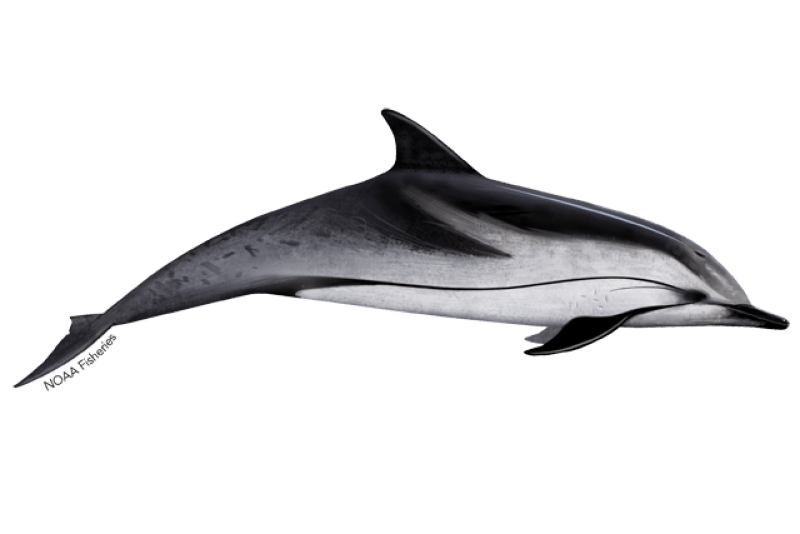
Male striped dolphins can reach lengths of about 9 feet and weigh up to 350 pounds, while females can reach up to 8 feet and 330 pounds. They have a small to medium-sized, robust, sleek body with a long, defined rostrum and round forehead (known as a melon). This species has 43 to 50 pairs of small, sharp, conical teeth in the upper and lower jaws. Their dorsal fin is hooked, tall, and located mid-back.
Striped dolphins are known for their distinct and striking coloration pattern, which includes vivid, thin stripes that extend from the eye to the flipper and another set of stripes down the side of the body to the anal region. This unique coloration distinguishes the striped dolphin from other cetacean species and is the origin of its common name.
The striped dolphin’s rostrum, tapered pectoral fins or flippers, tail, and back (or cape) are dark blue/gray. The area just above the side stripe is bluish or light gray and creates a contrasting shoulder blaze that curves back and up toward the animal's dorsal fin. The underside of the body is white to pinkish and much lighter than the rest of the body.
The markings and coloration of this species may vary by individual and geographic location. Calves and juveniles may have more muted colorations and patterns than adults.
Behavior and Diet Striped dolphins are usually found in tight, cohesive groups averaging between 25 and 100 individuals, but they have occasionally been seen in larger groups of up to several hundred and even thousands of animals. Within these groups, there is a complex system of individuals that may be organized by age, sex, and breeding status. Striped dolphins rarely associate with other species of whales, dolphins, and seabirds.
Their surface behavior is often characterized as sociable, athletic, energetic, active, and nimble with rapid swimming. They can often be observed breaching, roto-tailing, jumping, and leaping up to 20 feet above the surface. In the eastern tropical Pacific Ocean, field biologists and fishermen call striped dolphins "streakers" because they avoid vessels by rapidly swimming away.
Appearance
Striped dolphins are usually found in tight, cohesive groups averaging between 25 and 100 individuals, but they have occasionally been seen in larger groups of up to several hundred and even thousands of animals. Within these groups, there is a complex system of individuals that may be organized by age, sex, and breeding status. Striped dolphins rarely associate with other species of whales, dolphins, and seabirds.
Their surface behavior is often characterized as sociable, athletic, energetic, active, and nimble with rapid swimming. They can often be observed breaching, roto-tailing, jumping, and leaping up to 20 feet above the surface. In the eastern tropical Pacific Ocean, field biologists and fishermen call striped dolphins "streakers" because they avoid vessels by rapidly swimming away.
Striped dolphins feed throughout the water column on a diverse diet of fish and cephalopods (e.g., squid and octopus). They are capable of diving to at least 2,300 feet.
Where They Live Striped dolphins prefer tropical to warm temperate waters (52 to 84° F) that are oceanic and deep. They are mainly found in waters seaward of the continental shelf from 50° North to 40° South and are often linked to upwelling areas and convergence zones.
Striped dolphins are found worldwide. Their range includes waters off Greenland, northern Europe (United Kingdom, Denmark), the Mediterranean Sea, Japan, Argentina, South Africa, western Australia, and New Zealand.
In the United States, they can be found off the west coast, in the northwestern Atlantic, and in the Gulf of America (formerly Gulf of Mexico). They also live in the waters off Hawai‘i, but do not live in the colder temperate and boreal waters of Alaska. This species has been documented outside its normal range in areas such as the Faroe Islands, Denmark’ southern Greenland; the Kamchatka Peninsula, Russia; and Prince Edward Island, Canada.
Lifespan & Reproduction The estimated lifespan of striped dolphins is up to 58 years. They become sexually mature when they reach about 7 feet in length—between the ages of 5 and 13 years for females and 7 and 15 years for males. Their mating system is generally unknown, but is thought to be polygynous, meaning one male mates with more than one female. Every 3 to 4 years, females give birth to a single calf measuring approximately 3 feet in length during the summer or autumn after a gestation period of about 1 year. Lactation lasts 12 to 18 months.
Threats Entanglement in Fishing Gear One of the main threats to striped dolphins is becoming entangled or captured in commercial fishing gear such as trawls, gillnets, purse-seine nets, and hand-harpoons.
Disease In the early 1990s, more than 1,000 striped dolphins died in the Mediterranean Sea from a morbillivirus epizootic—a temporary, highly contagious, widespread, and lethal— disease outbreak that may have been triggered by pollution (e.g., organochlorines) and fewer available prey. Environmental toxins and contaminants lower their disease immunity.
Hunting Striped dolphins have been subjected to drive hunts in Japan and hunted in Sri Lanka and the Caribbean. During the mid-20th century, as many as 21,000 animals were caught and killed each year.
Scientific Classification Kingdom Animalia Phylum Chordata Class Mammalia Order Cetacea Family Delphinidae Genus Stenella Species coeruleoalba Last updated by NOAA Fisheries on 03/06/2025
Biology
Striped dolphins prefer tropical to warm temperate waters (52 to 84° F) that are oceanic and deep. They are mainly found in waters seaward of the continental shelf from 50° North to 40° South and are often linked to upwelling areas and convergence zones.
Striped dolphins are found worldwide. Their range includes waters off Greenland, northern Europe (United Kingdom, Denmark), the Mediterranean Sea, Japan, Argentina, South Africa, western Australia, and New Zealand.
In the United States, they can be found off the west coast, in the northwestern Atlantic, and in the Gulf of America (formerly Gulf of Mexico). They also live in the waters off Hawai‘i, but do not live in the colder temperate and boreal waters of Alaska. This species has been documented outside its normal range in areas such as the Faroe Islands, Denmark’ southern Greenland; the Kamchatka Peninsula, Russia; and Prince Edward Island, Canada.
Lifespan & Reproduction The estimated lifespan of striped dolphins is up to 58 years. They become sexually mature when they reach about 7 feet in length—between the ages of 5 and 13 years for females and 7 and 15 years for males. Their mating system is generally unknown, but is thought to be polygynous, meaning one male mates with more than one female. Every 3 to 4 years, females give birth to a single calf measuring approximately 3 feet in length during the summer or autumn after a gestation period of about 1 year. Lactation lasts 12 to 18 months.
Threats Entanglement in Fishing Gear One of the main threats to striped dolphins is becoming entangled or captured in commercial fishing gear such as trawls, gillnets, purse-seine nets, and hand-harpoons.
Disease In the early 1990s, more than 1,000 striped dolphins died in the Mediterranean Sea from a morbillivirus epizootic—a temporary, highly contagious, widespread, and lethal— disease outbreak that may have been triggered by pollution (e.g., organochlorines) and fewer available prey. Environmental toxins and contaminants lower their disease immunity.
Hunting Striped dolphins have been subjected to drive hunts in Japan and hunted in Sri Lanka and the Caribbean. During the mid-20th century, as many as 21,000 animals were caught and killed each year.
Scientific Classification Kingdom Animalia Phylum Chordata Class Mammalia Order Cetacea Family Delphinidae Genus Stenella Species coeruleoalba Last updated by NOAA Fisheries on 03/06/2025
Where they live
Range
Striped dolphins prefer tropical to warm temperate waters (52 to 84° F) that are oceanic and deep. They are mainly found in waters seaward of the continental shelf from 50° North to 40° South and are often linked to upwelling areas and convergence zones.
Striped dolphins are found worldwide. Their range includes waters off Greenland, northern Europe (United Kingdom, Denmark), the Mediterranean Sea, Japan, Argentina, South Africa, western Australia, and New Zealand.
Habitat
See the NOAA species profile for habitat detail for this entry.
Ocean City & Mid-Atlantic context
From Ocean City, Maryland, use this Striped Dolphin profile as NOAA Mid-Atlantic directory context—not a promise you will meet the species on every charter.
Striped Dolphin is protected. Do not harvest. Report unusual strandings or entanglements through official channels.
Source facts and imagery are adapted from the NOAA Fisheries species profile for Striped Dolphin.
What charter to book from Ocean City
Striped Dolphin is not a standard Ocean City charter harvest target. Use this profile for NOAA biology and Mid-Atlantic context only.
Not typical from OC
Bay guide — Not a typical Ocean City bay guide target for Striped Dolphin.
Inshore charter — Not a typical Ocean City inshore charter target for Striped Dolphin.
Casting / light tackle — Not a typical Ocean City casting / light tackle target for Striped Dolphin.
Trolling charter — Not a typical Ocean City trolling charter target for Striped Dolphin.
Nearshore wreck / bottom — Not a typical Ocean City nearshore wreck / bottom target for Striped Dolphin.
Offshore charter — Not a typical Ocean City offshore charter target for Striped Dolphin.
Head / party boat — Not a typical Ocean City head / party boat target for Striped Dolphin.
Start with the charter directory trip-type picker so you compare boats inside the right
archetype—not a bay-guide quote against a canyon invoice.