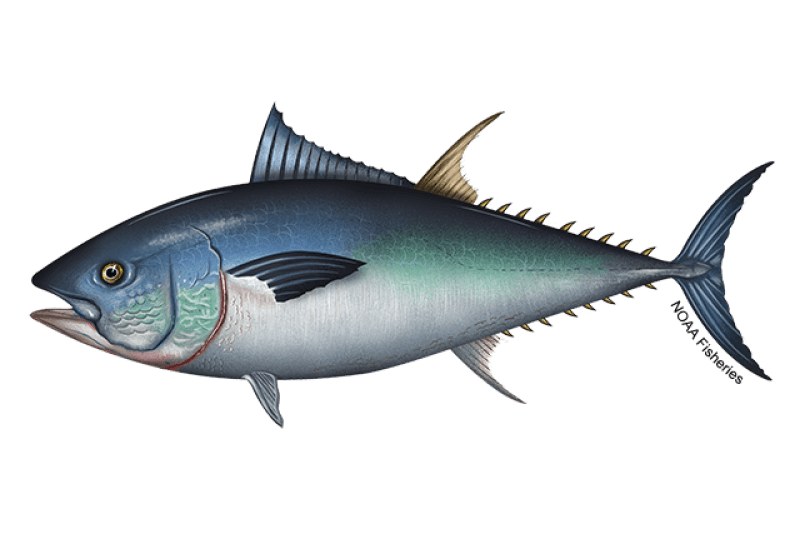
Thunnus thynnus , also known as Tuna, Bluefin tuna, Toro, Maguro, Giant bluefin, Northern bluefin tuna. U.S. wild-caught western Atlantic bluefin tuna is a smart seafood choice because it is sustainably managed under a rebuilding plan that allows limited harvest by U.S. fishermen.
Source: Species facts, status language, and imagery adapted from the NOAA Fisheries species profile (last updated 07/06/2026). Ocean City charter and Maryland
record notes are editorial orientation for OCEANCITY.MD readers. Always confirm current seasons, sizes, and
bag limits before you fish—rules change.
Illustration/photo: NOAA Fisheries — Western Atlantic Bluefin Tuna (Thunnus thynnus).
Quick facts
Region: New England/Mid-Atlantic,
Southeast
Category: Fish · Pelagic · Mid-Atlantic
Maryland likelihood: 5★ out of 5
About the species
U.S. wild-caught western Atlantic bluefin tuna is a smart seafood choice because it is sustainably managed under a rebuilding plan that allows limited harvest by U.S. fishermen.
Maryland record catch
Confirm whether Maryland DNR publishes an Atlantic state-record category for Western Atlantic Bluefin Tuna on the current sport-fish record board.
Maryland’s Atlantic recreational seasons/sizes/creel summary does not publish a dedicated line for Western Atlantic Bluefin Tuna. Verify COMAR, DNR public notices, and federal rules for your exact waters before you keep fish.
Rule
Maryland / applicable detail
Maryland minimum size
Not listed — no dedicated Western Atlantic Bluefin Tuna line on the MD Atlantic recreational table
Maryland daily creel (bag)
Not listed — no MD species-specific bag for Western Atlantic Bluefin Tuna
Maryland open season
Not listed on the MD Atlantic Ocean / Coastal Bays summary table
Verify
Check DNR eRegulations, COMAR, and NOAA for your date and coordinates before you keep fish.
Atlantic bluefin tuna have large, torpedo-shaped bodies that are nearly circular in cross-section.
They are the largest of the tuna species and can reach up to 13 feet and 2,000 pounds.
They have dark blue-black on the back and white on the lower sides and belly.
Atlantic bluefin tuna h ave colorless lines alternating with rows of colorless spots on their lower sides.
The second fin on their back (dorsal fin) is reddish brown, and they have short pectoral fins.
These characteristics separate this species from other members of the tuna genus, Thunnus .
Appearance
Bluefin tuna grow more slowly than other tuna.
They have a long lifespan, up to 20 years or more and generally don’t spawn until they are about 8 years old.
They spawn from mid-April to June, mainly in the Gulf of America.
Females can produce up to 10 million eggs a year.
The eggs are fertilized in the water column and hatch in about 2 days.
Bluefin tuna are top predators.
Juveniles eat fish, squid, and crustaceans, and adults feed mainly on baitfish such as herring, bluefish, and mackerel.
Sharks, marine mammals (including killer whales and pilot whales), and large fish feed on bluefin tuna.
Bluefish and seabirds also prey upon juvenile bluefin tuna.
Where They Live Range In the western Atlantic, bluefin tuna are found from Newfoundland to the Gulf of America.
Habitat Atlantic bluefin tuna live near the surface in temperate waters but frequently dive to depths of 500 to 1,000 meters.
They are a highly migratory species.
They can migrate thousands of miles across an entire ocean.
Tagging studies have indicated that bluefin tuna move across the east/west boundary in the Atlantic.
They tend to spawn in the same areas in the Gulf of America.
Fishery Management Effective conservation and management of highly migratory species like bluefin tuna require international cooperation as well as strong domestic management.
NOAA Fisheries , through the Atlantic Highly Migratory Species Management Division , manages the Atlantic bluefin tuna fishery in the United States, and sets regulations for the U.S. fishery based on conservation and management recommendations from the International Commission for the Conservation of Atlantic Tunas (ICCAT) , consistent with applicable U.S. laws.
Managed under the 2006 Consolidated Atlantic Highly Migratory Species Fishery Management Plan and amendments: Commercial and recreational fishermen must have a permit to harvest bluefin tuna.
Annual quota and subquotas Gear restrictions Time/area closures Minimum size limits Federal management for Atlantic tunas applies to state waters as well, except in Connecticut, and Mississippi.
NOAA Fisheries periodically reviews these states’ regulations to make sure they’re consistent with federal regulations.
Regulations do not allow targeted fishing of bluefin tuna in the Gulf of America, an important spawning area for the species.
NOAA Fisheries published several recent regulations that are expected to reduce and improve accounting for bluefin tuna dead discards, including gear restricted areas and individual transferable quotas in the pelagic longline fishery, modified quota category allocations, and enhanced monitoring and reporting.
In 2000, the United States established the Dolphin-Safe Tuna Tracking and Verification Program to monitor the domestic production and importation of all frozen and processed tuna products nationwide, and to authenticate any associated dolphin-safe claim.
Harvest ICCAT implemented harvest quotas for the western Atlantic bluefin tuna stock in 1982.
Since then, catch has been relatively stable.
U.S. catch comprises about half of the total western Atlantic bluefin tuna catch and less than 10 percent of Atlantic-wide bluefin tuna catch (including the Mediterranean Sea).
Commercial fishery: Ex-vessel prices depend on a number of factors, including the quality of the fish (e.g., freshness, fat content, method of storage), the weight of the fish, the supply of fish, and consumer demand.
Exports vary from year to year and generally depend on the amount of commercial landings and Japanese yen/U.S. dollar exchange rates.
Gear types, habitat impacts, and bycatch: U.S. fishermen harvest bluefin tuna with handgear (rod-and-reel, handline, and harpoon) and purse seines.
Although fishermen are not allowed to use pelagic longline gear in the United States to target bluefin tuna directly, regulations allow them to retain a limited number of bluefin tuna caught incidentally while fishing for other species such as swordfish and yellowfin tuna.
Fishermen generally target schools of bluefin tuna, and their fishing gear is fairly selective and allows for the live release of any unintentionally caught species.
Fishing gear used to catch bluefin tuna rarely contacts the ocean floor and therefore has minimal impact on habitat.
NOAA Fisheries requires U.S. commercial fishermen who fish for yellowfin tuna, swordfish, and other species with pelagic longlines in the Gulf of America to use weak hooks , a type of hook designed to reduce the incidental catch and bycatch of Atlantic bluefin tuna.
Fishing for bluefin tuna in two known hotspots—Cape Hatteras, North Carolina and the Gulf of America—is strictly regulated.
Recreational U.S. fishery: Recreationally-caught bluefin tuna may not be sold.
Bluefin tuna must be larger than 27 inches to be retained.
Depending on the recreational fishery (e.g., private vessels and charter/headboat vessels), limits on the amount and size of fish that fishermen can keep per fishing trip vary.
For the latest information on current retention limits, visit the NOAA Fisheries HMS Permit Shop .
All released bluefin tuna must be released without removing the fish from the water and in a manner that will maximize its survival.
Recreational fishing for highly migratory species such as bluefin tuna provides significant economic benefits to coastal communities through individual angler expenditures, recreational charters, tournaments, and the shoreside businesses that support those activities.
Scientific Classification Kingdom Animalia Phylum Chordata Class Actinopterygii Order Scombriformes Family Scombridae Genus Thunnus Species thynnus Last updated by NOAA Fisheries on 07/06/2026
Biology
In the western Atlantic, bluefin tuna are found from Newfoundland to the Gulf of America.
Habitat Atlantic bluefin tuna live near the surface in temperate waters but frequently dive to depths of 500 to 1,000 meters.
They are a highly migratory species.
They can migrate thousands of miles across an entire ocean.
Tagging studies have indicated that bluefin tuna move across the east/west boundary in the Atlantic.
They tend to spawn in the same areas in the Gulf of America.
Fishery Management Effective conservation and management of highly migratory species like bluefin tuna require international cooperation as well as strong domestic management.
NOAA Fisheries , through the Atlantic Highly Migratory Species Management Division , manages the Atlantic bluefin tuna fishery in the United States, and sets regulations for the U.S. fishery based on conservation and management recommendations from the International Commission for the Conservation of Atlantic Tunas (ICCAT) , consistent with applicable U.S. laws.
Managed under the 2006 Consolidated Atlantic Highly Migratory Species Fishery Management Plan and amendments: Commercial and recreational fishermen must have a permit to harvest bluefin tuna.
Annual quota and subquotas Gear restrictions Time/area closures Minimum size limits Federal management for Atlantic tunas applies to state waters as well, except in Connecticut, and Mississippi.
NOAA Fisheries periodically reviews these states’ regulations to make sure they’re consistent with federal regulations.
Regulations do not allow targeted fishing of bluefin tuna in the Gulf of America, an important spawning area for the species.
NOAA Fisheries published several recent regulations that are expected to reduce and improve accounting for bluefin tuna dead discards, including gear restricted areas and individual transferable quotas in the pelagic longline fishery, modified quota category allocations, and enhanced monitoring and reporting.
In 2000, the United States established the Dolphin-Safe Tuna Tracking and Verification Program to monitor the domestic production and importation of all frozen and processed tuna products nationwide, and to authenticate any associated dolphin-safe claim.
Harvest ICCAT implemented harvest quotas for the western Atlantic bluefin tuna stock in 1982.
Since then, catch has been relatively stable.
U.S. catch comprises about half of the total western Atlantic bluefin tuna catch and less than 10 percent of Atlantic-wide bluefin tuna catch (including the Mediterranean Sea).
Commercial fishery: Ex-vessel prices depend on a number of factors, including the quality of the fish (e.g., freshness, fat content, method of storage), the weight of the fish, the supply of fish, and consumer demand.
Exports vary from year to year and generally depend on the amount of commercial landings and Japanese yen/U.S. dollar exchange rates.
Gear types, habitat impacts, and bycatch: U.S. fishermen harvest bluefin tuna with handgear (rod-and-reel, handline, and harpoon) and purse seines.
Although fishermen are not allowed to use pelagic longline gear in the United States to target bluefin tuna directly, regulations allow them to retain a limited number of bluefin tuna caught incidentally while fishing for other species such as swordfish and yellowfin tuna.
Fishermen generally target schools of bluefin tuna, and their fishing gear is fairly selective and allows for the live release of any unintentionally caught species.
Fishing gear used to catch bluefin tuna rarely contacts the ocean floor and therefore has minimal impact on habitat.
NOAA Fisheries requires U.S. commercial fishermen who fish for yellowfin tuna, swordfish, and other species with pelagic longlines in the Gulf of America to use weak hooks , a type of hook designed to reduce the incidental catch and bycatch of Atlantic bluefin tuna.
Fishing for bluefin tuna in two known hotspots—Cape Hatteras, North Carolina and the Gulf of America—is strictly regulated.
Recreational U.S. fishery: Recreationally-caught bluefin tuna may not be sold.
Bluefin tuna must be larger than 27 inches to be retained.
Depending on the recreational fishery (e.g., private vessels and charter/headboat vessels), limits on the amount and size of fish that fishermen can keep per fishing trip vary.
For the latest information on current retention limits, visit the NOAA Fisheries HMS Permit Shop .
All released bluefin tuna must be released without removing the fish from the water and in a manner that will maximize its survival.
Recreational fishing for highly migratory species such as bluefin tuna provides significant economic benefits to coastal communities through individual angler expenditures, recreational charters, tournaments, and the shoreside businesses that support those activities.
Scientific Classification Kingdom Animalia Phylum Chordata Class Actinopterygii Order Scombriformes Family Scombridae Genus Thunnus Species thynnus Last updated by NOAA Fisheries on 07/06/2026
Where they live
Range
In the western Atlantic, bluefin tuna are found from Newfoundland to the Gulf of America.
Habitat Atlantic bluefin tuna live near the surface in temperate waters but frequently dive to depths of 500 to 1,000 meters.
Habitat
Effective conservation and management of highly migratory species like bluefin tuna require international cooperation as well as strong domestic management.
NOAA Fisheries , through the Atlantic Highly Migratory Species Management Division , manages the Atlantic bluefin tuna fishery in the United States, and sets regulations for the U.S. fishery based on conservation and management recommendations from the International Commission for the Conservation of Atlantic Tunas (ICCAT) , consistent with applicable U.S. laws.
Managed under the 2006 Consolidated Atlantic Highly Migratory Species Fishery Management Plan and amendments: Commercial and recreational fishermen must have a permit to harvest bluefin tuna.
Annual quota and subquotas Gear restrictions Time/area closures Minimum size limits Federal management for Atlantic tunas applies to state waters as well, except in Connecticut, and Mississippi.
NOAA Fisheries periodically reviews these states’ regulations to make sure they’re consistent with federal regulations.
Regulations do not allow targeted fishing of bluefin tuna in the Gulf of America, an important spawning area for the species.
NOAA Fisheries published several recent regulations that are expected to reduce and improve accounting for bluefin tuna dead discards, including gear restricted areas and individual transferable quotas in the pelagic longline fishery, modified quota category allocations, and enhanced monitoring and reporting.
In 2000, the United States established the Dolphin-Safe Tuna Tracking and Verification Program to monitor the domestic production and importation of all frozen and processed tuna products nationwide, and to authenticate any associated dolphin-safe claim.
Harvest ICCAT implemented harvest quotas for the western Atlantic bluefin tuna stock in 1982.
Since then, catch has been relatively stable.
U.S. catch comprises about half of the total western Atlantic bluefin tuna catch and less than 10 percent of Atlantic-wide bluefin tuna catch (including the Mediterranean Sea).
Commercial fishery: Ex-vessel prices depend on a number of factors, including the quality of the fish (e.g., freshness, fat content, method of storage), the weight of the fish, the supply of fish, and consumer demand.
Exports vary from year to year and generally depend on the amount of commercial landings and Japanese yen/U.S. dollar exchange rates.
Gear types, habitat impacts, and bycatch: U.S. fishermen harvest bluefin tuna with handgear (rod-and-reel, handline, and harpoon) and purse seines.
Although fishermen are not allowed to use pelagic longline gear in the United States to target bluefin tuna directly, regulations allow them to retain a limited number of bluefin tuna caught incidentally while fishing for other species such as swordfish and yellowfin tuna.
Fishermen generally target schools of bluefin tuna, and their fishing gear is fairly selective and allows for the live release of any unintentionally caught species.
Fishing gear used to catch bluefin tuna rarely contacts the ocean floor and therefore has minimal impact on habitat.
NOAA Fisheries requires U.S. commercial fishermen who fish for yellowfin tuna, swordfish, and other species with pelagic longlines in the Gulf of America to use weak hooks , a type of hook designed to reduce the incidental catch and bycatch of Atlantic bluefin tuna.
Fishing for bluefin tuna in two known hotspots—Cape Hatteras, North Carolina and the Gulf of America—is strictly regulated.
Recreational U.S. fishery: Recreationally-caught bluefin tuna may not be sold.
Bluefin tuna must be larger than 27 inches to be retained.
Depending on the recreational fishery (e.g., private vessels and charter/headboat vessels), limits on the amount and size of fish that fishermen can keep per fishing trip vary.
For the latest information on current retention limits, visit the NOAA Fisheries HMS Permit Shop .
All released bluefin tuna must be released without removing the fish from the water and in a manner that will maximize its survival.
Recreational fishing for highly migratory species such as bluefin tuna provides significant economic benefits to coastal communities through individual angler expenditures, recreational charters, tournaments, and the shoreside businesses that support those activities.
Scientific Classification Kingdom Animalia Phylum Chordata Class Actinopterygii Order Scombriformes Family Scombridae Genus Thunnus Species thynnus Last updated by NOAA Fisheries on 07/06/2026
Ocean City & Mid-Atlantic context
From Ocean City, Maryland, use this Western Atlantic Bluefin Tuna profile as NOAA Mid-Atlantic directory context—not a promise you will meet the species on every charter.
Always verify current Maryland and federal size, season, and bag rules for your exact date and coordinates before you keep any catch.
Source facts and imagery are adapted from the NOAA Fisheries species profile for Western Atlantic Bluefin Tuna.
What charter to book from Ocean City
Western Atlantic Bluefin Tuna fits Ocean City offshore and trolling programs more than bay guide mornings—book the trip for the pelagic menu you actually want.
Best fit
Offshore charter — Best OC trip family when you are specifically chasing Western Atlantic Bluefin Tuna.
Possible / related
Trolling charter — Possible overlap depending on season, water, and boat program.
Head / party boat — Possible overlap depending on season, water, and boat program.
Not typical from OC
Bay guide — Not a typical Ocean City bay guide target for Western Atlantic Bluefin Tuna.
Inshore charter — Not a typical Ocean City inshore charter target for Western Atlantic Bluefin Tuna.
Casting / light tackle — Not a typical Ocean City casting / light tackle target for Western Atlantic Bluefin Tuna.
Nearshore wreck / bottom — Not a typical Ocean City nearshore wreck / bottom target for Western Atlantic Bluefin Tuna.
Start with the charter directory trip-type picker so you compare boats inside the right
archetype—not a bay-guide quote against a canyon invoice.
ICCAT implemented harvest quotas for the western Atlantic bluefin tuna stock in 1982.
Since then, catch has been relatively stable.
U.S. catch comprises about half of the total western Atlantic bluefin tuna catch and less than 10 percent of Atlantic-wide bluefin tuna catch (including the Mediterranean Sea).
Commercial fishery: Ex-vessel prices depend on a number of factors, including the quality of the fish (e.g., freshness, fat content, method of storage), the weight of the fish, the supply of fish, and consumer demand.
Exports vary from year to year and generally depend on the amount of commercial landings and Japanese yen/U.S. dollar exchange rates.
Gear types, habitat impacts, and bycatch: U.S. fishermen harvest bluefin tuna with handgear (rod-and-reel, handline, and harpoon) and purse seines.
Although fishermen are not allowed to use pelagic longline gear in the United States to target bluefin tuna directly, regulations allow them to retain a limited number of bluefin tuna caught incidentally while fishing for other species such as swordfish and yellowfin tuna.
Fishermen generally target schools of bluefin tuna, and their fishing gear is fairly selective and allows for the live release of any unintentionally caught species.
Harvest
See the NOAA wild-caught fishery section for landings and gear notes when published for this species.
Landings and management details matter most for the waters where Western Atlantic Bluefin Tuna is actually fished—see the
NOAA species profile
.
Seafood facts
Fact
Detail
Sustainability
U.S. wild-caught western Atlantic bluefin tuna is a smart seafood choice because it is sustainably managed under a conservation and management plan that allows limited harvest by U.S. fishermen.
Availability
Year-round.
Source
U.S. wild-caught from Maine to Louisiana.
Taste
Bluefin has a distinctive flavor. With its high fat content, it is especially prized for sushi and sashimi. Cooking is generally not advised as it produces a strong fish taste and odor.
Texture
Bluefin tuna flesh is the darkest and fattiest of any tuna. A higher fat content in bluefin tuna is equated with a higher-quality product. The flesh has the firmness and appearance of beef steaks.
Color
Deep red when uncooked. When cooked, the meat is an off-white or ivory color.
Health
Bluefin tuna is a very good source of protein, thiamin, selenium, vitamin B6, and omega-3 fatty acids.
After a real OC boat day or market stop for Western Atlantic Bluefin Tuna, Seafood after boat days covers
dock buffer and cook-your-catch pacing.