Lagenorhynchus albirostris . White-beaked dolphins are found throughout the cold waters of the North Atlantic Ocean. They are active swimmers and often “surf” the waves created by vessels. They are usually fou
Source: Species facts, status language, and imagery adapted from the NOAA Fisheries species profile (last updated 03/05/2025). Ocean City charter and Maryland
record notes are editorial orientation for OCEANCITY.MD readers. Always confirm current seasons, sizes, and
bag limits before you fish—rules change.
White-beaked dolphins are found throughout the cold waters of the North Atlantic Ocean. They are active swimmers and often “surf” the waves created by vessels. They are usually found in groups of five to 30 individuals but sometimes travel in groups of up to 1,500.
White-beaked dolphins hunt for food both near the water’s surface and along the ocean bottom. Some fishermen in Canada call these dolphins “squidhounds” because they eat squid and octopi.
White-beaked dolphins, like all marine mammals, are protected under the Marine Mammal Protection Act . NOAA Fisheries and its partners are working to conserve white-beaked dolphins and advance our understanding of this species through research and conservation activities.
Maryland record catch
Confirm whether Maryland DNR publishes an Atlantic state-record category for White-Beaked Dolphin on the current sport-fish record board.
White-Beaked Dolphin is a protected marine species in U.S. waters. Do not harvest. This guide is biology and Ocean City context only—not a fishing target.
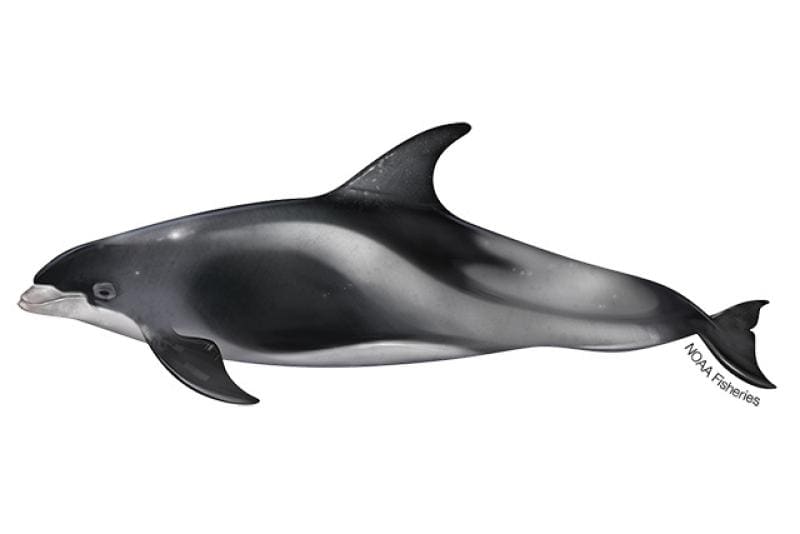
White-beaked dolphins are about 8 to 10.5 feet long and weigh about 395 to 770 pounds. Males are usually larger than females. Both males and females have a streamlined, robust body with a small beak and a large, tall, curved dorsal fin. Their body is mostly dark gray or black on the upper sides and back with light gray or white patches on their sides, back, and underside. The dorsal fin, flippers, and flukes are mostly dark. Their beaks, which are very short and thick, also have white “lips.” White-beaked dolphins have 22 to 28 pairs of small, cone-shaped teeth in each jaw.
Behavior and Diet White-beaked dolphins usually travel in groups of five to 30 individuals but are sometimes found in groups of up to 1,500 individuals. These groups can be organized by age and sex. White-beaked dolphins are sometimes seen in groups with other species, such as fin whales , humpback whales , sei whales and other small dolphins such as bottlenose , short-beaked common dolphins , Risso’s dolphins and Atlantic white-sided dolphins . Cooperative feeding has been observed.
White-beaked dolphins are active swimmers. They often breach and jump at the water’s surface and will sometimes "surf" the waves created by vessels.
White-beaked dolphins eat schooling fish (e.g., haddock , hakes , cod , herring and whiting ), crustaceans (e.g., shrimp and crabs), and cephalopods (e.g., squid and octopi). They typically work together to catch fish at the water’s surface but will also feed along the ocean bottom.
Where They Live White-beaked dolphins are found in colder temperate and subpolar waters throughout the North Atlantic Ocean. Their range includes the waters of eastern North America (Massachusetts to Newfoundland), northern Europe (north of Portugal), Scandinavia, Greenland, the United Kingdom, and the Barents Sea. Their distribution in U.S. waters is limited. They prefer waters less than 650 feet deep.
The distribution of this species varies with the seasons. Most white-beaked dolphins move south and farther offshore during the winter months. They then return north and closer to shore once the ice recedes during the warmer summer months.
Appearance
White-beaked dolphins usually travel in groups of five to 30 individuals but are sometimes found in groups of up to 1,500 individuals. These groups can be organized by age and sex. White-beaked dolphins are sometimes seen in groups with other species, such as fin whales , humpback whales , sei whales and other small dolphins such as bottlenose , short-beaked common dolphins , Risso’s dolphins and Atlantic white-sided dolphins . Cooperative feeding has been observed.
White-beaked dolphins are active swimmers. They often breach and jump at the water’s surface and will sometimes "surf" the waves created by vessels.
White-beaked dolphins eat schooling fish (e.g., haddock , hakes , cod , herring and whiting ), crustaceans (e.g., shrimp and crabs), and cephalopods (e.g., squid and octopi). They typically work together to catch fish at the water’s surface but will also feed along the ocean bottom.
Where They Live White-beaked dolphins are found in colder temperate and subpolar waters throughout the North Atlantic Ocean. Their range includes the waters of eastern North America (Massachusetts to Newfoundland), northern Europe (north of Portugal), Scandinavia, Greenland, the United Kingdom, and the Barents Sea. Their distribution in U.S. waters is limited. They prefer waters less than 650 feet deep.
The distribution of this species varies with the seasons. Most white-beaked dolphins move south and farther offshore during the winter months. They then return north and closer to shore once the ice recedes during the warmer summer months.
Lifespan & Reproduction The estimated lifespan of white-beaked dolphins is unknown. They reach sexual maturity when they are seven to 12 years old. Females are pregnant for about 11 months and give birth to a single calf, usually between May and September. Calves are about 3.6 to 4 feet long and weigh about 88.2 pounds at birth.
Threats Entanglement One of the main threats to white-beaked dolphins is becoming entangled or captured in commercial fishing gear such as gillnets, cod traps, and trawl nets. These interactions can cause dolphins to be injured or killed.
Hunting White-beaked dolphins are sometimes targeted and hunted for meat and oil in waters off Canada (Labrador and Newfoundland), Greenland, Iceland, and Norway.
Ocean Noise White-beaked dolphins rely on sound to communicate and echolocate. Noise interference from vessels, as well as industrial and military activities, disturbs white-beaked dolphins’ feeding, communication, and orientation. Increasing evidence suggests that exposure to intense underwater sound in some settings may cause some dolphins to strand and ultimately die. If loud enough, noise can cause temporary or permanent hearing loss.
Scientific Classification Kingdom Animalia Phylum Chordata Class Mammalia Order Cetacea Family Delphinidae Genus Lagenorhynchus Species albirostris Last updated by NOAA Fisheries on 03/05/2025
Biology
White-beaked dolphins are found in colder temperate and subpolar waters throughout the North Atlantic Ocean. Their range includes the waters of eastern North America (Massachusetts to Newfoundland), northern Europe (north of Portugal), Scandinavia, Greenland, the United Kingdom, and the Barents Sea. Their distribution in U.S. waters is limited. They prefer waters less than 650 feet deep.
The distribution of this species varies with the seasons. Most white-beaked dolphins move south and farther offshore during the winter months. They then return north and closer to shore once the ice recedes during the warmer summer months.
Lifespan & Reproduction The estimated lifespan of white-beaked dolphins is unknown. They reach sexual maturity when they are seven to 12 years old. Females are pregnant for about 11 months and give birth to a single calf, usually between May and September. Calves are about 3.6 to 4 feet long and weigh about 88.2 pounds at birth.
Threats Entanglement One of the main threats to white-beaked dolphins is becoming entangled or captured in commercial fishing gear such as gillnets, cod traps, and trawl nets. These interactions can cause dolphins to be injured or killed.
Hunting White-beaked dolphins are sometimes targeted and hunted for meat and oil in waters off Canada (Labrador and Newfoundland), Greenland, Iceland, and Norway.
Ocean Noise White-beaked dolphins rely on sound to communicate and echolocate. Noise interference from vessels, as well as industrial and military activities, disturbs white-beaked dolphins’ feeding, communication, and orientation. Increasing evidence suggests that exposure to intense underwater sound in some settings may cause some dolphins to strand and ultimately die. If loud enough, noise can cause temporary or permanent hearing loss.
Scientific Classification Kingdom Animalia Phylum Chordata Class Mammalia Order Cetacea Family Delphinidae Genus Lagenorhynchus Species albirostris Last updated by NOAA Fisheries on 03/05/2025
Where they live
Range
White-beaked dolphins are found in colder temperate and subpolar waters throughout the North Atlantic Ocean. Their range includes the waters of eastern North America (Massachusetts to Newfoundland), northern Europe (north of Portugal), Scandinavia, Greenland, the United Kingdom, and the Barents Sea. Their distribution in U.S. waters is limited. They prefer waters less than 650 feet deep.
The distribution of this species varies with the seasons. Most white-beaked dolphins move south and farther offshore during the winter months. They then return north and closer to shore once the ice recedes during the warmer summer months.
Habitat
See the NOAA species profile for habitat detail for this entry.
Ocean City & Mid-Atlantic context
From Ocean City, Maryland, use this White-Beaked Dolphin profile as NOAA Mid-Atlantic directory context—not a promise you will meet the species on every charter.
White-Beaked Dolphin is protected. Do not harvest. Report unusual strandings or entanglements through official channels.
Source facts and imagery are adapted from the NOAA Fisheries species profile for White-Beaked Dolphin.
What charter to book from Ocean City
White-Beaked Dolphin is not a standard Ocean City charter harvest target. Use this profile for NOAA biology and Mid-Atlantic context only.
Not typical from OC
Bay guide — Not a typical Ocean City bay guide target for White-Beaked Dolphin.
Inshore charter — Not a typical Ocean City inshore charter target for White-Beaked Dolphin.
Casting / light tackle — Not a typical Ocean City casting / light tackle target for White-Beaked Dolphin.
Trolling charter — Not a typical Ocean City trolling charter target for White-Beaked Dolphin.
Nearshore wreck / bottom — Not a typical Ocean City nearshore wreck / bottom target for White-Beaked Dolphin.
Offshore charter — Not a typical Ocean City offshore charter target for White-Beaked Dolphin.
Head / party boat — Not a typical Ocean City head / party boat target for White-Beaked Dolphin.
Start with the charter directory trip-type picker so you compare boats inside the right
archetype—not a bay-guide quote against a canyon invoice.
Overseeing Marine Mammal Health and Stranding Response We work with volunteer networks in all coastal states to respond to marine mammal strandings including all dolphins and porpoises. When stranded animals are found alive, NOAA Fisheries and our partners assess the animal’s health and determine the best course of action. When stranded animals are found dead, our scientists work to understand and investigate the cause of death. Although the cause often remains unknown, scientists can sometimes attribute strandings to disease, harmful algal blooms, vessel strikes, fishing gear entanglements, pollution exposure, and underwater noise. Some strandings can serve as indicators of ocean health, giving insight into larger environmental issues that may also have implications for human health and welfare.
Learn more about the Marine Mammal Health and Stranding Response Program
Marine Mammal Unusual Mortality Events White-beaked dolphins have never been part of a declared unusual mortality event. Under the Marine Mammal Protection Act , an unusual mortality event is defined as "a stranding that is unexpected; involves a significant die-off of any marine mammal population; and demands immediate response." To understand the health of marine mammal populations, scientists study unusual mortality events.
Addressing Ocean Noise NOAA Fisheries is investigating all aspects of acoustic communication and hearing in marine animals, as well as the effects of sound on dolphin behavior and hearing. In 2018, we revised marine mammal acoustic technical guidance for assessing the effects of anthropogenic (human-caused) sound on marine mammals’ hearing.
Educating the Public NOAA Fisheries aims to increase public awareness and support for white-beaked dolphin conservation through education, outreach, and public participation. We share information with the public about the status of white-beaked dolphins, as well as our research and efforts to promote their recovery.
Key Actions and Documents Incidental Take Incidental Take Incidental Take Authorization: Military Readiness Activities in the Atlantic Fleet Training and Testing (AFTT) Study Area (2025-2032) Incidental Take Authorization: Military Readiness Activities in the Atlantic Fleet Training and Testing (AFTT) Study Area (2025-2032) Final Rule Proposed Rule Notice of Receipt of Application Final Rule, New England/Mid-Atlantic Southeast
Harvest
See the NOAA wild-caught fishery section for landings and gear notes when published for this species.
Landings and management details matter most for the waters where White-Beaked Dolphin is actually fished—see the
NOAA species profile
.