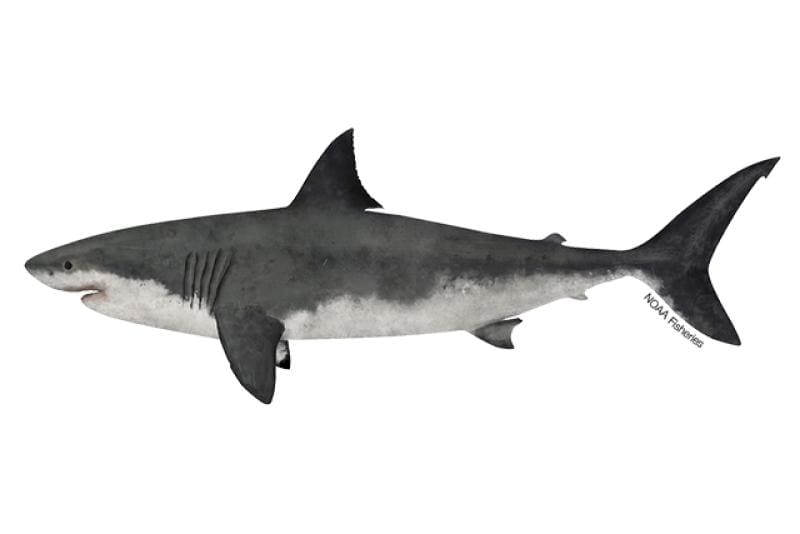
Carcharodon carcharias , also known as Great white, Great white shark, White pointer. The white shark is a large, wide-ranging species that occurs in temperate and subtropical seas worldwide. As an apex predator, the white shark is at the top of the food chain and p
Source: Species facts, status language, and imagery adapted from the NOAA Fisheries species profile (last updated 06/26/2026). Ocean City charter and Maryland
record notes are editorial orientation for OCEANCITY.MD readers. Always confirm current seasons, sizes, and
bag limits before you fish—rules change.
Illustration/photo: NOAA Fisheries — White Shark (Carcharodon carcharias).
Quick facts
Length: About 4 feet (at birth) and up to 21 feet (adult)
Lifespan: 70 years or more
Region: Alaska,
New England/Mid-Atlantic,
Pacific Islands,
Southeast,
West Coast
Category: Shark / ray · Mid-Atlantic
Maryland likelihood: 3★ out of 5
About the species
The white shark is a large, wide-ranging species that occurs in temperate and subtropical seas worldwide. As an apex predator, the white shark is at the top of the food chain and plays an important ecological role in the oceans. It is also an iconic species due to its occurrence in near-shore habitats and frequent appearance in films and documentaries. But despite its fearsome reputation, its large size and low productivity (reproductive rates, growth rates, age at maturity, longevity, etc.) make the white shark vulnerable to declines from human impacts. Due to these natural vulnerabilities, the white shark is one of the most widely protected sharks globally.
The white shark is also one of the most well-studied shark species in the world, including its populations off the east and west coasts of the United States. Seasonal aggregations in key feeding areas along the coast allows researchers to study them. NOAA Fisheries studies the biology of white sharks as well as monitors their populations and manages fisheries that may incidentally catch them. However, there is still much we don't know about them. Many basic questions about their abundance, life history, habitats, and movements remain unanswered.
Maryland record catch
Confirm whether Maryland DNR publishes an Atlantic state-record category for White Shark on the current sport-fish record board.
Maryland’s Atlantic recreational seasons/sizes/creel summary does not publish a dedicated line for White Shark. Verify COMAR, DNR public notices, and federal rules for your exact waters before you keep fish.
Rule
Maryland / applicable detail
Maryland minimum size
Not listed — no dedicated White Shark line on the MD Atlantic recreational table
Maryland daily creel (bag)
Not listed — no MD species-specific bag for White Shark
Maryland open season
Not listed on the MD Atlantic Ocean / Coastal Bays summary table
Verify
Check DNR eRegulations, COMAR, and NOAA for your date and coordinates before you keep fish.
The white shark gets its name from its white-colored underside but is dark gray to brown on top. Like other “mackerel sharks” ( mako , porbeagle, and salmon sharks), the white shark has a torpedo-shaped body with a conical snout and a prominent keel at the base of its crescent-shaped tail. The white shark is the largest shark in the mackerel shark family. It has a large first dorsal fin, which typically has a pointed apex (tip). There is often a black spot on the underside of the pectoral fins. White shark teeth are broad and triangular with distinct serrations. However, the lower teeth are typically more narrow. Biology The white shark grows slowly. Males mature at approximately 26 years old and females at approximately 33 years old. Maximum age is hard to determine and estimates range from 30 to over 70 years old. The white shark is born at approximately 4 feet long and can grow up to about 20 feet long, weighing over 4,000 pounds. The white shark has a diverse and opportunistic diet of fish, invertebrates, and marine mammals. Juvenile white sharks mainly eat bottom fish, smaller sharks and rays, and schooling fish and squids. Larger white sharks often gather around seal and sea lion colonies to feed and also occasionally scavenge dead whales. The white shark is regionally endothermic, meaning it is partially warm-blooded, and can maintain its internal body temperature above that of the surrounding water. This means that it can be a more active predator in cooler waters compared to cold-blooded species. Where They Live Range The white shark occurs worldwide in temperate and subtropical waters, often migrating seasonally to follow its preferred temperature range (approximately 50 to 80 °F). In the U.S. Atlantic, they range from Maine to the Gulf of America (formerly Gulf of Mexico) and U.S. Caribbean. In the U.S. Pacific, they range from Alaska to California and Hawaii. The white shark also lives in waters off the Pacific coast of Mexico. There are nursery areas for juvenile white sharks in near-shore waters of southern California and off Long Island, New York. Habitat The white shark occurs in both near-shore coastal waters and offshore pelagic waters. Their preferred habitats shift with age. Pups and juveniles tend to remain in near-shore habitats over shallow continental-shelf, in warmer waters. As they age and their diets change, they split their time between seal and sea lion rookeries and pelagic habitats. Fishery Management The white shark is a prohibited species (no retention allowed) in most U.S. waters and fisheries. There are no commercial fisheries for white sharks, but they are occasionally caught as bycatch. In the Atlantic, the white shark is managed under the 2006 Consolidated Atlantic Highly Migratory Species Fishery Management Plan . In the Pacific, it is managed by the Pacific Fishery Management Council under the West Coast HMS Fishery Management Plan . There are complementary management measures protecting the white shark in state waters along the East and West Coast. The white shark is further protected in some of NOAA’s National Marine Sanctuaries . The white shark is also protected internationally under CITES Appendix II , CMS Appendix II, UNCLOS, and other international regional fisheries management organizations. Harvest This is a prohibited species. White sharks are occasionally caught by recreational and commercial fishermen but must be released immediately.
Scientific Classification Kingdom Animalia Phylum Chordata Class Chondrichthyes Order Lamniformes Family Lamnidae Genus Carcharodon Species carcharias Last updated by NOAA Fisheries on 06/26/2026
Appearance
The white shark grows slowly. Males mature at approximately 26 years old and females at approximately 33 years old. Maximum age is hard to determine and estimates range from 30 to over 70 years old. The white shark is born at approximately 4 feet long and can grow up to about 20 feet long, weighing over 4,000 pounds. The white shark has a diverse and opportunistic diet of fish, invertebrates, and marine mammals. Juvenile white sharks mainly eat bottom fish, smaller sharks and rays, and schooling fish and squids. Larger white sharks often gather around seal and sea lion colonies to feed and also occasionally scavenge dead whales. The white shark is regionally endothermic, meaning it is partially warm-blooded, and can maintain its internal body temperature above that of the surrounding water. This means that it can be a more active predator in cooler waters compared to cold-blooded species. Where They Live Range The white shark occurs worldwide in temperate and subtropical waters, often migrating seasonally to follow its preferred temperature range (approximately 50 to 80 °F). In the U.S. Atlantic, they range from Maine to the Gulf of America (formerly Gulf of Mexico) and U.S. Caribbean. In the U.S. Pacific, they range from Alaska to California and Hawaii. The white shark also lives in waters off the Pacific coast of Mexico. There are nursery areas for juvenile white sharks in near-shore waters of southern California and off Long Island, New York. Habitat The white shark occurs in both near-shore coastal waters and offshore pelagic waters. Their preferred habitats shift with age. Pups and juveniles tend to remain in near-shore habitats over shallow continental-shelf, in warmer waters. As they age and their diets change, they split their time between seal and sea lion rookeries and pelagic habitats. Fishery Management The white shark is a prohibited species (no retention allowed) in most U.S. waters and fisheries. There are no commercial fisheries for white sharks, but they are occasionally caught as bycatch. In the Atlantic, the white shark is managed under the 2006 Consolidated Atlantic Highly Migratory Species Fishery Management Plan . In the Pacific, it is managed by the Pacific Fishery Management Council under the West Coast HMS Fishery Management Plan . There are complementary management measures protecting the white shark in state waters along the East and West Coast. The white shark is further protected in some of NOAA’s National Marine Sanctuaries . The white shark is also protected internationally under CITES Appendix II , CMS Appendix II, UNCLOS, and other international regional fisheries management organizations. Harvest This is a prohibited species. White sharks are occasionally caught by recreational and commercial fishermen but must be released immediately.
Scientific Classification Kingdom Animalia Phylum Chordata Class Chondrichthyes Order Lamniformes Family Lamnidae Genus Carcharodon Species carcharias Last updated by NOAA Fisheries on 06/26/2026
Biology
The white shark occurs worldwide in temperate and subtropical waters, often migrating seasonally to follow its preferred temperature range (approximately 50 to 80 °F). In the U.S. Atlantic, they range from Maine to the Gulf of America (formerly Gulf of Mexico) and U.S. Caribbean. In the U.S. Pacific, they range from Alaska to California and Hawaii. The white shark also lives in waters off the Pacific coast of Mexico. There are nursery areas for juvenile white sharks in near-shore waters of southern California and off Long Island, New York. Habitat The white shark occurs in both near-shore coastal waters and offshore pelagic waters. Their preferred habitats shift with age. Pups and juveniles tend to remain in near-shore habitats over shallow continental-shelf, in warmer waters. As they age and their diets change, they split their time between seal and sea lion rookeries and pelagic habitats. Fishery Management The white shark is a prohibited species (no retention allowed) in most U.S. waters and fisheries. There are no commercial fisheries for white sharks, but they are occasionally caught as bycatch. In the Atlantic, the white shark is managed under the 2006 Consolidated Atlantic Highly Migratory Species Fishery Management Plan . In the Pacific, it is managed by the Pacific Fishery Management Council under the West Coast HMS Fishery Management Plan . There are complementary management measures protecting the white shark in state waters along the East and West Coast. The white shark is further protected in some of NOAA’s National Marine Sanctuaries . The white shark is also protected internationally under CITES Appendix II , CMS Appendix II, UNCLOS, and other international regional fisheries management organizations. Harvest This is a prohibited species. White sharks are occasionally caught by recreational and commercial fishermen but must be released immediately.
Scientific Classification Kingdom Animalia Phylum Chordata Class Chondrichthyes Order Lamniformes Family Lamnidae Genus Carcharodon Species carcharias Last updated by NOAA Fisheries on 06/26/2026
Where they live
Range
The white shark occurs worldwide in temperate and subtropical waters, often migrating seasonally to follow its preferred temperature range (approximately 50 to 80 °F). In the U.S. Atlantic, they range from Maine to the Gulf of America (formerly Gulf of Mexico) and U.S. Caribbean. In the U.S. Pacific, they range from Alaska to California and Hawaii. The white shark also lives in waters off the Pacific coast of Mexico. There are nursery areas for juvenile white sharks in near-shore waters of southern California and off Long Island, New York. Habitat The white shark occurs in both near-shore coastal waters and offshore pelagic waters. Their preferred habitats shift with age. Pups and juveniles tend to remain in near-shore habitats over shallow continental-shelf, in warmer waters. As they age and their diets change, they split their time between seal and sea lion rookeries and pelagic habitats. Fishery Management The white shark is a prohibited species (no retention allowed) in most U.S. waters and fisheries. There are no commercial fisheries for white sharks, but they are occasionally caught as bycatch. In the Atlantic, the white shark is managed under the 2006 Consolidated Atlantic Highly Migratory Species Fishery Management Plan . In the Pacific, it is managed by the Pacific Fishery Management Council under the West Coast HMS Fishery Management Plan . There are complementary management measures protecting the white shark in state waters along the East and West Coast. The white shark is further protected in some of NOAA’s National Marine Sanctuaries . The white shark is also protected internationally under CITES Appendix II , CMS Appendix II, UNCLOS, and other international regional fisheries management organizations. Harvest This is a prohibited species. White sharks are occasionally caught by recreational and commercial fishermen but must be released immediately.
Scientific Classification Kingdom Animalia Phylum Chordata Class Chondrichthyes Order Lamniformes Family Lamnidae Genus Carcharodon Species carcharias Last updated by NOAA Fisheries on 06/26/2026
Habitat
The white shark is a prohibited species (no retention allowed) in most U.S. waters and fisheries. There are no commercial fisheries for white sharks, but they are occasionally caught as bycatch. In the Atlantic, the white shark is managed under the 2006 Consolidated Atlantic Highly Migratory Species Fishery Management Plan . In the Pacific, it is managed by the Pacific Fishery Management Council under the West Coast HMS Fishery Management Plan . There are complementary management measures protecting the white shark in state waters along the East and West Coast. The white shark is further protected in some of NOAA’s National Marine Sanctuaries . The white shark is also protected internationally under CITES Appendix II , CMS Appendix II, UNCLOS, and other international regional fisheries management organizations. Harvest This is a prohibited species. White sharks are occasionally caught by recreational and commercial fishermen but must be released immediately.
Scientific Classification Kingdom Animalia Phylum Chordata Class Chondrichthyes Order Lamniformes Family Lamnidae Genus Carcharodon Species carcharias Last updated by NOAA Fisheries on 06/26/2026
Ocean City & Mid-Atlantic context
From Ocean City, Maryland, use this White Shark profile as NOAA Mid-Atlantic directory context—not a promise you will meet the species on every charter.
Always verify current Maryland and federal size, season, and bag rules for your exact date and coordinates before you keep any catch.
Source facts and imagery are adapted from the NOAA Fisheries species profile for White Shark.
What charter to book from Ocean City
White Shark may show on Ocean City shark, wreck, or offshore days depending on season and permits—confirm HMS/state rules before you book or keep fish.
Possible / related
Inshore charter — Possible overlap depending on season, water, and boat program.
This is a prohibited species. White sharks are occasionally caught by recreational and commercial fishermen but must be released immediately.
Scientific Classification Kingdom Animalia Phylum Chordata Class Chondrichthyes Order Lamniformes Family Lamnidae Genus Carcharodon Species carcharias Last updated by NOAA Fisheries on 06/26/2026
Harvest
See the NOAA wild-caught fishery section for landings and gear notes when published for this species.
Landings and management details matter most for the waters where White Shark is actually fished—see the
NOAA species profile
.