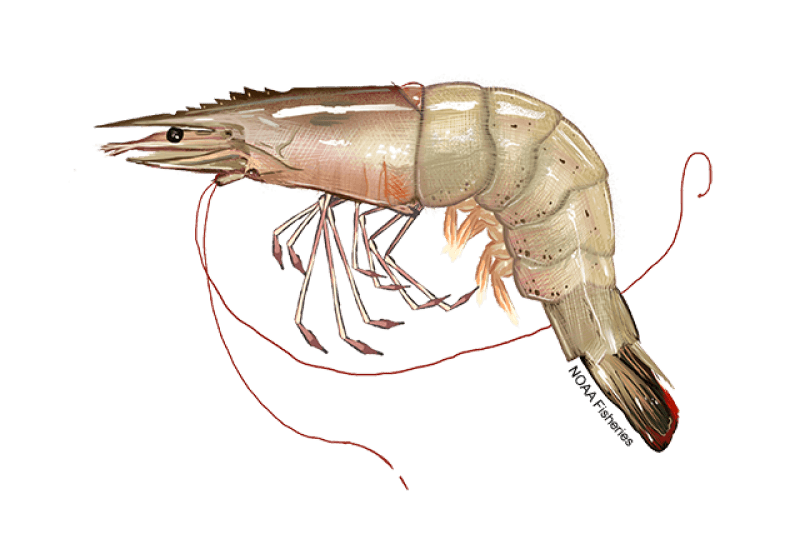
Litopenaeus setiferus , also known as Northern white shrimp, Gray shrimp, Lake shrimp, Green shrimp, Common shrimp, Daytona shrimp, Southern shrimp. U.S. wild-caught white shrimp is a smart seafood choice because it is sustainably managed and responsibly harvested under U.S. regulations.
Source: Species facts, status language, and imagery adapted from the NOAA Fisheries species profile (last updated 06/30/2026). Ocean City charter and Maryland
record notes are editorial orientation for OCEANCITY.MD readers. Always confirm current seasons, sizes, and
bag limits before you fish—rules change.
Illustration/photo: NOAA Fisheries — White Shrimp (Litopenaeus setiferus).
Quick facts
Region: New England/Mid-Atlantic,
Southeast
Category: Invertebrate · Mid-Atlantic
Maryland likelihood: 3★ out of 5
About the species
U.S. wild-caught white shrimp is a smart seafood choice because it is sustainably managed and responsibly harvested under U.S. regulations.
Maryland record catch
Confirm whether Maryland DNR publishes an Atlantic state-record category for White Shrimp on the current sport-fish record board.
Maryland’s Atlantic recreational seasons/sizes/creel summary does not publish a dedicated line for White Shrimp. Verify COMAR, DNR public notices, and federal rules for your exact waters before you keep fish.
Rule
Maryland / applicable detail
Maryland minimum size
Not listed — no dedicated White Shrimp line on the MD Atlantic recreational table
Maryland daily creel (bag)
Not listed — no MD species-specific bag for White Shrimp
Maryland open season
Not listed on the MD Atlantic Ocean / Coastal Bays summary table
Verify
Check DNR eRegulations, COMAR, and NOAA for your date and coordinates before you keep fish.
White shrimp are crustaceans with 10 slender, relatively long walking legs and five pairs of swimming legs located on the front surface of the abdomen. Their bodies are light gray, with green coloration on the tail and a yellow band on part of the abdomen. Their carapace is not grooved. Part of their shell is a well-developed, toothed rostrum that extends to or beyond the outer edge of the eyes. They have longer antennae than other shrimp (2.5 to 3 times longer than their body length). Biology White shrimp grow fairly fast, depending on factors such as water temperature and salinity, and can reach up to 7 or 8 inches in length. They have a short life span, usually less than 2 years, and are often referred to as an “annual crop.” They are able to reproduce when they reach about 5 ½ inches long. White shrimp spawn when offshore ocean bottom water temperatures increase, generally from May through September in the Carolinas, and from March through September in the Gulf of America. Males mate with females and anchor their sperm to the females. Females release about 500,000 to 1 million eggs near the ocean floor, and the eggs are fertilized as they are released. Newly hatched shrimp travel to their estuarine nursery habitats in April and early May. Shrimp that survive the winter grow rapidly in late winter and early spring before returning to the ocean. White shrimp larvae feed on plankton (tiny floating plants and animals). Juvenile and adult shrimp are omnivorous and feed on the bottom on detritus, plants, microorganisms, macroinvertebrates, and small fish. Cannibalism is also common among adult white shrimp. Sheepshead minnows, water boatmen, and insect larvae eat postlarval shrimp, and grass shrimp, killifishes, and blue crabs prey on young shrimp. A wide variety of finfish feed heavily on juvenile and adult shrimp. Where They Live Range White shrimp are found from Fire Island, New York, to St. Lucie Inlet on the Atlantic Coast of Florida. In the Gulf of America, they are found from the Ochlochonee River, Florida, to Campeche, Mexico. Habitat White shrimp commonly inhabit estuaries and coastal areas out to about 100 feet offshore. Young shrimp live and grow in nursery areas with muddy ocean bottoms and low to moderate salinity. White shrimp are often found in association with other shrimp species, specifically brown shrimp . Fishery Management NOAA Fisheries and the South Atlantic and Gulf Fishery Management Councils manage the white shrimp fishery. In the South Atlantic, managed under the Shrimp Fishery Management Plan for the South Atlantic Region: Permits are needed to harvest shrimp in federal waters. Fishing trip reports must be submitted for each fishing trip. Observers must be carried aboard vessels if selected, to collect data on catch, bycatch, fishing effort, and fishing gear. Managers set catch levels based on historic harvest amounts and fishing rates, rather than abundance because white shrimp are short-lived and heavily influenced by environmental factors. The white shrimp population can be periodically decimated by severe winter cold in the South Atlantic, especially offshore of Georgia and South Carolina. Fishery closures may be implemented to help protect the remaining adult population so they can spawn. Federal waters close if cold weather reduces the shrimp population by 80 percent or more, or if water temperatures fall below a critical level. In the Gulf of America, managed under the Shrimp Fishery Management Plan : Permits are needed to harvest shrimp in federal waters. Currently no new permits are being issued to prevent an increase in the number of boats participating in the fishery. Electronic logbooks must be installed and selected fishermen must submit trip reports for each fishing trip. Observers must be carried aboard vessels if selected, to collect data on catch, bycatch, fishing effort, and fishing gear. Each year all shrimping in federal waters off Texas is closed from approximately mid-May to mid-July to protect brown shrimp populations. Harvest Commercial fishery: In 2024, landings of white shrimp totaled 107 million pounds and were valued at $159 million, according to the NOAA Fisheries commercial fishing landings database . The three species of penaeid shrimp (white, pink , and brown) make up the vast majority of the shrimp harvested in the southeast. This fishery is one of the most valuable fisheries in the southeastern United States. Almost all of the white shrimp harvested in the United States comes from the Gulf of America, mainly from Louisiana and Texas. Landings in the South Atlantic are generally spread evenly among the states. Annual harvests of white shrimp vary considerably from year to year, primarily due to environmental conditions. Harvests are much lower in years following severe winter weather. White shrimp were the first commercially important shrimp species in the United States, dating back to 1709. Gear types, habitat impacts, and bycatch: Commercial fishermen harvest shrimp with trawls towed near the ocean floor. The nets are wide in the front and taper toward the back. Shrimpers using otter trawl gear in the South Atlantic and Gulf of America are required to use sea turtle excluder devices (TEDs) . Some shrimp trawlers must also install bycatch reduction devices behind the TED, to reduce finfish bycatch. Area closures if fishing effort exceeds certain thresholds. Trawlers in the Gulf of America must have a weak-link in the tickler chain, which hangs in front of the net and drags along the ocean floor to stir up shrimp from the bottom into the net. This weak-link allows the tickler chain to drop away if it gets hung up on natural bottom structures. Fishermen do not trawl in areas with coral reefs and other known areas of high relief to avoid damage to their nets. Recreational fishery: Under federal management, there is no recognized recreational fishery. Fishing in federal waters requires a permit. Recreational fishermen catch white shrimp seasonally and almost always in state waters. State regulations vary from state to state.
*Executive Order 14172, “Restoring Names That Honor American Greatness” (Jan. 20, 2025), directs that the Gulf of Mexico be renamed the Gulf of America. On August 7, 2025, NOAA Fisheries and the National Ocean Service amended regulations in the Code of Federal Regulations to reflect the renaming. The name change did not result in any changes to, and had no effect on the applicability or enforceability of, any existing regulations. This website continues to use “Gulf of Mexico” when quoting statutes or previously published materials.
Scientific Classification Kingdom Animalia Phylum Arthropoda Class Malacostraca Order Decapoda Family Penaeidae Genus Litopenaeus Species setiferus Last updated by NOAA Fisheries on 06/30/2026
Appearance
White shrimp grow fairly fast, depending on factors such as water temperature and salinity, and can reach up to 7 or 8 inches in length. They have a short life span, usually less than 2 years, and are often referred to as an “annual crop.” They are able to reproduce when they reach about 5 ½ inches long. White shrimp spawn when offshore ocean bottom water temperatures increase, generally from May through September in the Carolinas, and from March through September in the Gulf of America. Males mate with females and anchor their sperm to the females. Females release about 500,000 to 1 million eggs near the ocean floor, and the eggs are fertilized as they are released. Newly hatched shrimp travel to their estuarine nursery habitats in April and early May. Shrimp that survive the winter grow rapidly in late winter and early spring before returning to the ocean. White shrimp larvae feed on plankton (tiny floating plants and animals). Juvenile and adult shrimp are omnivorous and feed on the bottom on detritus, plants, microorganisms, macroinvertebrates, and small fish. Cannibalism is also common among adult white shrimp. Sheepshead minnows, water boatmen, and insect larvae eat postlarval shrimp, and grass shrimp, killifishes, and blue crabs prey on young shrimp. A wide variety of finfish feed heavily on juvenile and adult shrimp. Where They Live Range White shrimp are found from Fire Island, New York, to St. Lucie Inlet on the Atlantic Coast of Florida. In the Gulf of America, they are found from the Ochlochonee River, Florida, to Campeche, Mexico. Habitat White shrimp commonly inhabit estuaries and coastal areas out to about 100 feet offshore. Young shrimp live and grow in nursery areas with muddy ocean bottoms and low to moderate salinity. White shrimp are often found in association with other shrimp species, specifically brown shrimp . Fishery Management NOAA Fisheries and the South Atlantic and Gulf Fishery Management Councils manage the white shrimp fishery. In the South Atlantic, managed under the Shrimp Fishery Management Plan for the South Atlantic Region: Permits are needed to harvest shrimp in federal waters. Fishing trip reports must be submitted for each fishing trip. Observers must be carried aboard vessels if selected, to collect data on catch, bycatch, fishing effort, and fishing gear. Managers set catch levels based on historic harvest amounts and fishing rates, rather than abundance because white shrimp are short-lived and heavily influenced by environmental factors. The white shrimp population can be periodically decimated by severe winter cold in the South Atlantic, especially offshore of Georgia and South Carolina. Fishery closures may be implemented to help protect the remaining adult population so they can spawn. Federal waters close if cold weather reduces the shrimp population by 80 percent or more, or if water temperatures fall below a critical level. In the Gulf of America, managed under the Shrimp Fishery Management Plan : Permits are needed to harvest shrimp in federal waters. Currently no new permits are being issued to prevent an increase in the number of boats participating in the fishery. Electronic logbooks must be installed and selected fishermen must submit trip reports for each fishing trip. Observers must be carried aboard vessels if selected, to collect data on catch, bycatch, fishing effort, and fishing gear. Each year all shrimping in federal waters off Texas is closed from approximately mid-May to mid-July to protect brown shrimp populations. Harvest Commercial fishery: In 2024, landings of white shrimp totaled 107 million pounds and were valued at $159 million, according to the NOAA Fisheries commercial fishing landings database . The three species of penaeid shrimp (white, pink , and brown) make up the vast majority of the shrimp harvested in the southeast. This fishery is one of the most valuable fisheries in the southeastern United States. Almost all of the white shrimp harvested in the United States comes from the Gulf of America, mainly from Louisiana and Texas. Landings in the South Atlantic are generally spread evenly among the states. Annual harvests of white shrimp vary considerably from year to year, primarily due to environmental conditions. Harvests are much lower in years following severe winter weather. White shrimp were the first commercially important shrimp species in the United States, dating back to 1709. Gear types, habitat impacts, and bycatch: Commercial fishermen harvest shrimp with trawls towed near the ocean floor. The nets are wide in the front and taper toward the back. Shrimpers using otter trawl gear in the South Atlantic and Gulf of America are required to use sea turtle excluder devices (TEDs) . Some shrimp trawlers must also install bycatch reduction devices behind the TED, to reduce finfish bycatch. Area closures if fishing effort exceeds certain thresholds. Trawlers in the Gulf of America must have a weak-link in the tickler chain, which hangs in front of the net and drags along the ocean floor to stir up shrimp from the bottom into the net. This weak-link allows the tickler chain to drop away if it gets hung up on natural bottom structures. Fishermen do not trawl in areas with coral reefs and other known areas of high relief to avoid damage to their nets. Recreational fishery: Under federal management, there is no recognized recreational fishery. Fishing in federal waters requires a permit. Recreational fishermen catch white shrimp seasonally and almost always in state waters. State regulations vary from state to state.
*Executive Order 14172, “Restoring Names That Honor American Greatness” (Jan. 20, 2025), directs that the Gulf of Mexico be renamed the Gulf of America. On August 7, 2025, NOAA Fisheries and the National Ocean Service amended regulations in the Code of Federal Regulations to reflect the renaming. The name change did not result in any changes to, and had no effect on the applicability or enforceability of, any existing regulations. This website continues to use “Gulf of Mexico” when quoting statutes or previously published materials.
Scientific Classification Kingdom Animalia Phylum Arthropoda Class Malacostraca Order Decapoda Family Penaeidae Genus Litopenaeus Species setiferus Last updated by NOAA Fisheries on 06/30/2026
Biology
White shrimp are found from Fire Island, New York, to St. Lucie Inlet on the Atlantic Coast of Florida. In the Gulf of America, they are found from the Ochlochonee River, Florida, to Campeche, Mexico. Habitat White shrimp commonly inhabit estuaries and coastal areas out to about 100 feet offshore. Young shrimp live and grow in nursery areas with muddy ocean bottoms and low to moderate salinity. White shrimp are often found in association with other shrimp species, specifically brown shrimp . Fishery Management NOAA Fisheries and the South Atlantic and Gulf Fishery Management Councils manage the white shrimp fishery. In the South Atlantic, managed under the Shrimp Fishery Management Plan for the South Atlantic Region: Permits are needed to harvest shrimp in federal waters. Fishing trip reports must be submitted for each fishing trip. Observers must be carried aboard vessels if selected, to collect data on catch, bycatch, fishing effort, and fishing gear. Managers set catch levels based on historic harvest amounts and fishing rates, rather than abundance because white shrimp are short-lived and heavily influenced by environmental factors. The white shrimp population can be periodically decimated by severe winter cold in the South Atlantic, especially offshore of Georgia and South Carolina. Fishery closures may be implemented to help protect the remaining adult population so they can spawn. Federal waters close if cold weather reduces the shrimp population by 80 percent or more, or if water temperatures fall below a critical level. In the Gulf of America, managed under the Shrimp Fishery Management Plan : Permits are needed to harvest shrimp in federal waters. Currently no new permits are being issued to prevent an increase in the number of boats participating in the fishery. Electronic logbooks must be installed and selected fishermen must submit trip reports for each fishing trip. Observers must be carried aboard vessels if selected, to collect data on catch, bycatch, fishing effort, and fishing gear. Each year all shrimping in federal waters off Texas is closed from approximately mid-May to mid-July to protect brown shrimp populations. Harvest Commercial fishery: In 2024, landings of white shrimp totaled 107 million pounds and were valued at $159 million, according to the NOAA Fisheries commercial fishing landings database . The three species of penaeid shrimp (white, pink , and brown) make up the vast majority of the shrimp harvested in the southeast. This fishery is one of the most valuable fisheries in the southeastern United States. Almost all of the white shrimp harvested in the United States comes from the Gulf of America, mainly from Louisiana and Texas. Landings in the South Atlantic are generally spread evenly among the states. Annual harvests of white shrimp vary considerably from year to year, primarily due to environmental conditions. Harvests are much lower in years following severe winter weather. White shrimp were the first commercially important shrimp species in the United States, dating back to 1709. Gear types, habitat impacts, and bycatch: Commercial fishermen harvest shrimp with trawls towed near the ocean floor. The nets are wide in the front and taper toward the back. Shrimpers using otter trawl gear in the South Atlantic and Gulf of America are required to use sea turtle excluder devices (TEDs) . Some shrimp trawlers must also install bycatch reduction devices behind the TED, to reduce finfish bycatch. Area closures if fishing effort exceeds certain thresholds. Trawlers in the Gulf of America must have a weak-link in the tickler chain, which hangs in front of the net and drags along the ocean floor to stir up shrimp from the bottom into the net. This weak-link allows the tickler chain to drop away if it gets hung up on natural bottom structures. Fishermen do not trawl in areas with coral reefs and other known areas of high relief to avoid damage to their nets. Recreational fishery: Under federal management, there is no recognized recreational fishery. Fishing in federal waters requires a permit. Recreational fishermen catch white shrimp seasonally and almost always in state waters. State regulations vary from state to state.
*Executive Order 14172, “Restoring Names That Honor American Greatness” (Jan. 20, 2025), directs that the Gulf of Mexico be renamed the Gulf of America. On August 7, 2025, NOAA Fisheries and the National Ocean Service amended regulations in the Code of Federal Regulations to reflect the renaming. The name change did not result in any changes to, and had no effect on the applicability or enforceability of, any existing regulations. This website continues to use “Gulf of Mexico” when quoting statutes or previously published materials.
Scientific Classification Kingdom Animalia Phylum Arthropoda Class Malacostraca Order Decapoda Family Penaeidae Genus Litopenaeus Species setiferus Last updated by NOAA Fisheries on 06/30/2026
Where they live
Range
White shrimp are found from Fire Island, New York, to St. Lucie Inlet on the Atlantic Coast of Florida. In the Gulf of America, they are found from the Ochlochonee River, Florida, to Campeche, Mexico. Habitat White shrimp commonly inhabit estuaries and coastal areas out to about 100 feet offshore. Young shrimp live and grow in nursery areas with muddy ocean bottoms and low to moderate salinity. White shrimp are often found in association with other shrimp species, specifically brown shrimp . Fishery Management NOAA Fisheries and the South Atlantic and Gulf Fishery Management Councils manage the white shrimp fishery. In the South Atlantic, managed under the Shrimp Fishery Management Plan for the South Atlantic Region: Permits are needed to harvest shrimp in federal waters. Fishing trip reports must be submitted for each fishing trip. Observers must be carried aboard vessels if selected, to collect data on catch, bycatch, fishing effort, and fishing gear. Managers set catch levels based on historic harvest amounts and fishing rates, rather than abundance because white shrimp are short-lived and heavily influenced by environmental factors. The white shrimp population can be periodically decimated by severe winter cold in the South Atlantic, especially offshore of Georgia and South Carolina. Fishery closures may be implemented to help protect the remaining adult population so they can spawn. Federal waters close if cold weather reduces the shrimp population by 80 percent or more, or if water temperatures fall below a critical level. In the Gulf of America, managed under the Shrimp Fishery Management Plan : Permits are needed to harvest shrimp in federal waters. Currently no new permits are being issued to prevent an increase in the number of boats participating in the fishery. Electronic logbooks must be installed and selected fishermen must submit trip reports for each fishing trip. Observers must be carried aboard vessels if selected, to collect data on catch, bycatch, fishing effort, and fishing gear. Each year all shrimping in federal waters off Texas is closed from approximately mid-May to mid-July to protect brown shrimp populations. Harvest Commercial fishery: In 2024, landings of white shrimp totaled 107 million pounds and were valued at $159 million, according to the NOAA Fisheries commercial fishing landings database . The three species of penaeid shrimp (white, pink , and brown) make up the vast majority of the shrimp harvested in the southeast. This fishery is one of the most valuable fisheries in the southeastern United States. Almost all of the white shrimp harvested in the United States comes from the Gulf of America, mainly from Louisiana and Texas. Landings in the South Atlantic are generally spread evenly among the states. Annual harvests of white shrimp vary considerably from year to year, primarily due to environmental conditions. Harvests are much lower in years following severe winter weather. White shrimp were the first commercially important shrimp species in the United States, dating back to 1709. Gear types, habitat impacts, and bycatch: Commercial fishermen harvest shrimp with trawls towed near the ocean floor. The nets are wide in the front and taper toward the back. Shrimpers using otter trawl gear in the South Atlantic and Gulf of America are required to use sea turtle excluder devices (TEDs) . Some shrimp trawlers must also install bycatch reduction devices behind the TED, to reduce finfish bycatch. Area closures if fishing effort exceeds certain thresholds. Trawlers in the Gulf of America must have a weak-link in the tickler chain, which hangs in front of the net and drags along the ocean floor to stir up shrimp from the bottom into the net. This weak-link allows the tickler chain to drop away if it gets hung up on natural bottom structures. Fishermen do not trawl in areas with coral reefs and other known areas of high relief to avoid damage to their nets. Recreational fishery: Under federal management, there is no recognized recreational fishery. Fishing in federal waters requires a permit. Recreational fishermen catch white shrimp seasonally and almost always in state waters. State regulations vary from state to state.
*Executive Order 14172, “Restoring Names That Honor American Greatness” (Jan. 20, 2025), directs that the Gulf of Mexico be renamed the Gulf of America. On August 7, 2025, NOAA Fisheries and the National Ocean Service amended regulations in the Code of Federal Regulations to reflect the renaming. The name change did not result in any changes to, and had no effect on the applicability or enforceability of, any existing regulations. This website continues to use “Gulf of Mexico” when quoting statutes or previously published materials.
Habitat
NOAA Fisheries and the South Atlantic and Gulf Fishery Management Councils manage the white shrimp fishery. In the South Atlantic, managed under the Shrimp Fishery Management Plan for the South Atlantic Region: Permits are needed to harvest shrimp in federal waters. Fishing trip reports must be submitted for each fishing trip. Observers must be carried aboard vessels if selected, to collect data on catch, bycatch, fishing effort, and fishing gear. Managers set catch levels based on historic harvest amounts and fishing rates, rather than abundance because white shrimp are short-lived and heavily influenced by environmental factors. The white shrimp population can be periodically decimated by severe winter cold in the South Atlantic, especially offshore of Georgia and South Carolina. Fishery closures may be implemented to help protect the remaining adult population so they can spawn. Federal waters close if cold weather reduces the shrimp population by 80 percent or more, or if water temperatures fall below a critical level. In the Gulf of America, managed under the Shrimp Fishery Management Plan : Permits are needed to harvest shrimp in federal waters. Currently no new permits are being issued to prevent an increase in the number of boats participating in the fishery. Electronic logbooks must be installed and selected fishermen must submit trip reports for each fishing trip. Observers must be carried aboard vessels if selected, to collect data on catch, bycatch, fishing effort, and fishing gear. Each year all shrimping in federal waters off Texas is closed from approximately mid-May to mid-July to protect brown shrimp populations. Harvest Commercial fishery: In 2024, landings of white shrimp totaled 107 million pounds and were valued at $159 million, according to the NOAA Fisheries commercial fishing landings database . The three species of penaeid shrimp (white, pink , and brown) make up the vast majority of the shrimp harvested in the southeast. This fishery is one of the most valuable fisheries in the southeastern United States. Almost all of the white shrimp harvested in the United States comes from the Gulf of America, mainly from Louisiana and Texas. Landings in the South Atlantic are generally spread evenly among the states. Annual harvests of white shrimp vary considerably from year to year, primarily due to environmental conditions. Harvests are much lower in years following severe winter weather. White shrimp were the first commercially important shrimp species in the United States, dating back to 1709. Gear types, habitat impacts, and bycatch: Commercial fishermen harvest shrimp with trawls towed near the ocean floor. The nets are wide in the front and taper toward the back. Shrimpers using otter trawl gear in the South Atlantic and Gulf of America are required to use sea turtle excluder devices (TEDs) . Some shrimp trawlers must also install bycatch reduction devices behind the TED, to reduce finfish bycatch. Area closures if fishing effort exceeds certain thresholds. Trawlers in the Gulf of America must have a weak-link in the tickler chain, which hangs in front of the net and drags along the ocean floor to stir up shrimp from the bottom into the net. This weak-link allows the tickler chain to drop away if it gets hung up on natural bottom structures. Fishermen do not trawl in areas with coral reefs and other known areas of high relief to avoid damage to their nets. Recreational fishery: Under federal management, there is no recognized recreational fishery. Fishing in federal waters requires a permit. Recreational fishermen catch white shrimp seasonally and almost always in state waters. State regulations vary from state to state.
*Executive Order 14172, “Restoring Names That Honor American Greatness” (Jan. 20, 2025), directs that the Gulf of Mexico be renamed the Gulf of America. On August 7, 2025, NOAA Fisheries and the National Ocean Service amended regulations in the Code of Federal Regulations to reflect the renaming. The name change did not result in any changes to, and had no effect on the applicability or enforceability of, any existing regulations. This website continues to use “Gulf of Mexico” when quoting statutes or previously published materials.
Scientific Classification Kingdom Animalia Phylum Arthropoda Class Malacostraca Order Decapoda Family Penaeidae Genus Litopenaeus Species setiferus Last updated by NOAA Fisheries on 06/30/2026
Ocean City & Mid-Atlantic context
From Ocean City, Maryland, use this White Shrimp profile as NOAA Mid-Atlantic directory context—not a promise you will meet the species on every charter.
Always verify current Maryland and federal size, season, and bag rules for your exact date and coordinates before you keep any catch.
Source facts and imagery are adapted from the NOAA Fisheries species profile for White Shrimp.
What charter to book from Ocean City
White Shrimp is more of a bay, inshore, or specialty harvest story than a typical OC six-pack trolling day—match the trip type to the animal.
Possible / related
Bay guide — Possible overlap depending on season, water, and boat program.
Inshore charter — Possible overlap depending on season, water, and boat program.
Commercial fishery: In 2024, landings of white shrimp totaled 107 million pounds and were valued at $159 million, according to the NOAA Fisheries commercial fishing landings database . The three species of penaeid shrimp (white, pink , and brown) make up the vast majority of the shrimp harvested in the southeast. This fishery is one of the most valuable fisheries in the southeastern United States. Almost all of the white shrimp harvested in the United States comes from the Gulf of America, mainly from Louisiana and Texas. Landings in the South Atlantic are generally spread evenly among the states. Annual harvests of white shrimp vary considerably from year to year, primarily due to environmental conditions. Harvests are much lower in years following severe winter weather. White shrimp were the first commercially important shrimp species in the United States, dating back to 1709. Gear types, habitat impacts, and bycatch: Commercial fishermen harvest shrimp with trawls towed near the ocean floor. The nets are wide in the front and taper toward the back. Shrimpers using otter trawl gear in the South Atlantic and Gulf of America are required to use sea turtle excluder devices (TEDs) . Some shrimp trawlers must also install bycatch reduction devices behind the TED, to reduce finfish bycatch. Area closures if fishing effort exceeds certain thresholds. Trawlers in the Gulf of America must have a weak-link in the tickler chain, which hangs in front of the net and drags along the ocean floor to stir up shrimp from the bottom into the net. This weak-link allows the tickler chain to drop away if it gets hung up on natural bottom structures. Fishermen do not trawl in areas with coral reefs and other known areas of high relief to avoid damage to their nets. Recreational fishery: Under federal management, there is no recognized recreational fishery. Fishing in federal waters requires a permit. Recreational fishermen catch white shrimp seasonally and almost always in state waters. State regulations vary from state to state.
*Executive Order 14172, “Restoring Names That Honor American Greatness” (Jan. 20, 2025), directs that the Gulf of Mexico be renamed the Gulf of America. On August 7, 2025, NOAA Fisheries and the National Ocean Service amended regulations in the Code of Federal Regulations to reflect the renaming. The name change did not result in any changes to, and had no effect on the applicability or enforceability of, any existing regulations. This website continues to use “Gulf of Mexico” when quoting statutes or previously published materials.
Scientific Classification Kingdom Animalia Phylum Arthropoda Class Malacostraca Order Decapoda Family Penaeidae Genus Litopenaeus Species setiferus Last updated by NOAA Fisheries on 06/30/2026
Harvest
See the NOAA wild-caught fishery section for landings and gear notes when published for this species.
Landings and management details matter most for the waters where White Shrimp is actually fished—see the
NOAA species profile
.
Seafood facts
Fact
Detail
Availability
Year-round, with peaks in the fall.
Source
U.S. wild-caught from North Carolina to Texas.
Taste
Flavorful and sweet. Large white shrimp don’t develop the slight iodine taste of other large shrimp.
Texture
Slightly more tender than other shrimp, and their shells are somewhat softer and easier to peel.
Color
Raw shrimp meat is translucent pink to gray. When cooked, their shells are pinkish-red and their meat is pearly white with pink and red shadings.
Health
Shrimp is low in saturated fat and is a very good source of protein, selenium, and vitamin B12.
After a real OC boat day or market stop for White Shrimp, Seafood after boat days covers
dock buffer and cook-your-catch pacing.