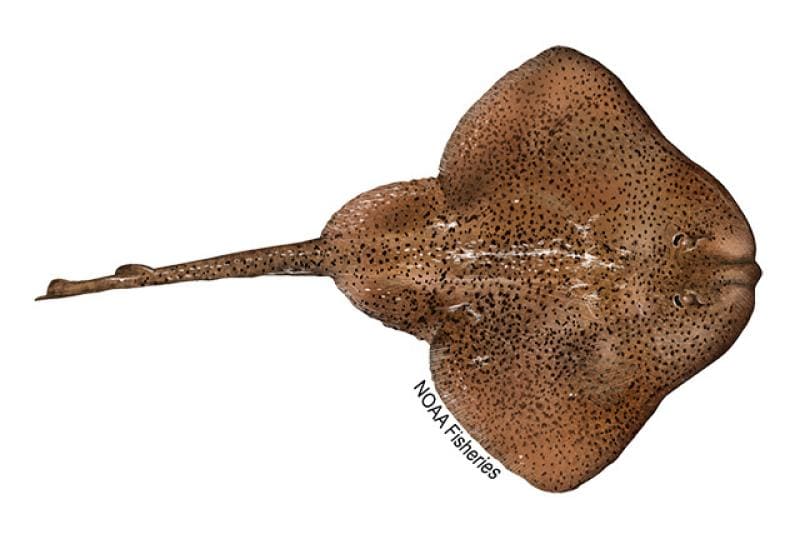
Leucoraja ocellata , also known as Skate, Big skate, Spotted skate, Eyed skate. Winter skate is managed as a part of the Northeast Skate Complex along with six other skate species in the same fishery management plan. Of these species, winter skates are the pri
Source: Species facts, status language, and imagery adapted from the NOAA Fisheries species profile (last updated 06/30/2026). Ocean City charter and Maryland
record notes are editorial orientation for OCEANCITY.MD readers. Always confirm current seasons, sizes, and
bag limits before you fish—rules change.
Winter skate is managed as a part of the Northeast Skate Complex along with six other skate species in the same fishery management plan. Of these species, winter skates are the primary species harvested for human consumption, for the meat in their wings. U.S. wild-caught winter skate is a smart seafood choice because it is sustainably managed and responsibly harvested under U.S. regulations.
Maryland record catch
Confirm whether Maryland DNR publishes an Atlantic state-record category for Winter Skate on the current sport-fish record board.
Maryland’s Atlantic recreational seasons/sizes/creel summary does not publish a dedicated line for Winter Skate. Verify COMAR, DNR public notices, and federal rules for your exact waters before you keep fish.
Rule
Maryland / applicable detail
Maryland minimum size
Not listed — no dedicated Winter Skate line on the MD Atlantic recreational table
Maryland daily creel (bag)
Not listed — no MD species-specific bag for Winter Skate
Maryland open season
Not listed on the MD Atlantic Ocean / Coastal Bays summary table
Verify
Check DNR eRegulations, COMAR, and NOAA for your date and coordinates before you keep fish.
Skates are a relative of sharks and rays and have a kite-like shape.
Winter skates are light brown and covered with small dark spots.
Small spines cover most of their back.
Biology Winter skates have large bodies and can grow up to 5 feet in length.
They can live for about 20 years.
They reproduce at a late age, when they’re approximately 11 years old and 2.5 feet long.
Appearance
Winter skates have large bodies and can grow up to 5 feet in length.
They can live for about 20 years.
They reproduce at a late age, when they’re approximately 11 years old and 2.5 feet long.
Skates lay eggs year-round but have few offspring.
Their eggs are enclosed in a hard leathery case called a “mermaid’s purse.” The eggs incubate for 6 to 12 months, and young skates have the adult form when they hatch.
Skates feed on a variety of organisms such as crustaceans, mollusks, worms, squids, and fish.
Where They Live Range Winter skates range from the Gulf of Saint Lawrence in Canada to Cape Hatteras, North Carolina.
Habitat Winter skate live on sand and gravel bottoms in the northwest Atlantic, most commonly in southern New England and on Georges Bank.
They are occasionally found in the Gulf of Maine, on the Scotian Shelf, in the Gulf of Saint Lawrence, and in the Mid-Atlantic.
Skates are not known to migrate far, but they do move with the seasons as water temperature changes.
They are generally offshore during the summer and early autumn and inshore during winter and spring.
Fishery Management NOAA Fisheries and the New England Fishery Management Council manage the winter skate fishery.
Managed under the Northeast Skate Complex Fishery Management Plan : Valid open access permit is required to catch, possess, transport, or sell skate.
Annual catch limits for winter, little, clearnose, and rosette skates, as well as response measures if the catch limits are exceeded.
Winter skates are the only species targeted for human consumption.
Little skate is used as bait for lobster fisheries and clearnose and rosette skates are usually discarded.
Fishermen are prohibited from retaining smooth (Gulf of Maine only), barndoor, and thorny skates.
Fishermen and dealers must report their catch by species.
Management measures in other fisheries also indirectly aid in the recovery of the overfished skate species and conserve the resource.
Harvest Commercial fishery: In 2024, commercial landings totaled 17 million pounds and were valued at $6 million, according to the NOAA Fisheries commercial fishing landings database .
More than half of skate landings come from Massachusetts and Rhode Island.
Skates are harvested in two different fisheries, one for wings for human consumption and one for lobster bait.
In the bait fishery, vessels from southern New England target mostly little skates (more than 90 percent) and, to a much lesser extent, juvenile winter skates (less than 10 percent).
Juvenile winter skates are difficult to differentiate from little skates because they look nearly identical.
The wing fishery is labor-intensive because the wings need to be cut into fillets, but participation has grown recently due to increasing restrictions on other, more profitable groundfish species.
In the wing fishery, mainly trawlers and gillnetters harvest winter skates when targeting other species such as groundfish, monkfish, and scallops.
Fishermen keep the skates if the price is profitable.
Gear types, habitat impacts, and bycatch: Most skates are caught incidentally in otter trawl fisheries targeting other more valuable species, such as groundfish, monkfish, and scallops.
Otter trawls can impact habitat depending on where they are used.
They can also interact with marine mammals (e.g., whales, harbor porpoises, and seals) and sea turtles.
Management measures including closed areas, restrictions on gear and fishing effort, and modifying fishing gear to reduce contact with habitat help reduce these impacts and interactions.
Skates are also caught in bottom gillnet fisheries, which have less of an impact on habitat.
Skates are caught and discarded as bycatch in numerous fisheries, but the rate of discards has decreased in recent years as the value of skate products has increased.
Scientific Classification Kingdom Animalia Phylum Chordata Class Chondrichthyes Order Rajiformes Family Rajidae Genus Leucoraja Species ocellata Last updated by NOAA Fisheries on 06/30/2026
Biology
Winter skates range from the Gulf of Saint Lawrence in Canada to Cape Hatteras, North Carolina.
Habitat Winter skate live on sand and gravel bottoms in the northwest Atlantic, most commonly in southern New England and on Georges Bank.
They are occasionally found in the Gulf of Maine, on the Scotian Shelf, in the Gulf of Saint Lawrence, and in the Mid-Atlantic.
Skates are not known to migrate far, but they do move with the seasons as water temperature changes.
They are generally offshore during the summer and early autumn and inshore during winter and spring.
Fishery Management NOAA Fisheries and the New England Fishery Management Council manage the winter skate fishery.
Managed under the Northeast Skate Complex Fishery Management Plan : Valid open access permit is required to catch, possess, transport, or sell skate.
Annual catch limits for winter, little, clearnose, and rosette skates, as well as response measures if the catch limits are exceeded.
Winter skates are the only species targeted for human consumption.
Little skate is used as bait for lobster fisheries and clearnose and rosette skates are usually discarded.
Fishermen are prohibited from retaining smooth (Gulf of Maine only), barndoor, and thorny skates.
Fishermen and dealers must report their catch by species.
Management measures in other fisheries also indirectly aid in the recovery of the overfished skate species and conserve the resource.
Harvest Commercial fishery: In 2024, commercial landings totaled 17 million pounds and were valued at $6 million, according to the NOAA Fisheries commercial fishing landings database .
More than half of skate landings come from Massachusetts and Rhode Island.
Skates are harvested in two different fisheries, one for wings for human consumption and one for lobster bait.
In the bait fishery, vessels from southern New England target mostly little skates (more than 90 percent) and, to a much lesser extent, juvenile winter skates (less than 10 percent).
Juvenile winter skates are difficult to differentiate from little skates because they look nearly identical.
The wing fishery is labor-intensive because the wings need to be cut into fillets, but participation has grown recently due to increasing restrictions on other, more profitable groundfish species.
In the wing fishery, mainly trawlers and gillnetters harvest winter skates when targeting other species such as groundfish, monkfish, and scallops.
Fishermen keep the skates if the price is profitable.
Gear types, habitat impacts, and bycatch: Most skates are caught incidentally in otter trawl fisheries targeting other more valuable species, such as groundfish, monkfish, and scallops.
Otter trawls can impact habitat depending on where they are used.
They can also interact with marine mammals (e.g., whales, harbor porpoises, and seals) and sea turtles.
Management measures including closed areas, restrictions on gear and fishing effort, and modifying fishing gear to reduce contact with habitat help reduce these impacts and interactions.
Skates are also caught in bottom gillnet fisheries, which have less of an impact on habitat.
Skates are caught and discarded as bycatch in numerous fisheries, but the rate of discards has decreased in recent years as the value of skate products has increased.
Scientific Classification Kingdom Animalia Phylum Chordata Class Chondrichthyes Order Rajiformes Family Rajidae Genus Leucoraja Species ocellata Last updated by NOAA Fisheries on 06/30/2026
Where they live
Range
Winter skates range from the Gulf of Saint Lawrence in Canada to Cape Hatteras, North Carolina.
Habitat Winter skate live on sand and gravel bottoms in the northwest Atlantic, most commonly in southern New England and on Georges Bank.
Habitat
NOAA Fisheries and the New England Fishery Management Council manage the winter skate fishery.
Managed under the Northeast Skate Complex Fishery Management Plan : Valid open access permit is required to catch, possess, transport, or sell skate.
Annual catch limits for winter, little, clearnose, and rosette skates, as well as response measures if the catch limits are exceeded.
Winter skates are the only species targeted for human consumption.
Little skate is used as bait for lobster fisheries and clearnose and rosette skates are usually discarded.
Fishermen are prohibited from retaining smooth (Gulf of Maine only), barndoor, and thorny skates.
Fishermen and dealers must report their catch by species.
Management measures in other fisheries also indirectly aid in the recovery of the overfished skate species and conserve the resource.
Harvest Commercial fishery: In 2024, commercial landings totaled 17 million pounds and were valued at $6 million, according to the NOAA Fisheries commercial fishing landings database .
More than half of skate landings come from Massachusetts and Rhode Island.
Skates are harvested in two different fisheries, one for wings for human consumption and one for lobster bait.
In the bait fishery, vessels from southern New England target mostly little skates (more than 90 percent) and, to a much lesser extent, juvenile winter skates (less than 10 percent).
Juvenile winter skates are difficult to differentiate from little skates because they look nearly identical.
The wing fishery is labor-intensive because the wings need to be cut into fillets, but participation has grown recently due to increasing restrictions on other, more profitable groundfish species.
In the wing fishery, mainly trawlers and gillnetters harvest winter skates when targeting other species such as groundfish, monkfish, and scallops.
Fishermen keep the skates if the price is profitable.
Gear types, habitat impacts, and bycatch: Most skates are caught incidentally in otter trawl fisheries targeting other more valuable species, such as groundfish, monkfish, and scallops.
Otter trawls can impact habitat depending on where they are used.
They can also interact with marine mammals (e.g., whales, harbor porpoises, and seals) and sea turtles.
Management measures including closed areas, restrictions on gear and fishing effort, and modifying fishing gear to reduce contact with habitat help reduce these impacts and interactions.
Skates are also caught in bottom gillnet fisheries, which have less of an impact on habitat.
Skates are caught and discarded as bycatch in numerous fisheries, but the rate of discards has decreased in recent years as the value of skate products has increased.
Scientific Classification Kingdom Animalia Phylum Chordata Class Chondrichthyes Order Rajiformes Family Rajidae Genus Leucoraja Species ocellata Last updated by NOAA Fisheries on 06/30/2026
Ocean City & Mid-Atlantic context
From Ocean City, Maryland, use this Winter Skate profile as NOAA Mid-Atlantic directory context—not a promise you will meet the species on every charter.
Always verify current Maryland and federal size, season, and bag rules for your exact date and coordinates before you keep any catch.
Source facts and imagery are adapted from the NOAA Fisheries species profile for Winter Skate.
What charter to book from Ocean City
Winter Skate may show on Ocean City shark, wreck, or offshore days depending on season and permits—confirm HMS/state rules before you book or keep fish.
Possible / related
Inshore charter — Possible overlap depending on season, water, and boat program.
Commercial fishery: In 2024, commercial landings totaled 17 million pounds and were valued at $6 million, according to the NOAA Fisheries commercial fishing landings database .
More than half of skate landings come from Massachusetts and Rhode Island.
Skates are harvested in two different fisheries, one for wings for human consumption and one for lobster bait.
In the bait fishery, vessels from southern New England target mostly little skates (more than 90 percent) and, to a much lesser extent, juvenile winter skates (less than 10 percent).
Juvenile winter skates are difficult to differentiate from little skates because they look nearly identical.
The wing fishery is labor-intensive because the wings need to be cut into fillets, but participation has grown recently due to increasing restrictions on other, more profitable groundfish species.
In the wing fishery, mainly trawlers and gillnetters harvest winter skates when targeting other species such as groundfish, monkfish, and scallops.
Fishermen keep the skates if the price is profitable.
Harvest
See the NOAA wild-caught fishery section for landings and gear notes when published for this species.
Landings and management details matter most for the waters where Winter Skate is actually fished—see the
NOAA species profile
.
Seafood facts
Fact
Detail
Sustainability
U.S. wild-caught winter skate is a smart seafood choice because it is sustainably managed and responsibly harvested under U.S. regulations.
Availability
Year-round.
Source
U.S. wild-caught from Maine to North Carolina (mainly Massachusetts and Rhode Island).
Taste
Mild flavor that is similar to scallops.
Texture
Firm and stringy.
Color
The meat is off-white, sometimes pinkish, when raw and is off-white when cooked.
After a real OC boat day or market stop for Winter Skate, Seafood after boat days covers
dock buffer and cook-your-catch pacing.