Polyprion americanus , also known as Sea bass, Stone bass. U.S. wild-caught wreckfish is a smart seafood choice because it is sustainably managed and responsibly harvested under U.S. regulations.
Source: Species facts, status language, and imagery adapted from the NOAA Fisheries species profile (last updated 06/25/2026). Ocean City charter and Maryland
record notes are editorial orientation for OCEANCITY.MD readers. Always confirm current seasons, sizes, and
bag limits before you fish—rules change.
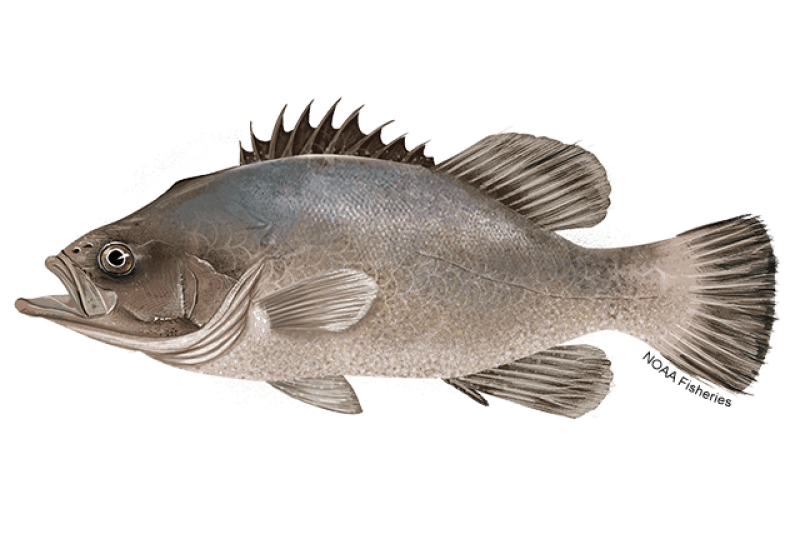
Wreckfish are bluish gray on the back and paler with a silvery sheen on the belly.
Juveniles have black blotches on their head and body.
They have a big head with a big mouth and a rough, bony ridge across the upper part of the gill cover.
Biology Wreckfish are typically 40 to 60 pounds and 2.5 to 4 feet long, but can reach a maximum of 220 pounds and 6.5 feet.
They have a long life span, with some living more than 70 years.
They are able to reproduce at 8 years of age.
Appearance
Wreckfish are typically 40 to 60 pounds and 2.5 to 4 feet long, but can reach a maximum of 220 pounds and 6.5 feet.
They have a long life span, with some living more than 70 years.
They are able to reproduce at 8 years of age.
From January through mid-April, wreckfish spawn multiple times in the Charleston Bump area.
After eggs are fertilized externally, eggs and larvae are transported across the Atlantic Ocean to the coast of Europe, and return as adults to the southeastern coast of the United States.
Wreckfish in the South Atlantic are large predators that lurk in caves and under overhangs on the Charleston Bump and come out to feed on fish and squid migrating during the day.
Where They Live Range Wreckfish are found in the western Atlantic Ocean from Grand Banks, Newfoundland, to La Plata River, Argentina.
Habitat Wreckfish live in water ranging in depth from 140 to 3,300 feet.
Juvenile wreckfish are found in surface waters, often near floating debris.
Adult wreckfish prefer steep, rocky ocean bottoms and deep reefs, which provide food and shelter.
They’re often found near caves and overhangs.
Fishery Management NOAA Fisheries and the South Atlantic Fishery Management Council manage the wreckfish fishery.
Managed under the Fishery Management Plan for the Snapper Grouper Fishery of the South Atlantic Region : A permit is required to fish for, land, or sell wreckfish.
Bottom longlining is prohibited (only vertical hook-and-line may be used).
Commercial fishery is closed during wreckfish spawning season (from mid-January through mid-April).
The commercial fishery is managed under an individual transferable quota (ITQ, also known as catch shares ) program.
Each wreckfish fisherman owns a share of the quota and can choose to fish it anytime during the open season. 5 percent of the annual catch limit is allocated to recreational fishermen.
Recreational fishing for wreckfish is allowed during July and August each year, and there is a bag limit per vessel.
Harvest The wreckfish fishery is small, with fewer than 10 vessels currently operating in the commercial sector.
Commercial landings are confidential due to the limited number of participants.
The total annual catch limit has remained over 400,000 pounds since 2015.
Wreckfish fishermen are based in Charleston, South Carolina, northeast Florida, and the Florida Keys.
They supply most of the wreckfish in the domestic market.
Primary fishing grounds are the Charleston Bump, a deep-water bank located 80 to 100 miles southeast of Charleston, South Carolina.
Commercial fishermen use heavy-duty hydraulic reels with 1/8-inch cable to harvest wreckfish.
They attach heavy weights and multiple circle hooks baited with squid to the cable and fish just above the bottom.
Scientific Classification Kingdom Animalia Phylum Chordata Class Actinopterygii Order Perciformes Family Polyprionidae Genus Polyprion Species americanus Last updated by NOAA Fisheries on 06/25/2026
Biology
Wreckfish are found in the western Atlantic Ocean from Grand Banks, Newfoundland, to La Plata River, Argentina.
Habitat Wreckfish live in water ranging in depth from 140 to 3,300 feet.
Juvenile wreckfish are found in surface waters, often near floating debris.
Adult wreckfish prefer steep, rocky ocean bottoms and deep reefs, which provide food and shelter.
They’re often found near caves and overhangs.
Fishery Management NOAA Fisheries and the South Atlantic Fishery Management Council manage the wreckfish fishery.
Managed under the Fishery Management Plan for the Snapper Grouper Fishery of the South Atlantic Region : A permit is required to fish for, land, or sell wreckfish.
Bottom longlining is prohibited (only vertical hook-and-line may be used).
Commercial fishery is closed during wreckfish spawning season (from mid-January through mid-April).
The commercial fishery is managed under an individual transferable quota (ITQ, also known as catch shares ) program.
Each wreckfish fisherman owns a share of the quota and can choose to fish it anytime during the open season. 5 percent of the annual catch limit is allocated to recreational fishermen.
Recreational fishing for wreckfish is allowed during July and August each year, and there is a bag limit per vessel.
Harvest The wreckfish fishery is small, with fewer than 10 vessels currently operating in the commercial sector.
Commercial landings are confidential due to the limited number of participants.
The total annual catch limit has remained over 400,000 pounds since 2015.
Wreckfish fishermen are based in Charleston, South Carolina, northeast Florida, and the Florida Keys.
They supply most of the wreckfish in the domestic market.
Primary fishing grounds are the Charleston Bump, a deep-water bank located 80 to 100 miles southeast of Charleston, South Carolina.
Commercial fishermen use heavy-duty hydraulic reels with 1/8-inch cable to harvest wreckfish.
They attach heavy weights and multiple circle hooks baited with squid to the cable and fish just above the bottom.
Scientific Classification Kingdom Animalia Phylum Chordata Class Actinopterygii Order Perciformes Family Polyprionidae Genus Polyprion Species americanus Last updated by NOAA Fisheries on 06/25/2026
Where they live
Range
Wreckfish are found in the western Atlantic Ocean from Grand Banks, Newfoundland, to La Plata River, Argentina.
Habitat Wreckfish live in water ranging in depth from 140 to 3,300 feet.
Habitat
NOAA Fisheries and the South Atlantic Fishery Management Council manage the wreckfish fishery.
Managed under the Fishery Management Plan for the Snapper Grouper Fishery of the South Atlantic Region : A permit is required to fish for, land, or sell wreckfish.
Bottom longlining is prohibited (only vertical hook-and-line may be used).
Commercial fishery is closed during wreckfish spawning season (from mid-January through mid-April).
The commercial fishery is managed under an individual transferable quota (ITQ, also known as catch shares ) program.
Each wreckfish fisherman owns a share of the quota and can choose to fish it anytime during the open season. 5 percent of the annual catch limit is allocated to recreational fishermen.
Recreational fishing for wreckfish is allowed during July and August each year, and there is a bag limit per vessel.
Harvest The wreckfish fishery is small, with fewer than 10 vessels currently operating in the commercial sector.
Commercial landings are confidential due to the limited number of participants.
The total annual catch limit has remained over 400,000 pounds since 2015.
Wreckfish fishermen are based in Charleston, South Carolina, northeast Florida, and the Florida Keys.
They supply most of the wreckfish in the domestic market.
Primary fishing grounds are the Charleston Bump, a deep-water bank located 80 to 100 miles southeast of Charleston, South Carolina.
Commercial fishermen use heavy-duty hydraulic reels with 1/8-inch cable to harvest wreckfish.
They attach heavy weights and multiple circle hooks baited with squid to the cable and fish just above the bottom.
Scientific Classification Kingdom Animalia Phylum Chordata Class Actinopterygii Order Perciformes Family Polyprionidae Genus Polyprion Species americanus Last updated by NOAA Fisheries on 06/25/2026
Ocean City & Mid-Atlantic context
From Ocean City, Maryland, use this Wreckfish profile as NOAA Mid-Atlantic directory context—not a promise you will meet the species on every charter.
Always verify current Maryland and federal size, season, and bag rules for your exact date and coordinates before you keep any catch.
Source facts and imagery are adapted from the NOAA Fisheries species profile for Wreckfish.
What charter to book from Ocean City
Wreckfish may appear on Ocean City trips depending on season and habitat—use the NOAA biology below and book the charter archetype that matches how you will actually fish.
Possible / related
Bay guide — Possible overlap depending on season, water, and boat program.
Inshore charter — Possible overlap depending on season, water, and boat program.