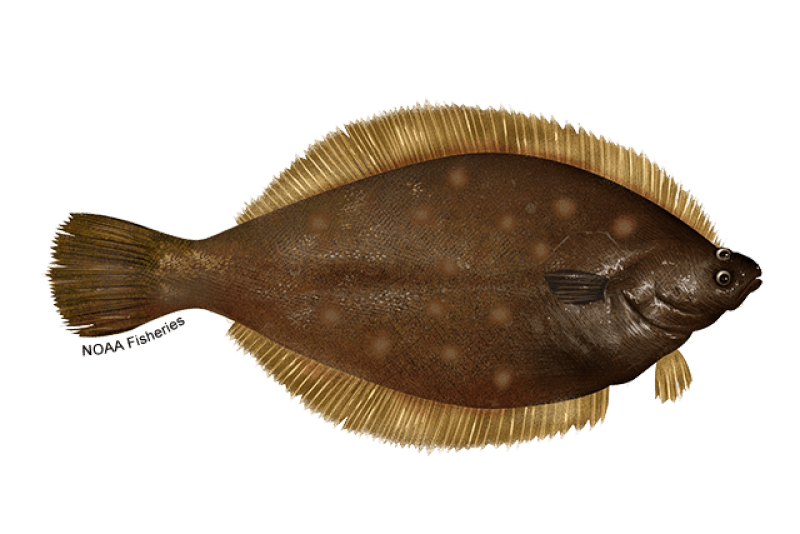
Limanda ferruginea , also known as Flounder, Rusty dab. Yellowtail flounder live along the Atlantic coast of North America from Newfoundland to the Chesapeake Bay. There are three stocks in U.S waters: the Gulf of Maine/Cape Cod, George
Source: Species facts, status language, and imagery adapted from the NOAA Fisheries species profile (last updated 06/25/2026). Ocean City charter and Maryland
record notes are editorial orientation for OCEANCITY.MD readers. Always confirm current seasons, sizes, and
bag limits before you fish—rules change.
Lifespan: Up to 17 years (most do not live past age 7)
Region: New England/Mid-Atlantic
Category: Fish · Mid-Atlantic
Maryland likelihood: 2★ out of 5
About the species
Yellowtail flounder live along the Atlantic coast of North America from Newfoundland to the Chesapeake Bay. There are three stocks in U.S waters: the Gulf of Maine/Cape Cod, Georges Bank, and Southern New England/Mid-Atlantic stocks, all of which NOAA Fisheries is working to rebuild.
Maryland record catch
Confirm whether Maryland DNR publishes an Atlantic state-record category for Yellowtail Flounder on the current sport-fish record board.
Maryland’s Atlantic recreational seasons/sizes/creel summary does not publish a dedicated line for Yellowtail Flounder. Verify COMAR, DNR public notices, and federal rules for your exact waters before you keep fish.
Rule
Maryland / applicable detail
Maryland minimum size
Not listed — no dedicated Yellowtail Flounder line on the MD Atlantic recreational table
Maryland daily creel (bag)
Not listed — no MD species-specific bag for Yellowtail Flounder
Maryland open season
Not listed on the MD Atlantic Ocean / Coastal Bays summary table
Verify
Check DNR eRegulations, COMAR, and NOAA for your date and coordinates before you keep fish.
Yellowtail flounder is a thin-bodied, right-eyed flounder. They are wide—nearly half as broad as they are long—with an oval body. Their upper side, including the fins, is brownish or olive, tinged with red and marked with large, irregular rusty red spots. The underside is white, except for the caudal peduncle (the area between the body and the tail), which is yellowish. They have a small mouth and an arched lateral line. True to their name, their tail fin and the edges of the two long fins are yellow.
Biology Yellowtail flounder grow faster than most flatfish, up to 22 inches and 2.2 pounds. They can live up to 17 years, although most don’t live past age 7. They also mature earlier than most flatfish.
Almost all females are able to reproduce by the time they reach age 3. They spawn during the spring and summer. Females spawn buoyant, spherical, pelagic eggs near the surface, along continental shelf waters of Georges Bank, northwest of Cape Cod, southern New England, and nearshore along New Jersey and southern Long Island. Eggs hatch approximately 5 days after fertilization at temperatures of 10–11° C.
When yellowtail flounder are first hatched, their eyes are symmetrical, with an eye on each side of their head. As the fish grows, it flattens out and the left eye slowly moves over to the right side of its head. After this metamorphosis, the juvenile settles to the ocean bottom.
Juvenile yellowtail flounder mostly eat worms. Adults feed on crustaceans and worms. Spiny dogfish, skate, and a number of fish such as cod, hakes, flounder, and monkfish prey on yellowtail flounder.
Where They Live Range Yellowtail flounder are found along the Atlantic coast of North America from Newfoundland to the Chesapeake Bay.
Appearance
Yellowtail flounder grow faster than most flatfish, up to 22 inches and 2.2 pounds. They can live up to 17 years, although most don’t live past age 7. They also mature earlier than most flatfish.
Almost all females are able to reproduce by the time they reach age 3. They spawn during the spring and summer. Females spawn buoyant, spherical, pelagic eggs near the surface, along continental shelf waters of Georges Bank, northwest of Cape Cod, southern New England, and nearshore along New Jersey and southern Long Island. Eggs hatch approximately 5 days after fertilization at temperatures of 10–11° C.
When yellowtail flounder are first hatched, their eyes are symmetrical, with an eye on each side of their head. As the fish grows, it flattens out and the left eye slowly moves over to the right side of its head. After this metamorphosis, the juvenile settles to the ocean bottom.
Juvenile yellowtail flounder mostly eat worms. Adults feed on crustaceans and worms. Spiny dogfish, skate, and a number of fish such as cod, hakes, flounder, and monkfish prey on yellowtail flounder.
Where They Live Range Yellowtail flounder are found along the Atlantic coast of North America from Newfoundland to the Chesapeake Bay.
Habitat Yellowtail flounder are relatively sedentary. They live on sandy bottoms in waters between 130 and 230 feet deep.
Fishery Management There are three stocks of yellowtail flounder in U.S. waters, the Gulf of Maine/Cape Cod, Georges Bank, and Southern New England/Mid-Atlantic stocks.
NOAA Fisheries and the New England Fishery Management Council manage Gulf of Maine and Southern New England/Mid-Atlantic yellowtail flounder; NOAA Fisheries and the New England Fishery Management Council collaborate with Canada to jointly manage Georges Bank yellowtail flounder, because the stock spans the international boundary.
Yellowtail flounder, along with other groundfish in New England waters, are managed under the Northeast Multispecies Fishery Management Plan, which includes:
Permitting requirements for commercial vessels Separate management measures for recreational vessels Time/Area Closures to protect spawning fish and habitat Minimum fish sizes to prevent harvest of juvenile fish Annual catch limits, based on best available science An optional sector ( catch share ) program can be used for yellowtail flounder and other groundfish species. The sector program allows fishermen to form harvesting cooperatives and work together to decide when, where, and how they harvest fish. A rebuilding plan for the Gulf of Maine/Cape Cod stock was put in place in 2004 and the stock rebuilt in 2022. A rebuilding plan to rebuild the Southern New England/Mid-Atlantic stock to the target population level is in place with a target date of 2029. A rebuilding plan to rebuild the Georges Bank stock to the target population level is in place with a target date of 2032.
Harvest Commercial Fishery for Yellowtail Flounder In 2024, commercial landings of yellowtail flounder totaled 556,000 pounds, and were valued at $429,000, according to the NOAA Fisheries commercial fishing landings database .
Gear Types, Habitat Impacts, and Bycatch Yellowtail flounder are commonly harvested using trawl nets and, to a lesser extent, gillnets.
Areas closures and gear restrictions reduce habitat impacts from trawl nets. Fishermen follow management measures to designed to reduce interactions with marine mammals, including gear modifications, seasonal closures, and use of marine mammal deterrents.
Recreational Fishery for Yellowtail Flounder Yellowtail flounder are not commonly encountered by the recreational fishery. Regulations include minimum fish sizes and possession limits.
Scientific Classification Kingdom Animalia Phylum Chordata Class Actinopterygii Order Pleuronectiformes Family Pleuronectidae Genus Limanda Species ferruginea Last updated by NOAA Fisheries on 06/25/2026
Biology
Yellowtail flounder are found along the Atlantic coast of North America from Newfoundland to the Chesapeake Bay.
Habitat Yellowtail flounder are relatively sedentary. They live on sandy bottoms in waters between 130 and 230 feet deep.
Fishery Management There are three stocks of yellowtail flounder in U.S. waters, the Gulf of Maine/Cape Cod, Georges Bank, and Southern New England/Mid-Atlantic stocks.
NOAA Fisheries and the New England Fishery Management Council manage Gulf of Maine and Southern New England/Mid-Atlantic yellowtail flounder; NOAA Fisheries and the New England Fishery Management Council collaborate with Canada to jointly manage Georges Bank yellowtail flounder, because the stock spans the international boundary.
Yellowtail flounder, along with other groundfish in New England waters, are managed under the Northeast Multispecies Fishery Management Plan, which includes:
Permitting requirements for commercial vessels Separate management measures for recreational vessels Time/Area Closures to protect spawning fish and habitat Minimum fish sizes to prevent harvest of juvenile fish Annual catch limits, based on best available science An optional sector ( catch share ) program can be used for yellowtail flounder and other groundfish species. The sector program allows fishermen to form harvesting cooperatives and work together to decide when, where, and how they harvest fish. A rebuilding plan for the Gulf of Maine/Cape Cod stock was put in place in 2004 and the stock rebuilt in 2022. A rebuilding plan to rebuild the Southern New England/Mid-Atlantic stock to the target population level is in place with a target date of 2029. A rebuilding plan to rebuild the Georges Bank stock to the target population level is in place with a target date of 2032.
Harvest Commercial Fishery for Yellowtail Flounder In 2024, commercial landings of yellowtail flounder totaled 556,000 pounds, and were valued at $429,000, according to the NOAA Fisheries commercial fishing landings database .
Gear Types, Habitat Impacts, and Bycatch Yellowtail flounder are commonly harvested using trawl nets and, to a lesser extent, gillnets.
Areas closures and gear restrictions reduce habitat impacts from trawl nets. Fishermen follow management measures to designed to reduce interactions with marine mammals, including gear modifications, seasonal closures, and use of marine mammal deterrents.
Recreational Fishery for Yellowtail Flounder Yellowtail flounder are not commonly encountered by the recreational fishery. Regulations include minimum fish sizes and possession limits.
Scientific Classification Kingdom Animalia Phylum Chordata Class Actinopterygii Order Pleuronectiformes Family Pleuronectidae Genus Limanda Species ferruginea Last updated by NOAA Fisheries on 06/25/2026
Where they live
Range
Yellowtail flounder are found along the Atlantic coast of North America from Newfoundland to the Chesapeake Bay.
Habitat Yellowtail flounder are relatively sedentary. They live on sandy bottoms in waters between 130 and 230 feet deep.
Habitat
There are three stocks of yellowtail flounder in U.S. waters, the Gulf of Maine/Cape Cod, Georges Bank, and Southern New England/Mid-Atlantic stocks.
NOAA Fisheries and the New England Fishery Management Council manage Gulf of Maine and Southern New England/Mid-Atlantic yellowtail flounder; NOAA Fisheries and the New England Fishery Management Council collaborate with Canada to jointly manage Georges Bank yellowtail flounder, because the stock spans the international boundary.
Yellowtail flounder, along with other groundfish in New England waters, are managed under the Northeast Multispecies Fishery Management Plan, which includes:
Permitting requirements for commercial vessels Separate management measures for recreational vessels Time/Area Closures to protect spawning fish and habitat Minimum fish sizes to prevent harvest of juvenile fish Annual catch limits, based on best available science An optional sector ( catch share ) program can be used for yellowtail flounder and other groundfish species. The sector program allows fishermen to form harvesting cooperatives and work together to decide when, where, and how they harvest fish. A rebuilding plan for the Gulf of Maine/Cape Cod stock was put in place in 2004 and the stock rebuilt in 2022. A rebuilding plan to rebuild the Southern New England/Mid-Atlantic stock to the target population level is in place with a target date of 2029. A rebuilding plan to rebuild the Georges Bank stock to the target population level is in place with a target date of 2032.
Harvest Commercial Fishery for Yellowtail Flounder In 2024, commercial landings of yellowtail flounder totaled 556,000 pounds, and were valued at $429,000, according to the NOAA Fisheries commercial fishing landings database .
Gear Types, Habitat Impacts, and Bycatch Yellowtail flounder are commonly harvested using trawl nets and, to a lesser extent, gillnets.
Areas closures and gear restrictions reduce habitat impacts from trawl nets. Fishermen follow management measures to designed to reduce interactions with marine mammals, including gear modifications, seasonal closures, and use of marine mammal deterrents.
Recreational Fishery for Yellowtail Flounder Yellowtail flounder are not commonly encountered by the recreational fishery. Regulations include minimum fish sizes and possession limits.
Scientific Classification Kingdom Animalia Phylum Chordata Class Actinopterygii Order Pleuronectiformes Family Pleuronectidae Genus Limanda Species ferruginea Last updated by NOAA Fisheries on 06/25/2026
Ocean City & Mid-Atlantic context
From Ocean City, Maryland, use this Yellowtail Flounder profile as NOAA Mid-Atlantic directory context—not a promise you will meet the species on every charter.
Always verify current Maryland and federal size, season, and bag rules for your exact date and coordinates before you keep any catch.
Source facts and imagery are adapted from the NOAA Fisheries species profile for Yellowtail Flounder.
What charter to book from Ocean City
Yellowtail Flounder may appear on Ocean City trips depending on season and habitat—use the NOAA biology below and book the charter archetype that matches how you will actually fish.
Possible / related
Bay guide — Possible overlap depending on season, water, and boat program.
Inshore charter — Possible overlap depending on season, water, and boat program.
Commercial Fishery for Yellowtail Flounder In 2024, commercial landings of yellowtail flounder totaled 556,000 pounds, and were valued at $429,000, according to the NOAA Fisheries commercial fishing landings database .
Gear Types, Habitat Impacts, and Bycatch Yellowtail flounder are commonly harvested using trawl nets and, to a lesser extent, gillnets.
Areas closures and gear restrictions reduce habitat impacts from trawl nets. Fishermen follow management measures to designed to reduce interactions with marine mammals, including gear modifications, seasonal closures, and use of marine mammal deterrents.
Recreational Fishery for Yellowtail Flounder Yellowtail flounder are not commonly encountered by the recreational fishery. Regulations include minimum fish sizes and possession limits.
Scientific Classification Kingdom Animalia Phylum Chordata Class Actinopterygii Order Pleuronectiformes Family Pleuronectidae Genus Limanda Species ferruginea Last updated by NOAA Fisheries on 06/25/2026
Harvest
See the NOAA wild-caught fishery section for landings and gear notes when published for this species.
Landings and management details matter most for the waters where Yellowtail Flounder is actually fished—see the
NOAA species profile
.
Seafood facts
Fact
Detail
Sustainability
U.S. wild-caught yellowtail flounder is a smart seafood choice because it is sustainably managed and responsibly harvested under U.S. regulations.
Availability
Year-round.
Source
U.S. wild-caught from Maine to New Jersey.
Taste
Sweet and mild.
Texture
Lean, boneless, flaky, and firm.
Color
Raw flounder ranges in color from white to pinkish to tan. Cooked flounder is pure white.
Health
Flounder is a good low-fat source of B vitamins and niacin.
After a real OC boat day or market stop for Yellowtail Flounder, Seafood after boat days covers
dock buffer and cook-your-catch pacing.