Black Sea Bass
Centropristis striata · Also known as: Sea bass, Blackfish, Rock bass, Black bass, Tallywag
The black sea bass fishery in the U.S. operates from Maine to Florida. Black sea bass are found in association with structured habitats. They migrate offshore and south in the fall
This is a Nature Guide page (viewing and ID). Catch limits, tackle, and charter fit live on the separate Fishing species profile—we keep those products apart on purpose.
Quick facts
| Group | Fish · Mid-Atlantic |
|---|---|
| Viewing lane | Bay & offshore |
| Likelihood nearby | ★★★★★ |
| Region | New England/Mid-Atlantic, Southeast |
How to recognize them
- Black sea bass grow slowly, up to 2 feet and 9 pounds.
- They are able to reproduce when they reach 1 to 3 years old.
- They are protogynous hermaphrodites—most black sea bass start out as females, and as they mature and grow they become males.
- Researchers aren’t sure why this happens, but one hypothesis suggests the relative scarcity of males in a spawning group may be the stimulus for a female to switch sex.
- Black sea bass spawn in coastal areas from January through July.
- Males gather a group of females to mate with and aggressively defend their territory.
- Depending on their size, females can produce between 30,000 and 500,000 eggs in a spawning season.
- Females can live up to 8 years; males live up to 12.
- Black sea bass eat whatever prey is available, but they especially like crabs, shrimp, worms, small fish, and clams.
- Little skate, spiny dogfish, monkfish, spotted hake, and summer flounder all feed on black sea bass.
- Where They Live Range Along the U.S.
- East Coast from Cape Cod to the Gulf of America (formerly Gulf of Mexico).
- Habitat Black sea bass prefer structured habitats such as reefs, wrecks, or oyster beds in temperate and subtropical waters.
- In the Mid-Atlantic (north of Cape Hatteras, North Carolina), they migrate seasonally as water temperature changes.
- They generally migrate to inshore coastal areas and bays in the spring and offshore in the fall.
- In the South Atlantic, black sea bass do not tend to migrate as far.
- Fishery Management NOAA Fisheries, the Mid-Atlantic Fishery Management Council , and the Atlantic States Marine Fisheries Commission cooperatively manage the black sea bass fishery north of Cape Hatteras, North Carolina.
- Managed under the Summer Flounder, Scup, and Black Sea Bass Fishery Management Plan : Annual catch limit divided between the commercial and recreational fisheries.
- The commercial catch limit is further divided among the states based on historical harvests.
- Specific management measures for the commercial fishery include: Minimum size limits.
- Minimum mesh requirements for trawls.
- A moratorium on entry into the fishery.
- NOAA Fisheries and the South Atlantic Fishery Management Council manage the black sea bass fishery south of Cape Hatteras, North Carolina.
- Managed under the South Atlantic Snapper Grouper Fishery Management Plan : Commercial fishermen must have a permit to harvest black sea bass.
- Annual catch limits, commercial trip limits, and recreational bag and possession limits.
- Sale and purchase restrictions applicable after a commercial quota closure.
- Accountability measures in place to ensure overfishing does not occur, or to correct for overages if catch limit is exceeded.
- Seasonal area closures for the commercial black sea bass component of the snapper-grouper fishery.
- Trawling has been banned in the South Atlantic since 1989 to prevent impacts to habitat.
- Gear restrictions for fish pots: Commercial fishermen must have a pot endorsement to use a black sea bass pot to harvest black sea bass.
- Minimum mesh size to reduce catch of undersized black sea bass.
- Pots must have escape vents and escape panels with degradable fasteners to prevent bycatch.
- Limit on the number of pots per trip.
- Pots must be brought back to shore at the end of each trip to reduce bycatch and impacts to habitat and protected species.
- Pots are only allowed north of Cape Canaveral, Florida, to prevent adverse impacts on live-bottom habitat.
- Spatial and temporal closures to minimize entanglement risk for endangered North Atlantic Right Whales. // Harvest Commercial fishery: In 2024, commercial landings of black sea bass totaled 4.8 million pounds, and were valued at $12.6 million, according to the NOAA Fisheries commercial fishing landings database .
- Gear types, habitat impacts, and bycatch: In the Mid-Atlantic, commercial fishermen mainly use hook-and-line gear, pots, and otter trawls to catch black sea bass.
- Fisheries for black sea bass change seasonally with the species’ migrations.
- Of the gear utilized within the snapper grouper fishery, only the black sea bass pot is considered to pose an entanglement risk to marine mammals.
- When the fish are inshore, commercial fishermen catch them primarily with fish pots (both baited and unbaited) and handlines.
- Once the fish move offshore in the winter, they’re caught in the trawl fishery that primarily targets summer flounder, scup, and longfin squid.
- In the South Atlantic, fishermen use pots and sometimes handlines.
- Fish bycatch in the pot fishery is minor because the gear is often not baited (black sea bass are drawn the structure and enter the pots without bait), and the pot mesh size is regulated to select fish at or above the minimum size limit.
- Recreational fishery: Recreational fishermen use handlines to catch black sea bass.
- In 2024, recreational anglers landed 6 million pounds of black sea bass, according to the NOAA Fisheries recreational fishing landings database .
- In the Mid-Atlantic: There are size and bag limits, and seasonal measures, established for federal waters as well as by each state, to ensure that the recreational harvest limit is not exceeded.
- The recreational fishery is evaluated after the season, and management measures (bag, size, and/or season) are adjusted as needed in the following year.
- In the South Atlantic: There are size limits, fishing season, and daily and yearly catch limits, established for federal waters as well as by each state.
- There is a limit on annual recreational harvest, and recreational harvest is prohibited when the limit is met.
- If annual catch exceeds the limit, the overage is taken off the following year’s limit.
- Scientific Classification Kingdom Animalia Phylum Chordata Class Actinopterygii Order Perciformes Family Serranidae Genus Centropristis Species striata Last updated by NOAA Fisheries on 06/25/2026
Biology notes
- East Coast from Cape Cod to the Gulf of America (formerly Gulf of Mexico).
- Habitat Black sea bass prefer structured habitats such as reefs, wrecks, or oyster beds in temperate and subtropical waters.
- In the Mid-Atlantic (north of Cape Hatteras, North Carolina), they migrate seasonally as water temperature changes.
- They generally migrate to inshore coastal areas and bays in the spring and offshore in the fall.
- In the South Atlantic, black sea bass do not tend to migrate as far.
- Fishery Management NOAA Fisheries, the Mid-Atlantic Fishery Management Council , and the Atlantic States Marine Fisheries Commission cooperatively manage the black sea bass fishery north of Cape Hatteras, North Carolina.
- Managed under the Summer Flounder, Scup, and Black Sea Bass Fishery Management Plan : Annual catch limit divided between the commercial and recreational fisheries.
- The commercial catch limit is further divided among the states based on historical harvests.
- Specific management measures for the commercial fishery include: Minimum size limits.
- Minimum mesh requirements for trawls.
- A moratorium on entry into the fishery.
- NOAA Fisheries and the South Atlantic Fishery Management Council manage the black sea bass fishery south of Cape Hatteras, North Carolina.
- Managed under the South Atlantic Snapper Grouper Fishery Management Plan : Commercial fishermen must have a permit to harvest black sea bass.
- Annual catch limits, commercial trip limits, and recreational bag and possession limits.
- Sale and purchase restrictions applicable after a commercial quota closure.
- Accountability measures in place to ensure overfishing does not occur, or to correct for overages if catch limit is exceeded.
- Seasonal area closures for the commercial black sea bass component of the snapper-grouper fishery.
- Trawling has been banned in the South Atlantic since 1989 to prevent impacts to habitat.
- Gear restrictions for fish pots: Commercial fishermen must have a pot endorsement to use a black sea bass pot to harvest black sea bass.
- Minimum mesh size to reduce catch of undersized black sea bass.
- Pots must have escape vents and escape panels with degradable fasteners to prevent bycatch.
- Limit on the number of pots per trip.
- Pots must be brought back to shore at the end of each trip to reduce bycatch and impacts to habitat and protected species.
- Pots are only allowed north of Cape Canaveral, Florida, to prevent adverse impacts on live-bottom habitat.
- Spatial and temporal closures to minimize entanglement risk for endangered North Atlantic Right Whales. // Harvest Commercial fishery: In 2024, commercial landings of black sea bass totaled 4.8 million pounds, and were valued at $12.6 million, according to the NOAA Fisheries commercial fishing landings database .
- Gear types, habitat impacts, and bycatch: In the Mid-Atlantic, commercial fishermen mainly use hook-and-line gear, pots, and otter trawls to catch black sea bass.
- Fisheries for black sea bass change seasonally with the species’ migrations.
- Of the gear utilized within the snapper grouper fishery, only the black sea bass pot is considered to pose an entanglement risk to marine mammals.
- When the fish are inshore, commercial fishermen catch them primarily with fish pots (both baited and unbaited) and handlines.
- Once the fish move offshore in the winter, they’re caught in the trawl fishery that primarily targets summer flounder, scup, and longfin squid.
- In the South Atlantic, fishermen use pots and sometimes handlines.
- Fish bycatch in the pot fishery is minor because the gear is often not baited (black sea bass are drawn the structure and enter the pots without bait), and the pot mesh size is regulated to select fish at or above the minimum size limit.
- Recreational fishery: Recreational fishermen use handlines to catch black sea bass.
- In 2024, recreational anglers landed 6 million pounds of black sea bass, according to the NOAA Fisheries recreational fishing landings database .
- In the Mid-Atlantic: There are size and bag limits, and seasonal measures, established for federal waters as well as by each state, to ensure that the recreational harvest limit is not exceeded.
- The recreational fishery is evaluated after the season, and management measures (bag, size, and/or season) are adjusted as needed in the following year.
- In the South Atlantic: There are size limits, fishing season, and daily and yearly catch limits, established for federal waters as well as by each state.
- There is a limit on annual recreational harvest, and recreational harvest is prohibited when the limit is met.
- If annual catch exceeds the limit, the overage is taken off the following year’s limit.
- Scientific Classification Kingdom Animalia Phylum Chordata Class Actinopterygii Order Perciformes Family Serranidae Genus Centropristis Species striata Last updated by NOAA Fisheries on 06/25/2026
Habitat & range
- NOAA Fisheries, the Mid-Atlantic Fishery Management Council , and the Atlantic States Marine Fisheries Commission cooperatively manage the black sea bass fishery north of Cape Hatteras, North Carolina.
- Managed under the Summer Flounder, Scup, and Black Sea Bass Fishery Management Plan : Annual catch limit divided between the commercial and recreational fisheries.
- The commercial catch limit is further divided among the states based on historical harvests.
- Specific management measures for the commercial fishery include: Minimum size limits.
- Minimum mesh requirements for trawls.
- A moratorium on entry into the fishery.
Population status
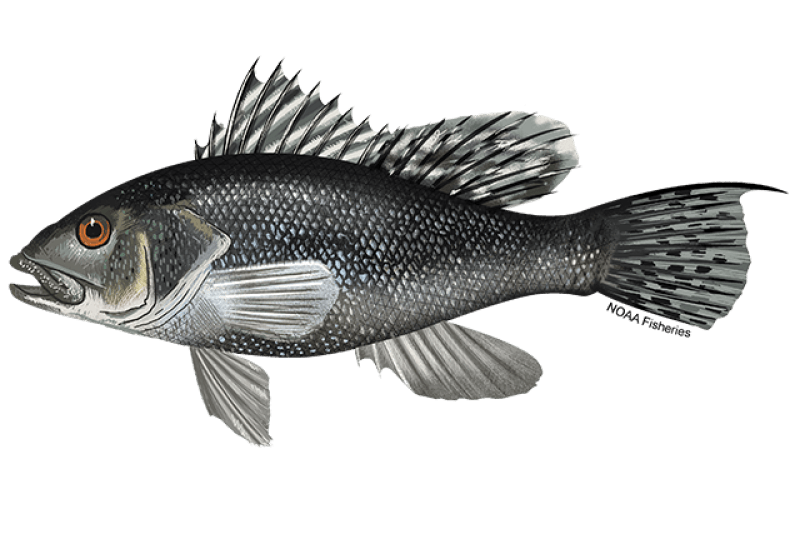
- Black sea bass are usually black, but smaller ones are more of a dusky brown.
- The belly is slightly paler than the sides.
- Fins are dark with dusky spots.
- The dorsal fin is marked with a series of white spots and bands.
- During spawning, dominant males turn bright blue and have a blue hump on their heads.
- Biology Black sea bass grow slowly, up to 2 feet and 9 pounds.
Where to see them around Ocean City
- Nearshore days: Inlet, guarded beaches, and bay overlooks. Farther days: watch for the same species from charter rails when water clarity and bait line up.
- Dawn and dusk often show more surface activity; midday heat can push fish deeper even when they are still in the area.
- Pair a beach walk with a short Inlet stop—two vantage points beat one crowded pier rail.
When to look
- Expect the richest shore viewing in summer; spring and fall migrations can still light up the Inlet and beaches.
- After storms, wait for water to clear—murky days hide even common species from the beach.
- Likelihood stars on this page reflect how often Maryland visitors can reasonably hope to encounter the species nearby—not fishing success rates.
Viewing tips & etiquette
- Use binoculars or a long lens; do not enter the water to corner fish, rays, or sharks for photos.
- Respect beach nesting closures, stay off dunes, and keep dogs leashed where required.
- If you find a stranded or injured animal, contact official wildlife responders—do not attempt rescue yourself.
- For harvest rules, size limits, or charter planning, use the Fishing profile for Black Sea Bass —not this Nature Guide page.
Sources
- NOAA Fisheries species profile (biology reference; angling product stays on our Fishing hub)
- OCEANCITY.MD Fishing species profile