Blueline Tilefish
Caulolatilus microps · Also known as: Tilefish, Gray tilefish
Tilefish are found Maine to Campeche, Mexico on the outer continental shelves, shelf breaks, and upper slopes. The tilefish fishery in the Greater Atlantic Region of the U.S. is ma
This is a Nature Guide page (viewing and ID). Catch limits, tackle, and charter fit live on the separate Fishing species profile—we keep those products apart on purpose.
Quick facts
| Group | Fish · Mid-Atlantic |
|---|---|
| Viewing lane | Offshore / bluewater |
| Likelihood nearby | ★★★★☆ |
| Region | New England/Mid-Atlantic, Southeast |
How to recognize them
- Tilefish can grow to be 35 inches long and live up to 26 years. Males can grow larger than females. Female tilefish mature when they are about 3 years old. They can spawn year-round, but peak spawning is in May. Spawning primarily occurs at night. Females can lay more than 4 million free-floating eggs. Tilefish feed primarily on invertebrates that live near the sea floor, such as crabs, shrimp, snails, worms, sea urchins, and small fish. Recent genetic studies suggest that the U.S. Atlantic population of tilefish is continuous from the northeastern Gulf of America, around the Florida Keys, and up through the Mid-Atlantic region. Where They Live Range Tilefish are commonly found in the western Atlantic from Campeche, Mexico, to Hudson Canyon, off the coast of Maryland, including the eastern Gulf of America. There are reports of catches as far north as Maine and as far west as Texas. Habitat Tilefish typically live along the outer continental shelf, shelf break, and upper slope. They live on irregular bottom with ledges or crevices, and around boulders or rubble piles at depths of 98 to 774 feet where temperatures range from 59 to 73.4 ° F. They have been found to burrow head first into cone-shaped piles of sand and may also occupy existing holes and crevices. Fishery Management The Mid-Atlantic , South Atlantic , and Gulf Fishery Management Councils develop management measures for the tilefish fisheries in their respective jurisdictions. NOAA Fisheries is responsible for implementing and enforcing these measures. The Mid-Atlantic Tilefish Fishery Management Plan measures for tilefish include: Permit requirements for commercial and for-hire vessels. Annual catch limits for the commercial and recreational fisheries. Limits on commercial possession. The fishery is closed if the landing limit is harvested. Closed season and bag limit for recreational anglers. Private recreational vessels are required to have a vessel permit and report each trip they target or retain tilefish. The South Atlantic Snapper Grouper Fishery Management Plan measures for blueline tilefish include: Permit requirements. Annual catch limits. Limits on the number or pounds of blueline tilefish commercial and recreational fishermen may harvest during a fishing trip. Prohibition of longline gear in certain areas to protect snapper-grouper species and live-bottom habitat. For more information on current management, see the NOAA Fisheries Southeast Regional Office’s South Atlantic Snapper-Grouper page. The Reef Fish Resources of the Gulf of America Fishery Management Plan blueline tilefish measures include: Annual catch limits for both the commercial and recreational fisheries. An Individual Fishing Quota program for the commercial fishery. Restrictions on the seasons, areas, and depths where longlines can be used, to protect reef fish, sea turtles, and bottom habitat. For more information on current management, see the Gulf of America reef fish page. Harvest Commercial fishery: In response to the stock assessment in 2013, more restrictive regulations were implemented in the South Atlantic’s Snapper-Grouper FMP and commercial landings declined by half. In 2017, management measures were developed by the Mid-Atlantic Council. In 2024, commercial landings of blueline tilefish totaled 193,000 pounds and were valued at $703,000, according to the NOAA Fisheries commercial fishing landings database . Gear types, habitat impacts, and bycatch: Commercial fishermen mainly use longline and vertical hook-and-line gear to harvest blueline tilefish. Sea turtles, marine mammals, smalltooth sawfish, and reef fishes can be incidentally caught while fishing for blueline tilefish. Commercial reef fish fishermen in the South Atlantic and Gulf of America must use “release gear” and follow safe-handling protocols to increase the chance of survival for incidentally caught protected species, like sea turtles and smalltooth sawfish . To further reduce bycatch, the use of trawl gear, fish traps, and bottom longlines are prohibited in certain areas of the South Atlantic, and several areas are also closed to all fishing to protect snapper and grouper species. To protect reef fish, sea turtles, and bottom habitat in the Gulf of America, there are restrictions on the areas and depths where longlines can be used. In the Gulf of America and certain areas of the South Atlantic, fishermen are required to use circle hooks to reduce injury to any unintentional catch. Recreational fishery: In 2024, recreational anglers caught 268,000 pounds of blueline tilefish. Charterboat/headboat reef fish fishermen in the South Atlantic and Gulf of America must use de-hooking devices and follow safe-handling protocols to increase the chance of survival for incidentally caught protected species, like sea turtles and smalltooth sawfish . In the Mid-Atlantic, for-hire vessels are required to have a permit and report catch, and recreational anglers can keep a limited number of blueline tilefish per fishing trip. In the South Atlantic, blueline tilefish are included in the daily aggregate grouper bag limit for recreational fishermen. In the Gulf of America, there is a limit on the number of reef fish, including blueline tilefish, that recreational fishermen can keep per day.
- *Executive Order 14172, “Restoring Names That Honor American Greatness” (Jan. 20, 2025), directs that the Gulf of Mexico be renamed the Gulf of America. On August 7, 2025, NOAA Fisheries and the National Ocean Service amended regulations in the Code of Federal Regulations to reflect the renaming. The name change did not result in any changes to, and had no effect on the applicability or enforceability of, any existing regulations. This website continues to use “Gulf of Mexico” when quoting statutes or previously published materials.
- Scientific Classification Kingdom Animalia Phylum Chordata Class Actinopterygii Order Perciformes Family Malacanthidae Genus Caulolatilus Species microps Last updated by NOAA Fisheries on 07/02/2026
Biology notes
- Tilefish are commonly found in the western Atlantic from Campeche, Mexico, to Hudson Canyon, off the coast of Maryland, including the eastern Gulf of America. There are reports of catches as far north as Maine and as far west as Texas. Habitat Tilefish typically live along the outer continental shelf, shelf break, and upper slope. They live on irregular bottom with ledges or crevices, and around boulders or rubble piles at depths of 98 to 774 feet where temperatures range from 59 to 73.4 ° F. They have been found to burrow head first into cone-shaped piles of sand and may also occupy existing holes and crevices. Fishery Management The Mid-Atlantic , South Atlantic , and Gulf Fishery Management Councils develop management measures for the tilefish fisheries in their respective jurisdictions. NOAA Fisheries is responsible for implementing and enforcing these measures. The Mid-Atlantic Tilefish Fishery Management Plan measures for tilefish include: Permit requirements for commercial and for-hire vessels. Annual catch limits for the commercial and recreational fisheries. Limits on commercial possession. The fishery is closed if the landing limit is harvested. Closed season and bag limit for recreational anglers. Private recreational vessels are required to have a vessel permit and report each trip they target or retain tilefish. The South Atlantic Snapper Grouper Fishery Management Plan measures for blueline tilefish include: Permit requirements. Annual catch limits. Limits on the number or pounds of blueline tilefish commercial and recreational fishermen may harvest during a fishing trip. Prohibition of longline gear in certain areas to protect snapper-grouper species and live-bottom habitat. For more information on current management, see the NOAA Fisheries Southeast Regional Office’s South Atlantic Snapper-Grouper page. The Reef Fish Resources of the Gulf of America Fishery Management Plan blueline tilefish measures include: Annual catch limits for both the commercial and recreational fisheries. An Individual Fishing Quota program for the commercial fishery. Restrictions on the seasons, areas, and depths where longlines can be used, to protect reef fish, sea turtles, and bottom habitat. For more information on current management, see the Gulf of America reef fish page. Harvest Commercial fishery: In response to the stock assessment in 2013, more restrictive regulations were implemented in the South Atlantic’s Snapper-Grouper FMP and commercial landings declined by half. In 2017, management measures were developed by the Mid-Atlantic Council. In 2024, commercial landings of blueline tilefish totaled 193,000 pounds and were valued at $703,000, according to the NOAA Fisheries commercial fishing landings database . Gear types, habitat impacts, and bycatch: Commercial fishermen mainly use longline and vertical hook-and-line gear to harvest blueline tilefish. Sea turtles, marine mammals, smalltooth sawfish, and reef fishes can be incidentally caught while fishing for blueline tilefish. Commercial reef fish fishermen in the South Atlantic and Gulf of America must use “release gear” and follow safe-handling protocols to increase the chance of survival for incidentally caught protected species, like sea turtles and smalltooth sawfish . To further reduce bycatch, the use of trawl gear, fish traps, and bottom longlines are prohibited in certain areas of the South Atlantic, and several areas are also closed to all fishing to protect snapper and grouper species. To protect reef fish, sea turtles, and bottom habitat in the Gulf of America, there are restrictions on the areas and depths where longlines can be used. In the Gulf of America and certain areas of the South Atlantic, fishermen are required to use circle hooks to reduce injury to any unintentional catch. Recreational fishery: In 2024, recreational anglers caught 268,000 pounds of blueline tilefish. Charterboat/headboat reef fish fishermen in the South Atlantic and Gulf of America must use de-hooking devices and follow safe-handling protocols to increase the chance of survival for incidentally caught protected species, like sea turtles and smalltooth sawfish . In the Mid-Atlantic, for-hire vessels are required to have a permit and report catch, and recreational anglers can keep a limited number of blueline tilefish per fishing trip. In the South Atlantic, blueline tilefish are included in the daily aggregate grouper bag limit for recreational fishermen. In the Gulf of America, there is a limit on the number of reef fish, including blueline tilefish, that recreational fishermen can keep per day.
- *Executive Order 14172, “Restoring Names That Honor American Greatness” (Jan. 20, 2025), directs that the Gulf of Mexico be renamed the Gulf of America. On August 7, 2025, NOAA Fisheries and the National Ocean Service amended regulations in the Code of Federal Regulations to reflect the renaming. The name change did not result in any changes to, and had no effect on the applicability or enforceability of, any existing regulations. This website continues to use “Gulf of Mexico” when quoting statutes or previously published materials.
- Scientific Classification Kingdom Animalia Phylum Chordata Class Actinopterygii Order Perciformes Family Malacanthidae Genus Caulolatilus Species microps Last updated by NOAA Fisheries on 07/02/2026
Habitat & range
- The Mid-Atlantic , South Atlantic , and Gulf Fishery Management Councils develop management measures for the tilefish fisheries in their respective jurisdictions. NOAA Fisheries is responsible for implementing and enforcing these measures. The Mid-Atlantic Tilefish Fishery Management Plan measures for tilefish include: Permit requirements for commercial and for-hire vessels. Annual catch limits for the commercial and recreational fisheries. Limits on commercial possession. The fishery is closed if the landing limit is harvested. Closed season and bag limit for recreational anglers. Private recreational vessels are required to have a vessel permit and report each trip they target or retain tilefish. The South Atlantic Snapper Grouper Fishery Management Plan measures for blueline tilefish include: Permit requirements. Annual catch limits. Limits on the number or pounds of blueline tilefish commercial and recreational fishermen may harvest during a fishing trip. Prohibition of longline gear in certain areas to protect snapper-grouper species and live-bottom habitat. For more information on current management, see the NOAA Fisheries Southeast Regional Office’s South Atlantic Snapper-Grouper page. The Reef Fish Resources of the Gulf of America Fishery Management Plan blueline tilefish measures include: Annual catch limits for both the commercial and recreational fisheries. An Individual Fishing Quota program for the commercial fishery. Restrictions on the seasons, areas, and depths where longlines can be used, to protect reef fish, sea turtles, and bottom habitat. For more information on current management, see the Gulf of America reef fish page. Harvest Commercial fishery: In response to the stock assessment in 2013, more restrictive regulations were implemented in the South Atlantic’s Snapper-Grouper FMP and commercial landings declined by half. In 2017, management measures were developed by the Mid-Atlantic Council. In 2024, commercial landings of blueline tilefish totaled 193,000 pounds and were valued at $703,000, according to the NOAA Fisheries commercial fishing landings database . Gear types, habitat impacts, and bycatch: Commercial fishermen mainly use longline and vertical hook-and-line gear to harvest blueline tilefish. Sea turtles, marine mammals, smalltooth sawfish, and reef fishes can be incidentally caught while fishing for blueline tilefish. Commercial reef fish fishermen in the South Atlantic and Gulf of America must use “release gear” and follow safe-handling protocols to increase the chance of survival for incidentally caught protected species, like sea turtles and smalltooth sawfish . To further reduce bycatch, the use of trawl gear, fish traps, and bottom longlines are prohibited in certain areas of the South Atlantic, and several areas are also closed to all fishing to protect snapper and grouper species. To protect reef fish, sea turtles, and bottom habitat in the Gulf of America, there are restrictions on the areas and depths where longlines can be used. In the Gulf of America and certain areas of the South Atlantic, fishermen are required to use circle hooks to reduce injury to any unintentional catch. Recreational fishery: In 2024, recreational anglers caught 268,000 pounds of blueline tilefish. Charterboat/headboat reef fish fishermen in the South Atlantic and Gulf of America must use de-hooking devices and follow safe-handling protocols to increase the chance of survival for incidentally caught protected species, like sea turtles and smalltooth sawfish . In the Mid-Atlantic, for-hire vessels are required to have a permit and report catch, and recreational anglers can keep a limited number of blueline tilefish per fishing trip. In the South Atlantic, blueline tilefish are included in the daily aggregate grouper bag limit for recreational fishermen. In the Gulf of America, there is a limit on the number of reef fish, including blueline tilefish, that recreational fishermen can keep per day.
- *Executive Order 14172, “Restoring Names That Honor American Greatness” (Jan. 20, 2025), directs that the Gulf of Mexico be renamed the Gulf of America. On August 7, 2025, NOAA Fisheries and the National Ocean Service amended regulations in the Code of Federal Regulations to reflect the renaming. The name change did not result in any changes to, and had no effect on the applicability or enforceability of, any existing regulations. This website continues to use “Gulf of Mexico” when quoting statutes or previously published materials.
- Scientific Classification Kingdom Animalia Phylum Chordata Class Actinopterygii Order Perciformes Family Malacanthidae Genus Caulolatilus Species microps Last updated by NOAA Fisheries on 07/02/2026
- Tilefish are commonly found in the western Atlantic from Campeche, Mexico, to Hudson Canyon, off the coast of Maryland, including the eastern Gulf of America. There are reports of catches as far north as Maine and as far west as Texas. Habitat Tilefish typically live along the outer continental shelf, shelf break, and upper slope. They live on irregular bottom with ledges or crevices, and around boulders or rubble piles at depths of 98 to 774 feet where temperatures range from 59 to 73.4 ° F. They have been found to burrow head first into cone-shaped piles of sand and may also occupy existing holes and crevices. Fishery Management The Mid-Atlantic , South Atlantic , and Gulf Fishery Management Councils develop management measures for the tilefish fisheries in their respective jurisdictions. NOAA Fisheries is responsible for implementing and enforcing these measures. The Mid-Atlantic Tilefish Fishery Management Plan measures for tilefish include: Permit requirements for commercial and for-hire vessels. Annual catch limits for the commercial and recreational fisheries. Limits on commercial possession. The fishery is closed if the landing limit is harvested. Closed season and bag limit for recreational anglers. Private recreational vessels are required to have a vessel permit and report each trip they target or retain tilefish. The South Atlantic Snapper Grouper Fishery Management Plan measures for blueline tilefish include: Permit requirements. Annual catch limits. Limits on the number or pounds of blueline tilefish commercial and recreational fishermen may harvest during a fishing trip. Prohibition of longline gear in certain areas to protect snapper-grouper species and live-bottom habitat. For more information on current management, see the NOAA Fisheries Southeast Regional Office’s South Atlantic Snapper-Grouper page. The Reef Fish Resources of the Gulf of America Fishery Management Plan blueline tilefish measures include: Annual catch limits for both the commercial and recreational fisheries. An Individual Fishing Quota program for the commercial fishery. Restrictions on the seasons, areas, and depths where longlines can be used, to protect reef fish, sea turtles, and bottom habitat. For more information on current management, see the Gulf of America reef fish page. Harvest Commercial fishery: In response to the stock assessment in 2013, more restrictive regulations were implemented in the South Atlantic’s Snapper-Grouper FMP and commercial landings declined by half. In 2017, management measures were developed by the Mid-Atlantic Council. In 2024, commercial landings of blueline tilefish totaled 193,000 pounds and were valued at $703,000, according to the NOAA Fisheries commercial fishing landings database . Gear types, habitat impacts, and bycatch: Commercial fishermen mainly use longline and vertical hook-and-line gear to harvest blueline tilefish. Sea turtles, marine mammals, smalltooth sawfish, and reef fishes can be incidentally caught while fishing for blueline tilefish. Commercial reef fish fishermen in the South Atlantic and Gulf of America must use “release gear” and follow safe-handling protocols to increase the chance of survival for incidentally caught protected species, like sea turtles and smalltooth sawfish . To further reduce bycatch, the use of trawl gear, fish traps, and bottom longlines are prohibited in certain areas of the South Atlantic, and several areas are also closed to all fishing to protect snapper and grouper species. To protect reef fish, sea turtles, and bottom habitat in the Gulf of America, there are restrictions on the areas and depths where longlines can be used. In the Gulf of America and certain areas of the South Atlantic, fishermen are required to use circle hooks to reduce injury to any unintentional catch. Recreational fishery: In 2024, recreational anglers caught 268,000 pounds of blueline tilefish. Charterboat/headboat reef fish fishermen in the South Atlantic and Gulf of America must use de-hooking devices and follow safe-handling protocols to increase the chance of survival for incidentally caught protected species, like sea turtles and smalltooth sawfish . In the Mid-Atlantic, for-hire vessels are required to have a permit and report catch, and recreational anglers can keep a limited number of blueline tilefish per fishing trip. In the South Atlantic, blueline tilefish are included in the daily aggregate grouper bag limit for recreational fishermen. In the Gulf of America, there is a limit on the number of reef fish, including blueline tilefish, that recreational fishermen can keep per day.
- *Executive Order 14172, “Restoring Names That Honor American Greatness” (Jan. 20, 2025), directs that the Gulf of Mexico be renamed the Gulf of America. On August 7, 2025, NOAA Fisheries and the National Ocean Service amended regulations in the Code of Federal Regulations to reflect the renaming. The name change did not result in any changes to, and had no effect on the applicability or enforceability of, any existing regulations. This website continues to use “Gulf of Mexico” when quoting statutes or previously published materials.
Population status
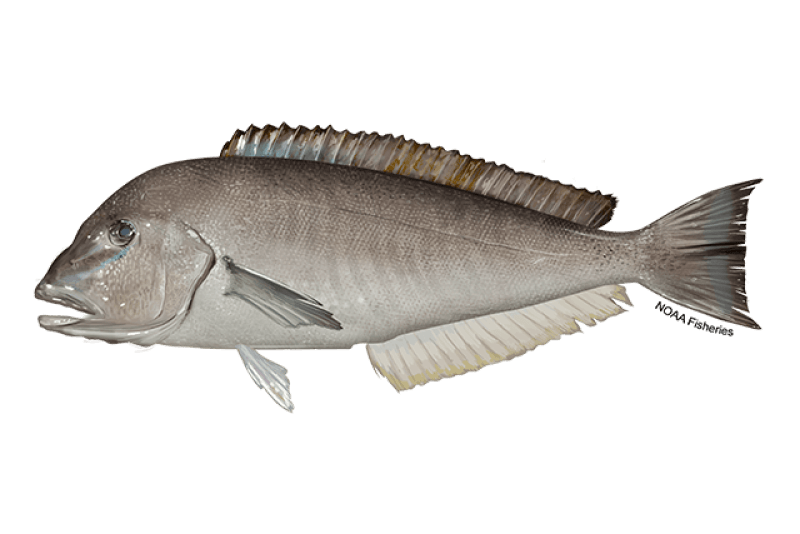
- Also known as blueline tilefish, they get this name from a narrow gold stripe underlined in blue that runs from their snout to the tip of their eye. They have a long snout and are a dull olive-gray on the top of their body and white on the bottom. They have long, continuous dorsal and anal fins that are more than half the length of their body. Unlike golden tilefish , they do not have a large adipose flap (crest) on their head. Biology Tilefish can grow to be 35 inches long and live up to 26 years. Males can grow larger than females. Female tilefish mature when they are about 3 years old. They can spawn year-round, but peak spawning is in May. Spawning primarily occurs at night. Females can lay more than 4 million free-floating eggs. Tilefish feed primarily on invertebrates that live near the sea floor, such as crabs, shrimp, snails, worms, sea urchins, and small fish. Recent genetic studies suggest that the U.S. Atlantic population of tilefish is continuous from the northeastern Gulf of America, around the Florida Keys, and up through the Mid-Atlantic region. Where They Live Range Tilefish are commonly found in the western Atlantic from Campeche, Mexico, to Hudson Canyon, off the coast of Maryland, including the eastern Gulf of America. There are reports of catches as far north as Maine and as far west as Texas. Habitat Tilefish typically live along the outer continental shelf, shelf break, and upper slope. They live on irregular bottom with ledges or crevices, and around boulders or rubble piles at depths of 98 to 774 feet where temperatures range from 59 to 73.4 ° F. They have been found to burrow head first into cone-shaped piles of sand and may also occupy existing holes and crevices. Fishery Management The Mid-Atlantic , South Atlantic , and Gulf Fishery Management Councils develop management measures for the tilefish fisheries in their respective jurisdictions. NOAA Fisheries is responsible for implementing and enforcing these measures. The Mid-Atlantic Tilefish Fishery Management Plan measures for tilefish include: Permit requirements for commercial and for-hire vessels. Annual catch limits for the commercial and recreational fisheries. Limits on commercial possession. The fishery is closed if the landing limit is harvested. Closed season and bag limit for recreational anglers. Private recreational vessels are required to have a vessel permit and report each trip they target or retain tilefish. The South Atlantic Snapper Grouper Fishery Management Plan measures for blueline tilefish include: Permit requirements. Annual catch limits. Limits on the number or pounds of blueline tilefish commercial and recreational fishermen may harvest during a fishing trip. Prohibition of longline gear in certain areas to protect snapper-grouper species and live-bottom habitat. For more information on current management, see the NOAA Fisheries Southeast Regional Office’s South Atlantic Snapper-Grouper page. The Reef Fish Resources of the Gulf of America Fishery Management Plan blueline tilefish measures include: Annual catch limits for both the commercial and recreational fisheries. An Individual Fishing Quota program for the commercial fishery. Restrictions on the seasons, areas, and depths where longlines can be used, to protect reef fish, sea turtles, and bottom habitat. For more information on current management, see the Gulf of America reef fish page. Harvest Commercial fishery: In response to the stock assessment in 2013, more restrictive regulations were implemented in the South Atlantic’s Snapper-Grouper FMP and commercial landings declined by half. In 2017, management measures were developed by the Mid-Atlantic Council. In 2024, commercial landings of blueline tilefish totaled 193,000 pounds and were valued at $703,000, according to the NOAA Fisheries commercial fishing landings database . Gear types, habitat impacts, and bycatch: Commercial fishermen mainly use longline and vertical hook-and-line gear to harvest blueline tilefish. Sea turtles, marine mammals, smalltooth sawfish, and reef fishes can be incidentally caught while fishing for blueline tilefish. Commercial reef fish fishermen in the South Atlantic and Gulf of America must use “release gear” and follow safe-handling protocols to increase the chance of survival for incidentally caught protected species, like sea turtles and smalltooth sawfish . To further reduce bycatch, the use of trawl gear, fish traps, and bottom longlines are prohibited in certain areas of the South Atlantic, and several areas are also closed to all fishing to protect snapper and grouper species. To protect reef fish, sea turtles, and bottom habitat in the Gulf of America, there are restrictions on the areas and depths where longlines can be used. In the Gulf of America and certain areas of the South Atlantic, fishermen are required to use circle hooks to reduce injury to any unintentional catch. Recreational fishery: In 2024, recreational anglers caught 268,000 pounds of blueline tilefish. Charterboat/headboat reef fish fishermen in the South Atlantic and Gulf of America must use de-hooking devices and follow safe-handling protocols to increase the chance of survival for incidentally caught protected species, like sea turtles and smalltooth sawfish . In the Mid-Atlantic, for-hire vessels are required to have a permit and report catch, and recreational anglers can keep a limited number of blueline tilefish per fishing trip. In the South Atlantic, blueline tilefish are included in the daily aggregate grouper bag limit for recreational fishermen. In the Gulf of America, there is a limit on the number of reef fish, including blueline tilefish, that recreational fishermen can keep per day.
- *Executive Order 14172, “Restoring Names That Honor American Greatness” (Jan. 20, 2025), directs that the Gulf of Mexico be renamed the Gulf of America. On August 7, 2025, NOAA Fisheries and the National Ocean Service amended regulations in the Code of Federal Regulations to reflect the renaming. The name change did not result in any changes to, and had no effect on the applicability or enforceability of, any existing regulations. This website continues to use “Gulf of Mexico” when quoting statutes or previously published materials.
- Scientific Classification Kingdom Animalia Phylum Chordata Class Actinopterygii Order Perciformes Family Malacanthidae Genus Caulolatilus Species microps Last updated by NOAA Fisheries on 07/02/2026
Where to see them around Ocean City
- Most reliable views are from head boats and private sportfish day trips when bluewater is close—watch for birds, bait, and surface activity from the rail.
- Shore viewers rarely see canyon pelagics; use the Inlet and Assateague for coastal species instead, then treat offshore sightings as trip bonuses.
- Keep a respectful distance if a vessel approaches whales, sharks, or rays—follow NOAA approach guidelines and captain instructions.
When to look
- Peak bluewater viewing usually tracks summer and early fall when warm water and bait move onto the shelf.
- Weather windows matter more than calendar weeks—canceled canyon days mean fewer offshore sightings for visitors.
- Winter and early spring sightings are possible but less predictable from a typical vacation schedule.
Viewing tips & etiquette
- Use binoculars or a long lens; do not enter the water to corner fish, rays, or sharks for photos.
- Respect beach nesting closures, stay off dunes, and keep dogs leashed where required.
- If you find a stranded or injured animal, contact official wildlife responders—do not attempt rescue yourself.
- For harvest rules, size limits, or charter planning, use the Fishing profile for Blueline Tilefish —not this Nature Guide page.
Sources
- NOAA Fisheries species profile (biology reference; angling product stays on our Fishing hub)
- OCEANCITY.MD Fishing species profile