North Atlantic Swordfish
Xiphias gladius · Also known as: Broadbilled swordfish, Broadbill, Espada, Emperado
U.S. wild-caught north Atlantic swordfish is a smart seafood choice because it is sustainably managed and responsibly harvested under U.S. regulations.
This is a Nature Guide page (viewing and ID). Catch limits, tackle, and charter fit live on the separate Fishing species profile—we keep those products apart on purpose.
Quick facts
| Group | Fish · Pelagic · Mid-Atlantic |
|---|---|
| Viewing lane | Offshore / bluewater |
| Likelihood nearby | ★★★★☆ |
| Region | New England/Mid-Atlantic, Southeast |
How to recognize them
- Atlantic swordfish are one of the fastest predators in the ocean.
- Their streamlined body allows them to swim at high speeds, up to 50 mph.
- They grow quickly and reach a maximum size of about 1,165 pounds.
- However, the average size caught in the fishery is 50 to 200 pounds.
- Females are able to reproduce between 4 and 5 years of age.
- Depending on their size, females can produce anywhere from 1 million to 29 million eggs.
- They spawn multiple times throughout the year in warm tropical and sub-tropical waters.
- In the western North Atlantic, they spawn south of the Sargasso Sea and in the upper Caribbean from December to March, and off the southeast coast of the United States from April through August.
- Swordfish feed on a variety of fish and invertebrates such as squid.
- They capture prey by slashing their bill back and forth, stunning or injuring prey in the process.
- They have developed unique characteristics, such as a special eye muscles and a heat exchange system that allows them to swim in deep, cold water in search of prey.
- Swordfish feed at the top of the food chain and are rarely preyed on by other animals.
- Sharks and larger predatory fishes may sometimes eat juvenile swordfish.
- Where They Live Range Swordfish are found around the world in tropical, temperate, and sometimes cold waters of the Atlantic, Indian, and Pacific Oceans.
- They are found in the Gulf Stream of the Western North Atlantic, extending north into the Grand Banks of Newfoundland.
- North Atlantic swordfish annually migrate thousands of miles along the eastern seaboard of the United States and Canada and also in the eastern Atlantic along Africa and Europe.
- Habitat Swordfish live in the surface to mid-water but feed throughout the water column.
- They move from spawning grounds in warm waters to feeding grounds in colder waters.
- The Gulf of America (formerly Gulf of Mexico) and Florida Straights are important nursery area for North Atlantic swordfish.
- Fishery Management NOAA Fisheries , through the Atlantic Highly Migratory Species Management Division , manage swordfish in the North Atlantic.
- Managed under the 2006 Consolidated Atlantic Highly Migratory Species Fishery Management Plan : Permits are required.
- Pelagic longline and some handgear permits are limited access permits, which means that the number of available permits restricts the number of vessels fishing for swordfish.
- There are also commercial open access permits for handgear, with the exception of buoy gear.
- Minimum size requirements and landing restrictions.
- Reporting requirements documenting catch, fishing activities, and sales.
- Required to carry at-sea fisheries observers upon request.
- Compliance guides are available for all commercial and recreational regulations across Atlantic highly migratory species fisheries.
- Highly migratory species, such as swordfish, have complicated management that requires international cooperation.
- A swordfish that is off Massachusetts one week could be caught off the coast of Canada the next.
- These resources must be managed both in the United States and at the international level.
- NOAA works with the International Commission for the Conservation of Atlantic Tunas (ICCAT) on the management of international species, like swordfish.
- NOAA sets regulations for swordfish based on U.S. science, conservation and management, and recommendations from ICCAT.
- Harvest Commercial fishery: U.S. swordfish landings consistently remain within the ICCAT-recommended quota, which contributes to maintaining a healthy stock throughout the North Atlantic Ocean.
- The majority of U.S. commercial landings come from the pelagic longline fleet, with a smaller portion of landings from handgear.
- Gear types, habitat impacts, and bycatch: Fishermen mainly use pelagic longline gear to harvest swordfish.
- They may also use rod-and-reel, harpoon, and buoy gear.
- Pelagic longline gear and handgear have no impact on habitat because they’re used in the water column and don’t come into contact with the ocean floor.
- Handgear used to catch swordfish is very selective and bycatch is minimal.
- NOAA Fisheries has taken the following additional measures to prevent bycatch and sustainably manage this fishery.
- Fishermen are: Required to use large circle hooks and certain types of bait that limit gear interactions with sea turtles.
- Circle hooks are specifically designed to minimize the damage caused by hooking, giving animals that are captured and released a better chance at survival.
- Trained and certified to use special techniques to safely de-hook and release incidentally caught turtles.
- Required to stop fishing and move 1 nautical mile if they encounter a protected species.
- Required to protect pilot whales and Risso's dolphins when fishing in the Mid-Atlantic Bight by limiting the length of their lines to 20 nautical miles and posting marine mammal handling/release guidelines on their vessels.
- In addition, if fishing in the Cape Hatteras Special Research Area, pelagic longliners must contact NOAA Fisheries at least 48 hours prior to a trip and carry observers if requested.
- Required to use weak hooks in the Gulf of America to reduce incidental catch of bluefin tuna, and are prohibited from using live bait to reduce bycatch of billfish.
- Restricted from areas in the Gulf of America to reduce bycatch of all species.
- Required to carry vessel monitoring systems onboard their boats to ensure compliance with regulations.
- Required to carry at-sea fisheries observers upon request.
- NOAA Fisheries reviews observer data to monitor protected species interactions and takes appropriate action as necessary.
- Recreational fishery: Recreational fishermen have fished for swordfish off the East Coast since the 1920s.
- Minimum size requirement and catch limits.
- Certain areas are closed to fishing during certain times of the year.
- Recreational fishermen must also report their swordfish catch by web , mobile app , or by phone 888-872-8862.
- If they release the fish, they must release it without removing it from the water in a manner that ensures it has a good chance of survival.
- Compliance guides are available for all recreational regulations across Atlantic highly migratory species fisheries.
- Scientific Classification Kingdom Animalia Phylum Chordata Class Actinopterygii Order Istiophoriformes Family Xiphiidae Genus Xiphias Species gladius Last updated by NOAA Fisheries on 07/01/2026
Biology notes
- Swordfish are found around the world in tropical, temperate, and sometimes cold waters of the Atlantic, Indian, and Pacific Oceans.
- They are found in the Gulf Stream of the Western North Atlantic, extending north into the Grand Banks of Newfoundland.
- North Atlantic swordfish annually migrate thousands of miles along the eastern seaboard of the United States and Canada and also in the eastern Atlantic along Africa and Europe.
- Habitat Swordfish live in the surface to mid-water but feed throughout the water column.
- They move from spawning grounds in warm waters to feeding grounds in colder waters.
- The Gulf of America (formerly Gulf of Mexico) and Florida Straights are important nursery area for North Atlantic swordfish.
- Fishery Management NOAA Fisheries , through the Atlantic Highly Migratory Species Management Division , manage swordfish in the North Atlantic.
- Managed under the 2006 Consolidated Atlantic Highly Migratory Species Fishery Management Plan : Permits are required.
- Pelagic longline and some handgear permits are limited access permits, which means that the number of available permits restricts the number of vessels fishing for swordfish.
- There are also commercial open access permits for handgear, with the exception of buoy gear.
- Minimum size requirements and landing restrictions.
- Reporting requirements documenting catch, fishing activities, and sales.
- Required to carry at-sea fisheries observers upon request.
- Compliance guides are available for all commercial and recreational regulations across Atlantic highly migratory species fisheries.
- Highly migratory species, such as swordfish, have complicated management that requires international cooperation.
- A swordfish that is off Massachusetts one week could be caught off the coast of Canada the next.
- These resources must be managed both in the United States and at the international level.
- NOAA works with the International Commission for the Conservation of Atlantic Tunas (ICCAT) on the management of international species, like swordfish.
- NOAA sets regulations for swordfish based on U.S. science, conservation and management, and recommendations from ICCAT.
- Harvest Commercial fishery: U.S. swordfish landings consistently remain within the ICCAT-recommended quota, which contributes to maintaining a healthy stock throughout the North Atlantic Ocean.
- The majority of U.S. commercial landings come from the pelagic longline fleet, with a smaller portion of landings from handgear.
- Gear types, habitat impacts, and bycatch: Fishermen mainly use pelagic longline gear to harvest swordfish.
- They may also use rod-and-reel, harpoon, and buoy gear.
- Pelagic longline gear and handgear have no impact on habitat because they’re used in the water column and don’t come into contact with the ocean floor.
- Handgear used to catch swordfish is very selective and bycatch is minimal.
- NOAA Fisheries has taken the following additional measures to prevent bycatch and sustainably manage this fishery.
- Fishermen are: Required to use large circle hooks and certain types of bait that limit gear interactions with sea turtles.
- Circle hooks are specifically designed to minimize the damage caused by hooking, giving animals that are captured and released a better chance at survival.
- Trained and certified to use special techniques to safely de-hook and release incidentally caught turtles.
- Required to stop fishing and move 1 nautical mile if they encounter a protected species.
- Required to protect pilot whales and Risso's dolphins when fishing in the Mid-Atlantic Bight by limiting the length of their lines to 20 nautical miles and posting marine mammal handling/release guidelines on their vessels.
- In addition, if fishing in the Cape Hatteras Special Research Area, pelagic longliners must contact NOAA Fisheries at least 48 hours prior to a trip and carry observers if requested.
- Required to use weak hooks in the Gulf of America to reduce incidental catch of bluefin tuna, and are prohibited from using live bait to reduce bycatch of billfish.
- Restricted from areas in the Gulf of America to reduce bycatch of all species.
- Required to carry vessel monitoring systems onboard their boats to ensure compliance with regulations.
- Required to carry at-sea fisheries observers upon request.
- NOAA Fisheries reviews observer data to monitor protected species interactions and takes appropriate action as necessary.
- Recreational fishery: Recreational fishermen have fished for swordfish off the East Coast since the 1920s.
- Minimum size requirement and catch limits.
- Certain areas are closed to fishing during certain times of the year.
- Recreational fishermen must also report their swordfish catch by web , mobile app , or by phone 888-872-8862.
- If they release the fish, they must release it without removing it from the water in a manner that ensures it has a good chance of survival.
- Compliance guides are available for all recreational regulations across Atlantic highly migratory species fisheries.
- Scientific Classification Kingdom Animalia Phylum Chordata Class Actinopterygii Order Istiophoriformes Family Xiphiidae Genus Xiphias Species gladius Last updated by NOAA Fisheries on 07/01/2026
Habitat & range
- NOAA Fisheries , through the Atlantic Highly Migratory Species Management Division , manage swordfish in the North Atlantic.
- Managed under the 2006 Consolidated Atlantic Highly Migratory Species Fishery Management Plan : Permits are required.
- Pelagic longline and some handgear permits are limited access permits, which means that the number of available permits restricts the number of vessels fishing for swordfish.
- There are also commercial open access permits for handgear, with the exception of buoy gear.
- Minimum size requirements and landing restrictions.
- Reporting requirements documenting catch, fishing activities, and sales.
Population status
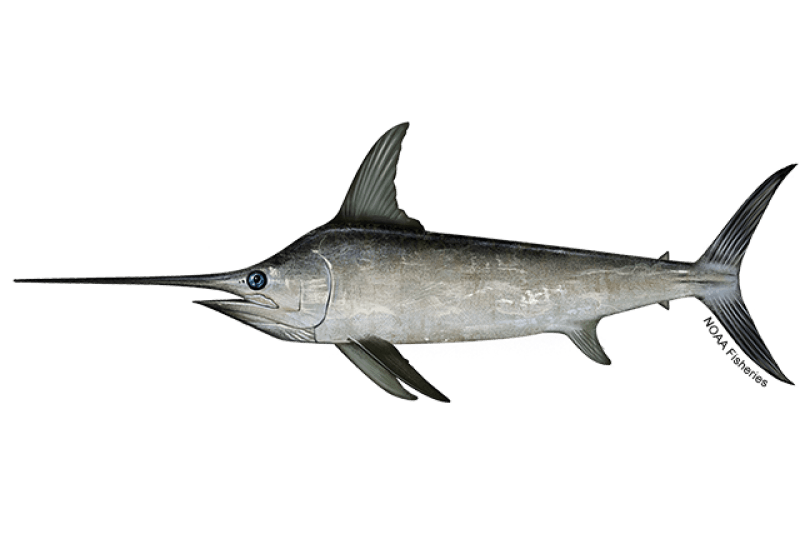
- Swordfish have a long, flattened bill that looks like a sword, as their name implies.
- They have a stout, rounded body and large eyes.
- Their first dorsal (back) fin is tall and crescent-shaped.
- Their second dorsal fin is much smaller.
- Their anal fins (on their belly) are similar in shape to the dorsal fins but are smaller.
- They have a broad, crescent-shaped tail.
Where to see them around Ocean City
- Most reliable views are from head boats and private sportfish day trips when bluewater is close—watch for birds, bait, and surface activity from the rail.
- Shore viewers rarely see canyon pelagics; use the Inlet and Assateague for coastal species instead, then treat offshore sightings as trip bonuses.
- Keep a respectful distance if a vessel approaches whales, sharks, or rays—follow NOAA approach guidelines and captain instructions.
- North Atlantic Swordfish is a bluewater animal for most visitors—treat shore sightings as rare bonuses, not the main plan.
When to look
- Peak bluewater viewing usually tracks summer and early fall when warm water and bait move onto the shelf.
- Weather windows matter more than calendar weeks—canceled canyon days mean fewer offshore sightings for visitors.
- Winter and early spring sightings are possible but less predictable from a typical vacation schedule.
Viewing tips & etiquette
- Use binoculars or a long lens; do not enter the water to corner fish, rays, or sharks for photos.
- Respect beach nesting closures, stay off dunes, and keep dogs leashed where required.
- If you find a stranded or injured animal, contact official wildlife responders—do not attempt rescue yourself.
- For harvest rules, size limits, or charter planning, use the Fishing profile for North Atlantic Swordfish —not this Nature Guide page.
Sources
- NOAA Fisheries species profile (biology reference; angling product stays on our Fishing hub)
- OCEANCITY.MD Fishing species profile