Scup
Stenotomus chrysops · Also known as: Porgy, Maiden, Fair maid, Ironsides, Northern porgy
The scup fishery in the U.S. operates from Maine to Cape Hatteras, North Carolina. Scup undergo an extensive migration between coastal waters in the summer and offshore waters (out
This is a Nature Guide page (viewing and ID). Catch limits, tackle, and charter fit live on the separate Fishing species profile—we keep those products apart on purpose.
Quick facts
| Group | Fish · Mid-Atlantic |
|---|---|
| Viewing lane | Bay / nearshore |
| Likelihood nearby | ★★★★★ |
| Region | New England/Mid-Atlantic, Southeast |
How to recognize them
- Scup grow slowly, up to about 20 inches long and 4 pounds.
- They can live a relatively long time, up to about 20 years.
- Scup are able to reproduce when they reach age 2, when they’re about 8 inches long.
- They spawn over weedy or sandy areas in southern New England from Massachusetts Bay south to the New York Bight from May through August, with peak activity in June.
- Individual scup spawn once a year.
- Most fish spawn at night, but scientists believe scup spawn in the morning.
- Females release an average of 7,000 eggs, which are fertilized externally.
- Scup are browsers—they nibble on invertebrates that live on the ocean bottom.
- They are able to grasp food with their incisors and crush hard-shelled animals with their strong molars.
- A variety of plankton-eaters—such as medusae, crustaceans, and fish—prey on scup larvae.
- A number of fish and shorebirds prey on juvenile and adult scup.
- Where They Live Range Scup are found in the Northwest Atlantic Ocean, primarily between Cape Cod, Massachusetts, and Cape Hatteras, North Carolina.
- Habitat Scup eggs and larvae are found in the water column in coastal waters during warmer months.
- As larvae mature, they settle to the seafloor and develop into juveniles.
- Juveniles live in a variety of habitats including rocky ledges, artificial reefs, mussel beds, sand, silty sand, shell, mud bottoms, and eelgrass.
- During the summer and early fall, juveniles and adults are common in large estuaries, open sandy bottoms, and structured habitats such as mussel beds, reefs, or rock rubble.
- Scup migrate north and inshore to spawn in the spring, then migrate south and offshore in autumn as the water cools, arriving by December in offshore areas where they spend the winter.
- Fishery Management NOAA Fisheries, the Mid-Atlantic Fishery Management Council , and the Atlantic States Marine Fisheries Commission cooperatively manage the scup fishery north of Cape Hatteras, North Carolina.
- Individual states may set different regulations for the commercial scup fishery.
- Where state measures differ from federal regulations, federally permitted fishery participants must adhere to the more restrictive measures.
- Managed under the Summer Flounder, Scup, and Black Sea Bass Fishery Management Plan : Annual commercial quota is divided into three harvest periods: Winter I (January–April), Summer (May–October), and Winter II (November–December).
- The Commission manages the summer quota with individual state quotas.
- NOAA Fisheries monitors commercial harvests and closes the federal scup fishery when the quotas are reached.
- Minimum size limits to prevent the harvest of young fish that likely haven’t yet reproduced.
- Minimum mesh size requirements for trawl nets to reduce bycatch of undersized scup.
- Scup pots and traps must have degradable hinges and escape vents to reduce bycatch and to prevent “ghost fishing” (when a lost trap continues to catch fish or lobster).
- A moratorium on entry into the fishery.
- Recreational anglers are subject to an annual harvest limit, minimum fish sizes, possession limits, and open harvest periods.
- NOAA Fisheries and the South Atlantic Fishery Management Council manage the black sea bass fishery south of Cape Hatteras, North Carolina.
- Managed under the South Atlantic Snapper Grouper Fishery Management Plan .
- A small amount of scup is harvested in the South Atlantic.
- Scup are managed as part of a complex with several other porgy species.
- The Snapper Grouper FMP requires fishermen to have a permit and to comply with gear restrictions.
- The complex is regulated through commercial and recreational annual catch limits and accountability measures to ensure overfishing does not occur.
- Harvest Commercial fishery: In 2024, commercial landings of scup totaled 14.4 million pounds and were valued at $10.6 million, according to the NOAA Fisheries commercial fishing landings database .
- The top five states for commercial scup landings are New York, Rhode Island, New Jersey, Connecticut, and Massachusetts.
- Gear types, habitat impacts, and bycatch: About 75 percent of commercial scup landings are caught with otter trawls.
- Otter trawls can impact bottom habitat.
- Scup are mainly harvested over sand and mud habitats, which appear to be more resilient to the effects of trawling than more structured habitats, such as gravel or coral.
- Otter trawls can incidentally catch undersized scup.
- Minimum mesh size regulations and time and area restrictions for trawl nets help to reduce incidental catch of undersized scup.
- The rest of the commercial harvest is mainly caught with floating traps and hand lines.
- Floating traps are anchored to the bottom in inshore waters in the migratory path of scup.
- Fishermen check on the traps daily to sort their catch.
- Paired trawl nets, pound nets, and pots catch a small percentage of the commercial harvest.
- Recreational fishery: In 2024, recreational anglers landed 11 million pounds of scup, according to the NOAA Fisheries commercial fishing landings database .
- The top three states for recreational scup landings are New York, Connecticut, and Rhode Island.
- In the Mid-Atlantic and southern New England, the recreational scup fishery is managed under separate regulations for federal and state waters.
- Managers set regulations for the recreational fishery annually.
- They include a combination of an annual catch quota, minimum size limits, bag limits, and fishing seasons.
- For-hire recreational vessels must have a permit to fish in federal waters.
- In the South Atlantic, there is a limit on the amount of scup recreational fishermen can keep and restrictions on the type of gear they can use.
- Last updated by NOAA Fisheries on 06/29/2026
Biology notes
- Scup are found in the Northwest Atlantic Ocean, primarily between Cape Cod, Massachusetts, and Cape Hatteras, North Carolina.
- Habitat Scup eggs and larvae are found in the water column in coastal waters during warmer months.
- As larvae mature, they settle to the seafloor and develop into juveniles.
- Juveniles live in a variety of habitats including rocky ledges, artificial reefs, mussel beds, sand, silty sand, shell, mud bottoms, and eelgrass.
- During the summer and early fall, juveniles and adults are common in large estuaries, open sandy bottoms, and structured habitats such as mussel beds, reefs, or rock rubble.
- Scup migrate north and inshore to spawn in the spring, then migrate south and offshore in autumn as the water cools, arriving by December in offshore areas where they spend the winter.
- Fishery Management NOAA Fisheries, the Mid-Atlantic Fishery Management Council , and the Atlantic States Marine Fisheries Commission cooperatively manage the scup fishery north of Cape Hatteras, North Carolina.
- Individual states may set different regulations for the commercial scup fishery.
- Where state measures differ from federal regulations, federally permitted fishery participants must adhere to the more restrictive measures.
- Managed under the Summer Flounder, Scup, and Black Sea Bass Fishery Management Plan : Annual commercial quota is divided into three harvest periods: Winter I (January–April), Summer (May–October), and Winter II (November–December).
- The Commission manages the summer quota with individual state quotas.
- NOAA Fisheries monitors commercial harvests and closes the federal scup fishery when the quotas are reached.
- Minimum size limits to prevent the harvest of young fish that likely haven’t yet reproduced.
- Minimum mesh size requirements for trawl nets to reduce bycatch of undersized scup.
- Scup pots and traps must have degradable hinges and escape vents to reduce bycatch and to prevent “ghost fishing” (when a lost trap continues to catch fish or lobster).
- A moratorium on entry into the fishery.
- Recreational anglers are subject to an annual harvest limit, minimum fish sizes, possession limits, and open harvest periods.
- NOAA Fisheries and the South Atlantic Fishery Management Council manage the black sea bass fishery south of Cape Hatteras, North Carolina.
- Managed under the South Atlantic Snapper Grouper Fishery Management Plan .
- A small amount of scup is harvested in the South Atlantic.
- Scup are managed as part of a complex with several other porgy species.
- The Snapper Grouper FMP requires fishermen to have a permit and to comply with gear restrictions.
- The complex is regulated through commercial and recreational annual catch limits and accountability measures to ensure overfishing does not occur.
- Harvest Commercial fishery: In 2024, commercial landings of scup totaled 14.4 million pounds and were valued at $10.6 million, according to the NOAA Fisheries commercial fishing landings database .
- The top five states for commercial scup landings are New York, Rhode Island, New Jersey, Connecticut, and Massachusetts.
- Gear types, habitat impacts, and bycatch: About 75 percent of commercial scup landings are caught with otter trawls.
- Otter trawls can impact bottom habitat.
- Scup are mainly harvested over sand and mud habitats, which appear to be more resilient to the effects of trawling than more structured habitats, such as gravel or coral.
- Otter trawls can incidentally catch undersized scup.
- Minimum mesh size regulations and time and area restrictions for trawl nets help to reduce incidental catch of undersized scup.
- The rest of the commercial harvest is mainly caught with floating traps and hand lines.
- Floating traps are anchored to the bottom in inshore waters in the migratory path of scup.
- Fishermen check on the traps daily to sort their catch.
- Paired trawl nets, pound nets, and pots catch a small percentage of the commercial harvest.
- Recreational fishery: In 2024, recreational anglers landed 11 million pounds of scup, according to the NOAA Fisheries commercial fishing landings database .
- The top three states for recreational scup landings are New York, Connecticut, and Rhode Island.
- In the Mid-Atlantic and southern New England, the recreational scup fishery is managed under separate regulations for federal and state waters.
- Managers set regulations for the recreational fishery annually.
- They include a combination of an annual catch quota, minimum size limits, bag limits, and fishing seasons.
- For-hire recreational vessels must have a permit to fish in federal waters.
- In the South Atlantic, there is a limit on the amount of scup recreational fishermen can keep and restrictions on the type of gear they can use.
- Last updated by NOAA Fisheries on 06/29/2026
Habitat & range
- NOAA Fisheries, the Mid-Atlantic Fishery Management Council , and the Atlantic States Marine Fisheries Commission cooperatively manage the scup fishery north of Cape Hatteras, North Carolina.
- Individual states may set different regulations for the commercial scup fishery.
- Where state measures differ from federal regulations, federally permitted fishery participants must adhere to the more restrictive measures.
- Managed under the Summer Flounder, Scup, and Black Sea Bass Fishery Management Plan : Annual commercial quota is divided into three harvest periods: Winter I (January–April), Summer (May–October), and Winter II (November–December).
- The Commission manages the summer quota with individual state quotas.
- NOAA Fisheries monitors commercial harvests and closes the federal scup fishery when the quotas are reached.
Population status
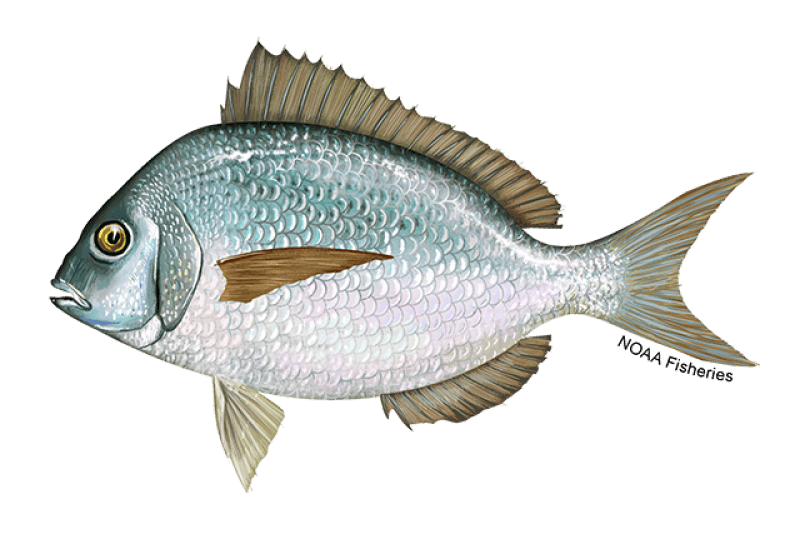
- Scup are deep-bodied (deeper from back to belly than they are wide).
- They are dusky brown with bright silvery reflections below and spiny fins.
- Adult fins are mottled with dark brown, and young scup fins may be faintly barred.
- Scup’s front teeth are very narrow, almost conical, and they have two rows of molars in the upper jaw.
- Longspine porgy look similar to scup, but can be easily identified by the elongated spines on their backs.
- Biology Scup grow slowly, up to about 20 inches long and 4 pounds.
Where to see them around Ocean City
- Scan Assateague and Ocean City beaches, the Inlet jetties, and quiet bay overlooks for surface flashes, bait boils, and clear-water shape.
- Boardwalk and pier rails help with binoculars when the surf is busy—stay clear of anglers’ casting lanes and nesting closures.
- Kayak or skiff edges of salt marsh and spoil islands can reveal schools in shallow water; give wildlife wide berth and never chase.
When to look
- Warm months (late spring through early fall) bring the most shore-visible activity in the coastal bays and surf.
- Shoulder seasons can still be excellent after calm nights and clear water—cold snaps quiet the shallows.
- Tide changes near the Inlet often concentrate bait; check the tide table before you plan a viewing walk.
Viewing tips & etiquette
- Use binoculars or a long lens; do not enter the water to corner fish, rays, or sharks for photos.
- Respect beach nesting closures, stay off dunes, and keep dogs leashed where required.
- If you find a stranded or injured animal, contact official wildlife responders—do not attempt rescue yourself.
- For harvest rules, size limits, or charter planning, use the Fishing profile for Scup —not this Nature Guide page.
Sources
- NOAA Fisheries species profile (biology reference; angling product stays on our Fishing hub)
- OCEANCITY.MD Fishing species profile