Summer Flounder
Paralichthys dentatus · Also known as: Flounder, Fluke, Northern fluke, Hirame
The summer flounder fishery in the U.S. operates from Maine to the North Carolina/South Carolina border. Summer flounder is one of the most sought after commercial and recreational
This is a Nature Guide page (viewing and ID). Catch limits, tackle, and charter fit live on the separate Fishing species profile—we keep those products apart on purpose.
Quick facts
| Group | Fish · Mid-Atlantic |
|---|---|
| Viewing lane | Bay / nearshore |
| Likelihood nearby | ★★★★★ |
| Region | New England/Mid-Atlantic, Southeast |
How to recognize them
- Summer flounder grow fast and have a relatively short life, about 12 to 14 years.
- Males grow to more than 2 feet in length and females grow up to 3 feet.
- They are able to reproduce when they reach age 2 or 3.
- Summer flounder spawn in the fall and early winter when they migrate offshore.
- They spawn several times throughout the spawning season.
- Spawning peaks in October and November when water temperatures change and autumn plankton is most productive.
- The combination of these elements improves the chance of survival for larval summer flounder.
- Depending on their size, females have between 460,000 and more than 4 million eggs.
- They release the eggs into the water column and the eggs hatch in waters of the continental shelf.
- Newly hatched larvae move with the currents toward coastal areas, where they develop into juveniles.
- Summer flounder eat a mixed diet of fish and invertebrates throughout their life.
- Larval and post-larval flounder feed on zooplankton (tiny floating animals) and small crustaceans.
- Juveniles eat crustaceans and fish.
- Adults are opportunistic feeders, eating whatever food is convenient at the time, and feed mostly on fish and crustaceans.
- Summer flounder lay on the ocean floor concealed, partly by sand and partly by their coloration, and wait for their prey to swim by.
- When suitable prey appears, flounder ambush them.
- Larval and juvenile summer flounder are preyed upon until they grow large enough to fend for themselves.
- Predators include spiny dogfish, monkfish, cod, hakes, sea raven, longhorn sculpin, and fourspot flounder.
- Large sharks, rays, and monkfish prey on adult summer flounder.
- Where They Live Range Summer flounder are found in the Atlantic Ocean from Nova Scotia to the east coast of Florida.
- In U.S. waters, summer flounder are most common in the mid-Atlantic region from Cape Cod, Massachusetts, to Cape Fear, North Carolina.
- Habitat Larval summer flounder live in estuaries and coastal lagoons.
- Juveniles burrow in the sediment in marsh creeks, seagrass beds, mud flats, and open bays, notably Pamlico Sound and Chesapeake Bay.
- Because this important life stage takes place near heavily populated urban areas, maintaining good water quality is important for successful growth and survival of young summer flounder.
- Adults spend most of their lives on or near the seafloor burrowing in the sand.
- They’re also found in marsh creeks, seagrass beds, and sand flats.
- Adult summer flounder migrate inshore and offshore seasonally with changes in water temperature.
- In the winter and early spring, they’re found offshore along the outer edge of the continental shelf.
- In late spring and early summer, they move inshore into shallow coastal waters and estuaries.
- Summer flounder migrate back offshore in the fall.
- Fishery Management NOAA Fisheries, the Mid-Atlantic Fishery Management Council , and the Atlantic States Marine Fisheries Commission cooperatively manage the summer flounder fishery because significant catch of these species comes from both state waters (0–3 nautical miles offshore) and federal waters (3-200 nautical miles offshore).
- Managed under the Summer Flounder, Scup, and Black Sea Bass Fishery Management Plan : Using scientific data on the summer flounder resource and fishery, managers determine how much summer flounder can be harvested the following year.
- They allocate 60 percent of the annual catch limit to the commercial fishery and 40 percent to the recreational fishery.
- The commercial catch limit is further distributed among the states based on their share of commercial landings during the 1980s.
- Fish and mesh size limits protect juvenile fish and help to maintain the part of the population that is able to reproduce.
- A permit is required to sell and purchase summer flounder.
- Monitoring of sea turtle catch occurs in the southern portion of the fishery.
- There is a moratorium on entry into the commercial fishery.
- There are reporting requirements.
- Harvest Commercial fishery: In 2024, commercial landings of summer flounder totaled 8.9 million pounds and were valued at $28 million, according to the NOAA Fisheries Coastwide Quota Monitoring .
- Gear types, habitat impacts, and bycatch: Commercial fishermen mainly use bottom trawls to harvest summer flounder, fishing offshore in the winter and inshore in the summer.
- Bottom trawls contact the bottom and can impact bottom habitats.
- However, summer flounder are most common on sandy ocean bottoms, which are more resilient than other habitat types to the impacts of fishing gear.
- Bottom trawls can unintentionally catch sea turtles.
- Since 1992, all vessels fishing for summer flounder with bottom trawls off Virginia and North Carolina have been required to use NOAA Fisheries–approved turtle excluder devices (TEDs) in their nets.
- A TED is a sorting grid that is sewn into a trawl net to allow fish to pass through to the back of the net while preventing larger animals, such as turtles and sharks, from passing through by allowing them to escape through flaps above or below the TED.
- Management measures also require the mesh on fishing nets to be a certain size to prevent bycatch of juvenile summer flounder and other species.
- Recreational fishery: Summer flounder are one of the most popular recreational fish on the Atlantic coast.
- In 2024, recreational landings were 5.5 million pounds, according to the NOAA Fisheries recreational fishing landings database .
- Anglers fish for summer flounder from the shore, piers, and boats with hook-and-line gear.
- The recreational harvest limits for each state are based on the recreational catch in 1998.
- Regulations for the recreational fishery are typically adjusted annually.
- They include an annual harvest limit, closed seasons, a minimum size for landed fish, and possession limits.
- Recreational landings varied widely over the years until harvest limits were put in place in 1993.
- Scientific Classification Kingdom Animalia Phylum Chordata Class Actinopterygii Order Pleuronectiformes Family Paralichthyidae Genus Paralichthys Species dentatus Last updated by NOAA Fisheries on 06/25/2026
Biology notes
- Summer flounder are found in the Atlantic Ocean from Nova Scotia to the east coast of Florida.
- In U.S. waters, summer flounder are most common in the mid-Atlantic region from Cape Cod, Massachusetts, to Cape Fear, North Carolina.
- Habitat Larval summer flounder live in estuaries and coastal lagoons.
- Juveniles burrow in the sediment in marsh creeks, seagrass beds, mud flats, and open bays, notably Pamlico Sound and Chesapeake Bay.
- Because this important life stage takes place near heavily populated urban areas, maintaining good water quality is important for successful growth and survival of young summer flounder.
- Adults spend most of their lives on or near the seafloor burrowing in the sand.
- They’re also found in marsh creeks, seagrass beds, and sand flats.
- Adult summer flounder migrate inshore and offshore seasonally with changes in water temperature.
- In the winter and early spring, they’re found offshore along the outer edge of the continental shelf.
- In late spring and early summer, they move inshore into shallow coastal waters and estuaries.
- Summer flounder migrate back offshore in the fall.
- Fishery Management NOAA Fisheries, the Mid-Atlantic Fishery Management Council , and the Atlantic States Marine Fisheries Commission cooperatively manage the summer flounder fishery because significant catch of these species comes from both state waters (0–3 nautical miles offshore) and federal waters (3-200 nautical miles offshore).
- Managed under the Summer Flounder, Scup, and Black Sea Bass Fishery Management Plan : Using scientific data on the summer flounder resource and fishery, managers determine how much summer flounder can be harvested the following year.
- They allocate 60 percent of the annual catch limit to the commercial fishery and 40 percent to the recreational fishery.
- The commercial catch limit is further distributed among the states based on their share of commercial landings during the 1980s.
- Fish and mesh size limits protect juvenile fish and help to maintain the part of the population that is able to reproduce.
- A permit is required to sell and purchase summer flounder.
- Monitoring of sea turtle catch occurs in the southern portion of the fishery.
- There is a moratorium on entry into the commercial fishery.
- There are reporting requirements.
- Harvest Commercial fishery: In 2024, commercial landings of summer flounder totaled 8.9 million pounds and were valued at $28 million, according to the NOAA Fisheries Coastwide Quota Monitoring .
- Gear types, habitat impacts, and bycatch: Commercial fishermen mainly use bottom trawls to harvest summer flounder, fishing offshore in the winter and inshore in the summer.
- Bottom trawls contact the bottom and can impact bottom habitats.
- However, summer flounder are most common on sandy ocean bottoms, which are more resilient than other habitat types to the impacts of fishing gear.
- Bottom trawls can unintentionally catch sea turtles.
- Since 1992, all vessels fishing for summer flounder with bottom trawls off Virginia and North Carolina have been required to use NOAA Fisheries–approved turtle excluder devices (TEDs) in their nets.
- A TED is a sorting grid that is sewn into a trawl net to allow fish to pass through to the back of the net while preventing larger animals, such as turtles and sharks, from passing through by allowing them to escape through flaps above or below the TED.
- Management measures also require the mesh on fishing nets to be a certain size to prevent bycatch of juvenile summer flounder and other species.
- Recreational fishery: Summer flounder are one of the most popular recreational fish on the Atlantic coast.
- In 2024, recreational landings were 5.5 million pounds, according to the NOAA Fisheries recreational fishing landings database .
- Anglers fish for summer flounder from the shore, piers, and boats with hook-and-line gear.
- The recreational harvest limits for each state are based on the recreational catch in 1998.
- Regulations for the recreational fishery are typically adjusted annually.
- They include an annual harvest limit, closed seasons, a minimum size for landed fish, and possession limits.
- Recreational landings varied widely over the years until harvest limits were put in place in 1993.
- Scientific Classification Kingdom Animalia Phylum Chordata Class Actinopterygii Order Pleuronectiformes Family Paralichthyidae Genus Paralichthys Species dentatus Last updated by NOAA Fisheries on 06/25/2026
Habitat & range
- NOAA Fisheries, the Mid-Atlantic Fishery Management Council , and the Atlantic States Marine Fisheries Commission cooperatively manage the summer flounder fishery because significant catch of these species comes from both state waters (0–3 nautical miles offshore) and federal waters (3-200 nautical miles offshore).
- Managed under the Summer Flounder, Scup, and Black Sea Bass Fishery Management Plan : Using scientific data on the summer flounder resource and fishery, managers determine how much summer flounder can be harvested the following year.
- They allocate 60 percent of the annual catch limit to the commercial fishery and 40 percent to the recreational fishery.
- The commercial catch limit is further distributed among the states based on their share of commercial landings during the 1980s.
- Fish and mesh size limits protect juvenile fish and help to maintain the part of the population that is able to reproduce.
- A permit is required to sell and purchase summer flounder.
Population status
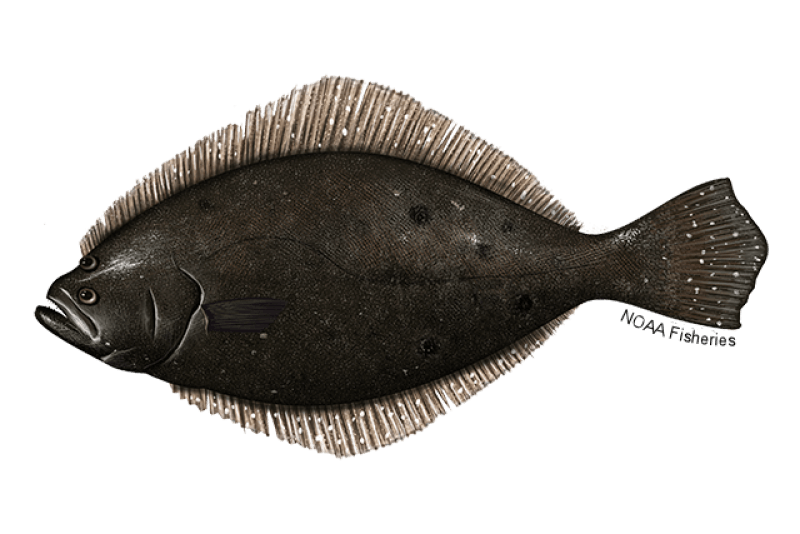
- Summer flounder have flat bodies.
- They are white below and some shade of brown, gray, or drab above.
- They’re nicknamed “chameleons of the sea” because they’re able to change their coloring to blend in with the texture and color of the bottom where they live.
- They also have spots on their back and can be distinguished because at least five of these dark spots are arranged in an "X" pattern.
- Summer flounder is a left-eyed flatfish (both eyes are on the left side of its body when viewed from above with the dorsal fin facing up).
- When larvae develop into juveniles, their right eye moves across the top of the head to the left side.
Where to see them around Ocean City
- Scan Assateague and Ocean City beaches, the Inlet jetties, and quiet bay overlooks for surface flashes, bait boils, and clear-water shape.
- Boardwalk and pier rails help with binoculars when the surf is busy—stay clear of anglers’ casting lanes and nesting closures.
- Kayak or skiff edges of salt marsh and spoil islands can reveal schools in shallow water; give wildlife wide berth and never chase.
When to look
- Warm months (late spring through early fall) bring the most shore-visible activity in the coastal bays and surf.
- Shoulder seasons can still be excellent after calm nights and clear water—cold snaps quiet the shallows.
- Tide changes near the Inlet often concentrate bait; check the tide table before you plan a viewing walk.
Viewing tips & etiquette
- Use binoculars or a long lens; do not enter the water to corner fish, rays, or sharks for photos.
- Respect beach nesting closures, stay off dunes, and keep dogs leashed where required.
- If you find a stranded or injured animal, contact official wildlife responders—do not attempt rescue yourself.
- For harvest rules, size limits, or charter planning, use the Fishing profile for Summer Flounder —not this Nature Guide page.
Sources
- NOAA Fisheries species profile (biology reference; angling product stays on our Fishing hub)
- OCEANCITY.MD Fishing species profile