Atlantic Striped Bass
Morone saxatilis · Also known as: Bass, Rockfish, Striper, Linesider
U.S. wild-caught Atlantic striped bass is a smart seafood choice because it is sustainably managed and responsibly harvested under U.S. regulations.
This is a Nature Guide page (viewing and ID). Catch limits, tackle, and charter fit live on the separate Fishing species profile—we keep those products apart on purpose.
Quick facts
| Group | Fish · Mid-Atlantic |
|---|---|
| Viewing lane | Bay & offshore |
| Likelihood nearby | ★★★★★ |
| Region | New England/Mid-Atlantic, Southeast |
How to recognize them
- Striped bass have a fairly long life, up to 30 years.
- Growth depends on where they live.
- Striped bass can grow up to 5 feet in length and 77 pounds.
- Males are sexually mature between the ages of 2 and 4 years old.
- Females are able to reproduce when they are 4 to 8 years old.
- Females produce large quantities of eggs, which are fertilized by males as they are released.
- Larval striped bass feed on zooplankton (microscopic animals).
- Juveniles eat insect larvae, small crustaceans, mayflies, and other larval fish.
- Adults are piscivorous (fish-eating) and eat almost any kind of small fish as well as several invertebrates, particularly crabs and squid.
- Bluefish, weakfish, cod, and silver hake prey on small striped bass.
- Adults have few predators, with the exception of seals and sharks.
- Where They Live Range Striped bass live along the East Coast from the St.
- Lawrence River in Canada to St.
- John’s River in Florida, and in the Gulf of America (formerly Gulf of Mexico) from Florida to Louisiana.
- They were introduced to inland lakes and reservoirs and to the West Coast, where they’re now found from Mexico to British Columbia.
- Habitat Striped bass are anadromous (they live in the ocean but return to freshwater to spawn).
- In the spring, mature striped bass migrate back to fresh or brackish water to spawn.
- Larvae drift downstream toward their nursery areas in river deltas and the inland portions of the coastal sounds and estuaries.
- Juveniles typically remain in estuaries for 2 to 4 years and then migrate out to the Atlantic Ocean.
- Some spend the majority of their adult life in rivers or coastal estuaries.
- Some spend their adult life in the ocean, migrating north and south seasonally and ascending to rivers to spawn in the spring.
- Striped bass tagged in the Chesapeake Bay have been caught in Canadian waters.
- Fishery Management The Atlantic States Marine Fisheries Commission manages the striped bass stock, which inhabits all coastal and estuarine areas from Maine through Virginia, and the coastal areas of North Carolina.
- Estuarine striped bass stocks in North Carolina are managed as non-coastal migratory stocks by the State of North Carolina under the auspices of the Commission.
- The Atlantic Striped Bass Conservation Act and the Atlantic Coastal Fisheries Cooperative Management Act direct state and federal conservation and management efforts for this population.
- Both Acts contain provisions to impose a federal moratorium on striped bass fishing in states that fail to comply with the Commission’s management plan.
- The Secretaries of Commerce and the Interior are required to provide biennial reports to Congress and the Commission on studies of the Atlantic striped bass resource.
- Managed under the Interstate Fishery Management Plan for Atlantic Striped Bass .
- Harvest limits are set at a level that will conserve the striped bass spawning stock so the resource can continue to replace harvested fish.
- Researchers have determined that the minimum age for female striped bass to reproduce is between the ages of 4 and 8 years.
- Managers set the target population levels for this species based on the size of the female spawning stock.
- In state waters, the commercial fishery is currently managed with: State-by-state catch quotas that limit the amount of fish that can be caught.
- Minimum size limits to protect younger striped bass so they can grow, mature, and reproduce.
- Seasonal fishery closures, mainly to protect spawning fish.
- Bycatch monitoring and research programs.
- In state waters, the recreational fishery is managed with: Minimum size and bag limits.
- Federal waters (between 3 and 200 miles offshore) remain closed to all commercial and recreational fishing for Atlantic striped bass.
- Harvest Commercial fishery: In 2024, commercial landings of striped bass (from state waters) totaled almost 4 million pounds and were valued at approximately $15 million, according to the NOAA Fisheries commercial fishing landings database .
- These figures may not match other agency sources of data due to confidential information.
- Gear types, habitat impacts, and bycatch: Commercial fishermen use gear types that have minimal impact on habitat—gill nets, hook-and-line, pound nets, seines, and trawls.
- Most striped bass are caught in recreational fisheries, using mainly hook-and-line gear with little or no impact on habitat.
- Gillnets can incidentally capture protected species, such as sea turtles, large whales (right, humpback, and fin whales), harbor porpoise, dolphins, and Atlantic sturgeon.
- Federal regulations are in place to prevent bycatch of protected species.
- Recreational fishery: The recreational harvest of striped bass regularly exceeds the commercial harvest.
- In 2024, recreational harvest of striped bass totaled 15 million pounds.
- Scientific Classification Kingdom Animalia Phylum Chordata Class Actinopterygii Order Perciformes Family Moronidae Genus Morone Species saxatilis Last updated by NOAA Fisheries on 06/25/2026
Biology notes
- Striped bass live along the East Coast from the St.
- Lawrence River in Canada to St.
- John’s River in Florida, and in the Gulf of America (formerly Gulf of Mexico) from Florida to Louisiana.
- They were introduced to inland lakes and reservoirs and to the West Coast, where they’re now found from Mexico to British Columbia.
- Habitat Striped bass are anadromous (they live in the ocean but return to freshwater to spawn).
- In the spring, mature striped bass migrate back to fresh or brackish water to spawn.
- Larvae drift downstream toward their nursery areas in river deltas and the inland portions of the coastal sounds and estuaries.
- Juveniles typically remain in estuaries for 2 to 4 years and then migrate out to the Atlantic Ocean.
- Some spend the majority of their adult life in rivers or coastal estuaries.
- Some spend their adult life in the ocean, migrating north and south seasonally and ascending to rivers to spawn in the spring.
- Striped bass tagged in the Chesapeake Bay have been caught in Canadian waters.
- Fishery Management The Atlantic States Marine Fisheries Commission manages the striped bass stock, which inhabits all coastal and estuarine areas from Maine through Virginia, and the coastal areas of North Carolina.
- Estuarine striped bass stocks in North Carolina are managed as non-coastal migratory stocks by the State of North Carolina under the auspices of the Commission.
- The Atlantic Striped Bass Conservation Act and the Atlantic Coastal Fisheries Cooperative Management Act direct state and federal conservation and management efforts for this population.
- Both Acts contain provisions to impose a federal moratorium on striped bass fishing in states that fail to comply with the Commission’s management plan.
- The Secretaries of Commerce and the Interior are required to provide biennial reports to Congress and the Commission on studies of the Atlantic striped bass resource.
- Managed under the Interstate Fishery Management Plan for Atlantic Striped Bass .
- Harvest limits are set at a level that will conserve the striped bass spawning stock so the resource can continue to replace harvested fish.
- Researchers have determined that the minimum age for female striped bass to reproduce is between the ages of 4 and 8 years.
- Managers set the target population levels for this species based on the size of the female spawning stock.
- In state waters, the commercial fishery is currently managed with: State-by-state catch quotas that limit the amount of fish that can be caught.
- Minimum size limits to protect younger striped bass so they can grow, mature, and reproduce.
- Seasonal fishery closures, mainly to protect spawning fish.
- Bycatch monitoring and research programs.
- In state waters, the recreational fishery is managed with: Minimum size and bag limits.
- Federal waters (between 3 and 200 miles offshore) remain closed to all commercial and recreational fishing for Atlantic striped bass.
- Harvest Commercial fishery: In 2024, commercial landings of striped bass (from state waters) totaled almost 4 million pounds and were valued at approximately $15 million, according to the NOAA Fisheries commercial fishing landings database .
- These figures may not match other agency sources of data due to confidential information.
- Gear types, habitat impacts, and bycatch: Commercial fishermen use gear types that have minimal impact on habitat—gill nets, hook-and-line, pound nets, seines, and trawls.
- Most striped bass are caught in recreational fisheries, using mainly hook-and-line gear with little or no impact on habitat.
- Gillnets can incidentally capture protected species, such as sea turtles, large whales (right, humpback, and fin whales), harbor porpoise, dolphins, and Atlantic sturgeon.
- Federal regulations are in place to prevent bycatch of protected species.
- Recreational fishery: The recreational harvest of striped bass regularly exceeds the commercial harvest.
- In 2024, recreational harvest of striped bass totaled 15 million pounds.
- Scientific Classification Kingdom Animalia Phylum Chordata Class Actinopterygii Order Perciformes Family Moronidae Genus Morone Species saxatilis Last updated by NOAA Fisheries on 06/25/2026
Habitat & range
- The Atlantic States Marine Fisheries Commission manages the striped bass stock, which inhabits all coastal and estuarine areas from Maine through Virginia, and the coastal areas of North Carolina.
- Estuarine striped bass stocks in North Carolina are managed as non-coastal migratory stocks by the State of North Carolina under the auspices of the Commission.
- The Atlantic Striped Bass Conservation Act and the Atlantic Coastal Fisheries Cooperative Management Act direct state and federal conservation and management efforts for this population.
- Both Acts contain provisions to impose a federal moratorium on striped bass fishing in states that fail to comply with the Commission’s management plan.
- The Secretaries of Commerce and the Interior are required to provide biennial reports to Congress and the Commission on studies of the Atlantic striped bass resource.
- Managed under the Interstate Fishery Management Plan for Atlantic Striped Bass .
Population status
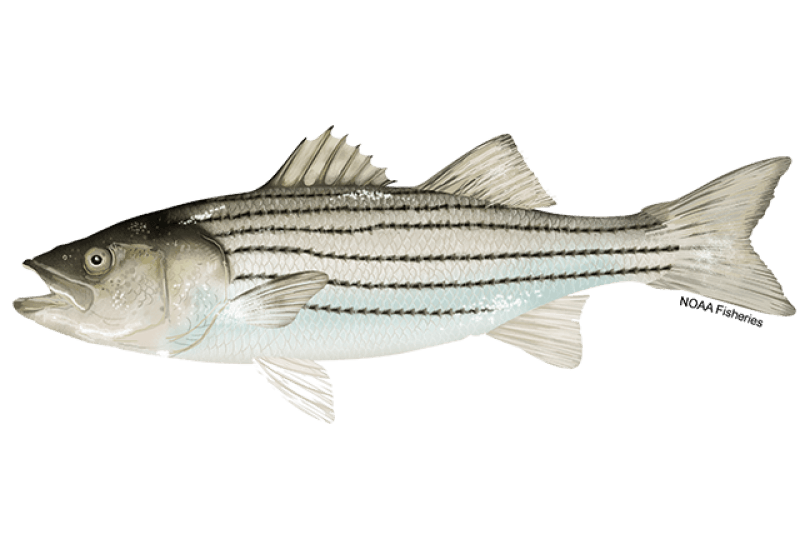
- Striped bass have stout bodies with seven to eight continuous horizontal stripes on each side, from their gills to their tail.
- They are light green, olive, steel blue, black, or brown on top, with a white or silver iridescent underside.
- Biology Striped bass have a fairly long life, up to 30 years.
- Growth depends on where they live.
- Striped bass can grow up to 5 feet in length and 77 pounds.
- Males are sexually mature between the ages of 2 and 4 years old.
Where to see them around Ocean City
- Nearshore days: Inlet, guarded beaches, and bay overlooks. Farther days: watch for the same species from charter rails when water clarity and bait line up.
- Dawn and dusk often show more surface activity; midday heat can push fish deeper even when they are still in the area.
- Pair a beach walk with a short Inlet stop—two vantage points beat one crowded pier rail.
When to look
- Expect the richest shore viewing in summer; spring and fall migrations can still light up the Inlet and beaches.
- After storms, wait for water to clear—murky days hide even common species from the beach.
- Likelihood stars on this page reflect how often Maryland visitors can reasonably hope to encounter the species nearby—not fishing success rates.
Viewing tips & etiquette
- Use binoculars or a long lens; do not enter the water to corner fish, rays, or sharks for photos.
- Respect beach nesting closures, stay off dunes, and keep dogs leashed where required.
- If you find a stranded or injured animal, contact official wildlife responders—do not attempt rescue yourself.
- For harvest rules, size limits, or charter planning, use the Fishing profile for Atlantic Striped Bass —not this Nature Guide page.
Sources
- NOAA Fisheries species profile (biology reference; angling product stays on our Fishing hub)
- OCEANCITY.MD Fishing species profile