Atlantic Blacktip Shark
Carcharhinus limbatus · Also known as: Black fin shark, Blacktip whaler, Common blacktip shark, Gray shark, Requiem shark, Small blacktip shark, Spot-fin ground shark
U.S. wild-caught Atlantic blacktip shark is a smart seafood choice because it is sustainably managed and responsibly harvested under U.S. regulations.
This is a Nature Guide page (viewing and ID). Shark fishing seasons, tackle, and regs live on the separate Fishing species profile and shark fishing guide.
Quick facts
| Group | Shark / ray · Mid-Atlantic |
|---|---|
| Viewing lane | Bay & offshore |
| Likelihood nearby | ★★★☆☆ |
| Length | Up to 6.5 feet |
| Region | New England/Mid-Atlantic, Southeast |
How to recognize them
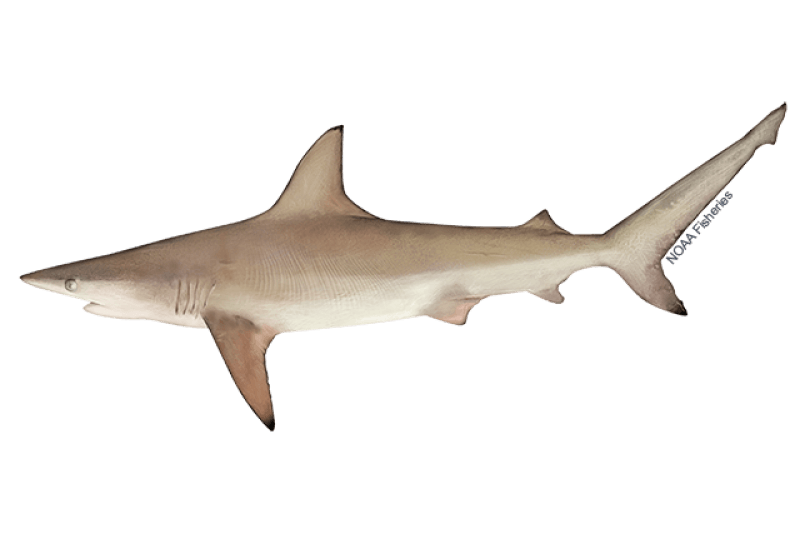
- Atlantic blacktip sharks grow quickly, and can reach up to 6 feet in length. The oldest observed blacktip shark was 15.5 years old. They often form large groups, segregated into separate schools of males and females when they are not mating. They mate between March and June. Males mature at 4 to 5 years of age, while females mature later, at 6 to 7 years of age. Females have an 11 to 12-month gestation period and give birth to an average of three pups per litter in the Atlantic and four to five pups per litter in the Gulf of America. Pups are born in shallow nursery grounds away from the adult population. After giving birth, the females leave the nursery area while juveniles remain. Blacktip sharks eat bony fishes, smaller sharks, squids, stingrays, shrimp, and crabs. They often follow fishing boats and are sometimes seen consuming discarded fish. Where They Live Range Atlantic blacktip sharks can be found year-round in the Gulf of America and are common from Virginia through Florida. They have been known to migrate as far north as Cape Cod, Massachusetts. Habitat The Atlantic blacktip shark is primarily a continental shelf species. They’re commonly found off beaches, in bays, estuaries, over coral reefs, and off river mouths. They can also be found around some oceanic islands. Fishery Management NOAA Fisheries and the Atlantic Highly Migratory Species Division manage the Atlantic blacktip shark fishery. Managed under the Consolidated Highly Migratory Species Fishery Management Plan : Permits are required, and only a limited number of permits are available. Commercial quotas and limits on how many sharks can be landed per fishing trip. Gear restrictions and requirements Fishing season is generally year-round, but individual commercial shark fisheries close when the quota is reached. Shark dealers are required to attend Atlantic shark identification workshops to help them better identify shark species. Prohibited species—there are more than 20 species of sharks that cannot be landed (e.g., white, dusky, basking, longfin mako, night). Some of these species look similar to the species that can be landed. Atlantic shark identification workshops can help with identification. The Shark Conservation Act requires that all sharks, with one exception, be brought to shore with their fins naturally attached. Compliance guides are available for all commercial and recreational regulations across Atlantic highly migratory species fisheries. Unlike some highly migratory shark species, there is no international management for Atlantic blacktip sharks at this time. Harvest Commercial fishery: To commercially harvest Atlantic sharks, vessel owners must obtain a valid Atlantic shark directed or incidental limited access permit or a smoothhound shark open access permit. More information regarding limited access permits can be found in the Atlantic HMS commercial compliance guide . Atlantic blacktip sharks belong to the large coastal shark complex. Gear types, habitat impacts, and bycatch: Bottom longlines and gillnets are used to catch Atlantic blacktip sharks. Gear used to catch blacktip sharks may catch other species, including marine mammals and turtles. Fishermen using bottom longline or gillnet gear must complete a protected species safe handling, release, and identification workshop . Certain areas are closed to shark fishing to protect nursery areas, sensitive habitats, and populations. Vessel monitoring systems ensure fishermen are complying with area closures. To reduce bycatch of fish, including Atlantic blacktip sharks, shrimp trawlers are required to use bycatch reduction devices , which are designed to retain shrimp but allow fish to exit the net. Recreational fishery: Recreational fishermen typically use rod-and-reel gear for blacktip sharks: Recreational fishermen must have an Atlantic HMS permit to harvest Atlantic blacktip sharks in federal waters. As of January 1, 2018, all HMS recreational permit holders will need a “shark endorsement” to fish for, retain, possess, or land sharks. Fishermen fishing recreationally for sharks will be required to use circle hook in most places. For more information regarding these requirements, please refer to HMS regulations and the Amendment 5b compliance guide . Blacktip sharks are a popular recreational species because they are found near shore and often jump and spin out of the water.
- *Executive Order 14172, “Restoring Names That Honor American Greatness” (Jan. 20, 2025), directs that the Gulf of Mexico be renamed the Gulf of America. On August 7, 2025, NOAA Fisheries and the National Ocean Service amended regulations in the Code of Federal Regulations to reflect the renaming. The name change did not result in any changes to, and had no effect on the applicability or enforceability of, any existing regulations. This website continues to use “Gulf of Mexico” when quoting statutes or previously published materials.
- Scientific Classification Kingdom Animalia Phylum Chordata Class Chondrichthyes Order Carcharhiniformes Family Carcharhinidae Genus Carcharhinus Species limbatus Last updated by NOAA Fisheries on 06/29/2026
Biology notes
- Atlantic blacktip sharks can be found year-round in the Gulf of America and are common from Virginia through Florida. They have been known to migrate as far north as Cape Cod, Massachusetts. Habitat The Atlantic blacktip shark is primarily a continental shelf species. They’re commonly found off beaches, in bays, estuaries, over coral reefs, and off river mouths. They can also be found around some oceanic islands. Fishery Management NOAA Fisheries and the Atlantic Highly Migratory Species Division manage the Atlantic blacktip shark fishery. Managed under the Consolidated Highly Migratory Species Fishery Management Plan : Permits are required, and only a limited number of permits are available. Commercial quotas and limits on how many sharks can be landed per fishing trip. Gear restrictions and requirements Fishing season is generally year-round, but individual commercial shark fisheries close when the quota is reached. Shark dealers are required to attend Atlantic shark identification workshops to help them better identify shark species. Prohibited species—there are more than 20 species of sharks that cannot be landed (e.g., white, dusky, basking, longfin mako, night). Some of these species look similar to the species that can be landed. Atlantic shark identification workshops can help with identification. The Shark Conservation Act requires that all sharks, with one exception, be brought to shore with their fins naturally attached. Compliance guides are available for all commercial and recreational regulations across Atlantic highly migratory species fisheries. Unlike some highly migratory shark species, there is no international management for Atlantic blacktip sharks at this time. Harvest Commercial fishery: To commercially harvest Atlantic sharks, vessel owners must obtain a valid Atlantic shark directed or incidental limited access permit or a smoothhound shark open access permit. More information regarding limited access permits can be found in the Atlantic HMS commercial compliance guide . Atlantic blacktip sharks belong to the large coastal shark complex. Gear types, habitat impacts, and bycatch: Bottom longlines and gillnets are used to catch Atlantic blacktip sharks. Gear used to catch blacktip sharks may catch other species, including marine mammals and turtles. Fishermen using bottom longline or gillnet gear must complete a protected species safe handling, release, and identification workshop . Certain areas are closed to shark fishing to protect nursery areas, sensitive habitats, and populations. Vessel monitoring systems ensure fishermen are complying with area closures. To reduce bycatch of fish, including Atlantic blacktip sharks, shrimp trawlers are required to use bycatch reduction devices , which are designed to retain shrimp but allow fish to exit the net. Recreational fishery: Recreational fishermen typically use rod-and-reel gear for blacktip sharks: Recreational fishermen must have an Atlantic HMS permit to harvest Atlantic blacktip sharks in federal waters. As of January 1, 2018, all HMS recreational permit holders will need a “shark endorsement” to fish for, retain, possess, or land sharks. Fishermen fishing recreationally for sharks will be required to use circle hook in most places. For more information regarding these requirements, please refer to HMS regulations and the Amendment 5b compliance guide . Blacktip sharks are a popular recreational species because they are found near shore and often jump and spin out of the water.
- *Executive Order 14172, “Restoring Names That Honor American Greatness” (Jan. 20, 2025), directs that the Gulf of Mexico be renamed the Gulf of America. On August 7, 2025, NOAA Fisheries and the National Ocean Service amended regulations in the Code of Federal Regulations to reflect the renaming. The name change did not result in any changes to, and had no effect on the applicability or enforceability of, any existing regulations. This website continues to use “Gulf of Mexico” when quoting statutes or previously published materials.
- Scientific Classification Kingdom Animalia Phylum Chordata Class Chondrichthyes Order Carcharhiniformes Family Carcharhinidae Genus Carcharhinus Species limbatus Last updated by NOAA Fisheries on 06/29/2026
Habitat & range
- NOAA Fisheries and the Atlantic Highly Migratory Species Division manage the Atlantic blacktip shark fishery. Managed under the Consolidated Highly Migratory Species Fishery Management Plan : Permits are required, and only a limited number of permits are available. Commercial quotas and limits on how many sharks can be landed per fishing trip. Gear restrictions and requirements Fishing season is generally year-round, but individual commercial shark fisheries close when the quota is reached. Shark dealers are required to attend Atlantic shark identification workshops to help them better identify shark species. Prohibited species—there are more than 20 species of sharks that cannot be landed (e.g., white, dusky, basking, longfin mako, night). Some of these species look similar to the species that can be landed. Atlantic shark identification workshops can help with identification. The Shark Conservation Act requires that all sharks, with one exception, be brought to shore with their fins naturally attached. Compliance guides are available for all commercial and recreational regulations across Atlantic highly migratory species fisheries. Unlike some highly migratory shark species, there is no international management for Atlantic blacktip sharks at this time. Harvest Commercial fishery: To commercially harvest Atlantic sharks, vessel owners must obtain a valid Atlantic shark directed or incidental limited access permit or a smoothhound shark open access permit. More information regarding limited access permits can be found in the Atlantic HMS commercial compliance guide . Atlantic blacktip sharks belong to the large coastal shark complex. Gear types, habitat impacts, and bycatch: Bottom longlines and gillnets are used to catch Atlantic blacktip sharks. Gear used to catch blacktip sharks may catch other species, including marine mammals and turtles. Fishermen using bottom longline or gillnet gear must complete a protected species safe handling, release, and identification workshop . Certain areas are closed to shark fishing to protect nursery areas, sensitive habitats, and populations. Vessel monitoring systems ensure fishermen are complying with area closures. To reduce bycatch of fish, including Atlantic blacktip sharks, shrimp trawlers are required to use bycatch reduction devices , which are designed to retain shrimp but allow fish to exit the net. Recreational fishery: Recreational fishermen typically use rod-and-reel gear for blacktip sharks: Recreational fishermen must have an Atlantic HMS permit to harvest Atlantic blacktip sharks in federal waters. As of January 1, 2018, all HMS recreational permit holders will need a “shark endorsement” to fish for, retain, possess, or land sharks. Fishermen fishing recreationally for sharks will be required to use circle hook in most places. For more information regarding these requirements, please refer to HMS regulations and the Amendment 5b compliance guide . Blacktip sharks are a popular recreational species because they are found near shore and often jump and spin out of the water.
- *Executive Order 14172, “Restoring Names That Honor American Greatness” (Jan. 20, 2025), directs that the Gulf of Mexico be renamed the Gulf of America. On August 7, 2025, NOAA Fisheries and the National Ocean Service amended regulations in the Code of Federal Regulations to reflect the renaming. The name change did not result in any changes to, and had no effect on the applicability or enforceability of, any existing regulations. This website continues to use “Gulf of Mexico” when quoting statutes or previously published materials.
- Scientific Classification Kingdom Animalia Phylum Chordata Class Chondrichthyes Order Carcharhiniformes Family Carcharhinidae Genus Carcharhinus Species limbatus Last updated by NOAA Fisheries on 06/29/2026
- Atlantic blacktip sharks can be found year-round in the Gulf of America and are common from Virginia through Florida. They have been known to migrate as far north as Cape Cod, Massachusetts. Habitat The Atlantic blacktip shark is primarily a continental shelf species. They’re commonly found off beaches, in bays, estuaries, over coral reefs, and off river mouths. They can also be found around some oceanic islands. Fishery Management NOAA Fisheries and the Atlantic Highly Migratory Species Division manage the Atlantic blacktip shark fishery. Managed under the Consolidated Highly Migratory Species Fishery Management Plan : Permits are required, and only a limited number of permits are available. Commercial quotas and limits on how many sharks can be landed per fishing trip. Gear restrictions and requirements Fishing season is generally year-round, but individual commercial shark fisheries close when the quota is reached. Shark dealers are required to attend Atlantic shark identification workshops to help them better identify shark species. Prohibited species—there are more than 20 species of sharks that cannot be landed (e.g., white, dusky, basking, longfin mako, night). Some of these species look similar to the species that can be landed. Atlantic shark identification workshops can help with identification. The Shark Conservation Act requires that all sharks, with one exception, be brought to shore with their fins naturally attached. Compliance guides are available for all commercial and recreational regulations across Atlantic highly migratory species fisheries. Unlike some highly migratory shark species, there is no international management for Atlantic blacktip sharks at this time. Harvest Commercial fishery: To commercially harvest Atlantic sharks, vessel owners must obtain a valid Atlantic shark directed or incidental limited access permit or a smoothhound shark open access permit. More information regarding limited access permits can be found in the Atlantic HMS commercial compliance guide . Atlantic blacktip sharks belong to the large coastal shark complex. Gear types, habitat impacts, and bycatch: Bottom longlines and gillnets are used to catch Atlantic blacktip sharks. Gear used to catch blacktip sharks may catch other species, including marine mammals and turtles. Fishermen using bottom longline or gillnet gear must complete a protected species safe handling, release, and identification workshop . Certain areas are closed to shark fishing to protect nursery areas, sensitive habitats, and populations. Vessel monitoring systems ensure fishermen are complying with area closures. To reduce bycatch of fish, including Atlantic blacktip sharks, shrimp trawlers are required to use bycatch reduction devices , which are designed to retain shrimp but allow fish to exit the net. Recreational fishery: Recreational fishermen typically use rod-and-reel gear for blacktip sharks: Recreational fishermen must have an Atlantic HMS permit to harvest Atlantic blacktip sharks in federal waters. As of January 1, 2018, all HMS recreational permit holders will need a “shark endorsement” to fish for, retain, possess, or land sharks. Fishermen fishing recreationally for sharks will be required to use circle hook in most places. For more information regarding these requirements, please refer to HMS regulations and the Amendment 5b compliance guide . Blacktip sharks are a popular recreational species because they are found near shore and often jump and spin out of the water.
- *Executive Order 14172, “Restoring Names That Honor American Greatness” (Jan. 20, 2025), directs that the Gulf of Mexico be renamed the Gulf of America. On August 7, 2025, NOAA Fisheries and the National Ocean Service amended regulations in the Code of Federal Regulations to reflect the renaming. The name change did not result in any changes to, and had no effect on the applicability or enforceability of, any existing regulations. This website continues to use “Gulf of Mexico” when quoting statutes or previously published materials.
Population status
- Atlantic blacktip sharks are gray to gray-brown, with white on the belly and a conspicuous wedge-shaped band or Z-shaped line on the sides. Their pectoral, dorsal, and tail fins have black tips, but the anal fin is white. Their bodies have a torpedo shape, which allows them to swim through the water with little effort. Atlantic blacktip sharks are often confused with spinner sharks due to their similar size, shape, coloration, and behavior. Both species are known for leaping and spinning out of the water while feeding on schools of fish. A distinguishing feature is that the anal fin on the blacktip shark is white whereas the anal fin of the spinner shark has a black tip. Biology Atlantic blacktip sharks grow quickly, and can reach up to 6 feet in length. The oldest observed blacktip shark was 15.5 years old. They often form large groups, segregated into separate schools of males and females when they are not mating. They mate between March and June. Males mature at 4 to 5 years of age, while females mature later, at 6 to 7 years of age. Females have an 11 to 12-month gestation period and give birth to an average of three pups per litter in the Atlantic and four to five pups per litter in the Gulf of America. Pups are born in shallow nursery grounds away from the adult population. After giving birth, the females leave the nursery area while juveniles remain. Blacktip sharks eat bony fishes, smaller sharks, squids, stingrays, shrimp, and crabs. They often follow fishing boats and are sometimes seen consuming discarded fish. Where They Live Range Atlantic blacktip sharks can be found year-round in the Gulf of America and are common from Virginia through Florida. They have been known to migrate as far north as Cape Cod, Massachusetts. Habitat The Atlantic blacktip shark is primarily a continental shelf species. They’re commonly found off beaches, in bays, estuaries, over coral reefs, and off river mouths. They can also be found around some oceanic islands. Fishery Management NOAA Fisheries and the Atlantic Highly Migratory Species Division manage the Atlantic blacktip shark fishery. Managed under the Consolidated Highly Migratory Species Fishery Management Plan : Permits are required, and only a limited number of permits are available. Commercial quotas and limits on how many sharks can be landed per fishing trip. Gear restrictions and requirements Fishing season is generally year-round, but individual commercial shark fisheries close when the quota is reached. Shark dealers are required to attend Atlantic shark identification workshops to help them better identify shark species. Prohibited species—there are more than 20 species of sharks that cannot be landed (e.g., white, dusky, basking, longfin mako, night). Some of these species look similar to the species that can be landed. Atlantic shark identification workshops can help with identification. The Shark Conservation Act requires that all sharks, with one exception, be brought to shore with their fins naturally attached. Compliance guides are available for all commercial and recreational regulations across Atlantic highly migratory species fisheries. Unlike some highly migratory shark species, there is no international management for Atlantic blacktip sharks at this time. Harvest Commercial fishery: To commercially harvest Atlantic sharks, vessel owners must obtain a valid Atlantic shark directed or incidental limited access permit or a smoothhound shark open access permit. More information regarding limited access permits can be found in the Atlantic HMS commercial compliance guide . Atlantic blacktip sharks belong to the large coastal shark complex. Gear types, habitat impacts, and bycatch: Bottom longlines and gillnets are used to catch Atlantic blacktip sharks. Gear used to catch blacktip sharks may catch other species, including marine mammals and turtles. Fishermen using bottom longline or gillnet gear must complete a protected species safe handling, release, and identification workshop . Certain areas are closed to shark fishing to protect nursery areas, sensitive habitats, and populations. Vessel monitoring systems ensure fishermen are complying with area closures. To reduce bycatch of fish, including Atlantic blacktip sharks, shrimp trawlers are required to use bycatch reduction devices , which are designed to retain shrimp but allow fish to exit the net. Recreational fishery: Recreational fishermen typically use rod-and-reel gear for blacktip sharks: Recreational fishermen must have an Atlantic HMS permit to harvest Atlantic blacktip sharks in federal waters. As of January 1, 2018, all HMS recreational permit holders will need a “shark endorsement” to fish for, retain, possess, or land sharks. Fishermen fishing recreationally for sharks will be required to use circle hook in most places. For more information regarding these requirements, please refer to HMS regulations and the Amendment 5b compliance guide . Blacktip sharks are a popular recreational species because they are found near shore and often jump and spin out of the water.
- *Executive Order 14172, “Restoring Names That Honor American Greatness” (Jan. 20, 2025), directs that the Gulf of Mexico be renamed the Gulf of America. On August 7, 2025, NOAA Fisheries and the National Ocean Service amended regulations in the Code of Federal Regulations to reflect the renaming. The name change did not result in any changes to, and had no effect on the applicability or enforceability of, any existing regulations. This website continues to use “Gulf of Mexico” when quoting statutes or previously published materials.
- Scientific Classification Kingdom Animalia Phylum Chordata Class Chondrichthyes Order Carcharhiniformes Family Carcharhinidae Genus Carcharhinus Species limbatus Last updated by NOAA Fisheries on 06/29/2026
Where to see them around Ocean City
- Nearshore days: Inlet, guarded beaches, and bay overlooks. Farther days: watch for the same species from charter rails when water clarity and bait line up.
- Dawn and dusk often show more surface activity; midday heat can push fish deeper even when they are still in the area.
- Pair a beach walk with a short Inlet stop—two vantage points beat one crowded pier rail.
- Atlantic Blacktip Shark sightings are usually brief—watch for a fin, wing, or dark shape rather than lingering surface shows.
When to look
- Expect the richest shore viewing in summer; spring and fall migrations can still light up the Inlet and beaches.
- After storms, wait for water to clear—murky days hide even common species from the beach.
- Likelihood stars on this page reflect how often Maryland visitors can reasonably hope to encounter the species nearby—not fishing success rates.
Viewing tips & etiquette
- Use binoculars or a long lens; do not enter the water to corner fish, rays, or sharks for photos.
- Respect beach nesting closures, stay off dunes, and keep dogs leashed where required.
- If you find a stranded or injured animal, contact official wildlife responders—do not attempt rescue yourself.
- For harvest rules or shark fishing trips, use the Fishing profile for Atlantic Blacktip Shark or the shark fishing guide.
Sources
- NOAA Fisheries species profile (biology reference)
- OCEANCITY.MD Fishing species profile