Atlantic Common Thresher Shark
Alopias vulpinus · Also known as: Thresher shark, Fox shark, Sea fox, Swingletail, Whiptail shark, Thintail shark
U.S. wild-caught Atlantic common thresher shark is a smart seafood choice because it is sustainably managed and responsibly harvested under U.S. regulations.
This is a Nature Guide page (viewing and ID). Shark fishing seasons, tackle, and regs live on the separate Fishing species profile and shark fishing guide.
Quick facts
| Group | Shark / ray · Mid-Atlantic |
|---|---|
| Viewing lane | Offshore / bluewater |
| Likelihood nearby | ★★★★☆ |
| Region | New England/Mid-Atlantic, Southeast |
How to recognize them
- Common thresher sharks live a long time (19 to 50 years), reproduce late in life, and have only a few young at a time.
- They grow slowly, but can reach up to 20 feet long.
- Males sexually mature when they’re 8 to 11 feet long and 3 to 6 years old.
- Females are able to reproduce when they’re 8 to 9 feet long and 4 to 5 years of age.
- Common thresher sharks mate in late summer.
- Eggs are fertilized internally and develop within the mother.
- Females bear live, fully developed young after a long gestation period (9 months), and only have a few pups.
- Common thresher sharks are aggressive predators that feed near the top of the food chain on schooling fish such as herring and mackerel and occasionally on squid and seabirds.
- They are named for their long, scythe-like tail, which is used to stun fish before preying on them.
- Adult common thresher sharks have few predators, but younger, smaller ones may fall prey to larger sharks.
- Where They Live Range Common thresher sharks are found in temperate waters around the world.
- In the northwest Atlantic Ocean, they range from Newfoundland to Cuba.
- Habitat Common thresher sharks are highly migratory species, often traveling over entire ocean basins.
- They’re most common near land and are often found in areas rich with plankton, where their prey is also abundant.
- Fishery Management NOAA Fisheries and the Atlantic Highly Migratory Species Division manage the Atlantic common thresher shark fishery in the United States.
- Managed under the Consolidated Atlantic Highly Migratory Species Fishery Management Plan : Permits are required, and only a limited number of permits are available.
- Commercial quotas and limits on how many sharks can be landed per fishing trip.
- Gear restrictions and requirements.
- Fishing season is generally year-round, but individual commercial shark fisheries close when the quota is reached.
- Shark dealers are required to attend Atlantic shark identification workshops to help them better identify shark species.
- Prohibited species—there are more than 20 species of sharks that cannot be landed (e.g., white, dusky, basking, longfin mako, night).
- Some of these species look similar to the species that can be landed.
- The recreational shark identification can help with identification.
- The Shark Conservation Act requires that all sharks, with one exception, be brought to shore with their fins naturally attached.
- Compliance guides are available for all commercial and recreational regulations across Atlantic highly migratory species fisheries.
- Highly migratory species, such as thresher sharks, have complicated management that requires international cooperation.
- A shark that is off the coast of Florida one week could be caught off the coast of Mexico the next.
- These resources must be managed both in the United States and at the international level.
- The United States negotiates with Regional Fisheries Management Organizations—including the International Commission for the Conservation of Atlantic Tunas , the Food and Agriculture Organization of the United Nations , and the Convention on International Trade in Endangered Species of Wild Fauna and Flora to enhance shark management worldwide.
- Harvest Commercial fishery: To commercially harvest Atlantic sharks, vessel owners must obtain a valid Atlantic shark directed or incidental limited access permit or a smoothhound shark open access permit.
- More information regarding limited access permits can be found in the Atlantic HMS fishery compliance guides .
- Most of this catch comes from New Jersey and North Carolina.
- Common thresher sharks are part of the pelagic shark complex.
- Gear types, habitat impacts, and bycatch: Atlantic common thresher sharks are primarily caught incidentally in longline fisheries targeting swordfish and tuna.
- Gear used to catch common thresher sharks does not impact habitat since it does not contact the ocean floor.
- Fishermen are required to use circle hooks on pelagic longlines to reduce bycatch of sea turtles.
- All pelagic longline fishing vessels must also carry safe handling and release gear to help in returning any unintentionally caught protected species to the sea safely.
- Fishermen using longline or gillnet gear must complete a protected species safe handling, release, and identification workshop .
- Certain areas are closed to fishing to protect nursery areas, sensitive habitats, and populations.
- Vessel monitoring systems ensure fishermen are complying with area closures.
- Recreational fishery: Recreational fishermen fish for common thresher sharks, mainly with rod-and-reel gear.
- Recreational fishermen must have an Atlantic HMS permit to harvest Atlantic common thresher sharks in federal waters.
- As of January 1, 2018, all HMS recreational permit holders will need a “shark endorsement” to fish for, retain, possess, or land sharks.
- In addition to the shark endorsement, fishermen fishing recreationally for sharks will be required to use circle hook in most places.
- Circle hooks are less likely to be caught in the thresher shark’s long tail, increasing the survival of sharks that are caught and released.
- For more information regarding these requirements, please refer to HMS regulations and the Amendment 5b compliance guide . Sharks must be a minimum size to be caught, and there is a limit on how many sharks can be caught per fishing trip.
- Scientific Classification Kingdom Animalia Phylum Chordata Class Chondrichthyes Order Lamniformes Family Alopiidae Genus Alopias Species vulpinus Last updated by NOAA Fisheries on 06/29/2026
Biology notes
- Common thresher sharks are found in temperate waters around the world.
- In the northwest Atlantic Ocean, they range from Newfoundland to Cuba.
- Habitat Common thresher sharks are highly migratory species, often traveling over entire ocean basins.
- They’re most common near land and are often found in areas rich with plankton, where their prey is also abundant.
- Fishery Management NOAA Fisheries and the Atlantic Highly Migratory Species Division manage the Atlantic common thresher shark fishery in the United States.
- Managed under the Consolidated Atlantic Highly Migratory Species Fishery Management Plan : Permits are required, and only a limited number of permits are available.
- Commercial quotas and limits on how many sharks can be landed per fishing trip.
- Gear restrictions and requirements.
- Fishing season is generally year-round, but individual commercial shark fisheries close when the quota is reached.
- Shark dealers are required to attend Atlantic shark identification workshops to help them better identify shark species.
- Prohibited species—there are more than 20 species of sharks that cannot be landed (e.g., white, dusky, basking, longfin mako, night).
- Some of these species look similar to the species that can be landed.
- The recreational shark identification can help with identification.
- The Shark Conservation Act requires that all sharks, with one exception, be brought to shore with their fins naturally attached.
- Compliance guides are available for all commercial and recreational regulations across Atlantic highly migratory species fisheries.
- Highly migratory species, such as thresher sharks, have complicated management that requires international cooperation.
- A shark that is off the coast of Florida one week could be caught off the coast of Mexico the next.
- These resources must be managed both in the United States and at the international level.
- The United States negotiates with Regional Fisheries Management Organizations—including the International Commission for the Conservation of Atlantic Tunas , the Food and Agriculture Organization of the United Nations , and the Convention on International Trade in Endangered Species of Wild Fauna and Flora to enhance shark management worldwide.
- Harvest Commercial fishery: To commercially harvest Atlantic sharks, vessel owners must obtain a valid Atlantic shark directed or incidental limited access permit or a smoothhound shark open access permit.
- More information regarding limited access permits can be found in the Atlantic HMS fishery compliance guides .
- Most of this catch comes from New Jersey and North Carolina.
- Common thresher sharks are part of the pelagic shark complex.
- Gear types, habitat impacts, and bycatch: Atlantic common thresher sharks are primarily caught incidentally in longline fisheries targeting swordfish and tuna.
- Gear used to catch common thresher sharks does not impact habitat since it does not contact the ocean floor.
- Fishermen are required to use circle hooks on pelagic longlines to reduce bycatch of sea turtles.
- All pelagic longline fishing vessels must also carry safe handling and release gear to help in returning any unintentionally caught protected species to the sea safely.
- Fishermen using longline or gillnet gear must complete a protected species safe handling, release, and identification workshop .
- Certain areas are closed to fishing to protect nursery areas, sensitive habitats, and populations.
- Vessel monitoring systems ensure fishermen are complying with area closures.
- Recreational fishery: Recreational fishermen fish for common thresher sharks, mainly with rod-and-reel gear.
- Recreational fishermen must have an Atlantic HMS permit to harvest Atlantic common thresher sharks in federal waters.
- As of January 1, 2018, all HMS recreational permit holders will need a “shark endorsement” to fish for, retain, possess, or land sharks.
- In addition to the shark endorsement, fishermen fishing recreationally for sharks will be required to use circle hook in most places.
- Circle hooks are less likely to be caught in the thresher shark’s long tail, increasing the survival of sharks that are caught and released.
- For more information regarding these requirements, please refer to HMS regulations and the Amendment 5b compliance guide . Sharks must be a minimum size to be caught, and there is a limit on how many sharks can be caught per fishing trip.
- Scientific Classification Kingdom Animalia Phylum Chordata Class Chondrichthyes Order Lamniformes Family Alopiidae Genus Alopias Species vulpinus Last updated by NOAA Fisheries on 06/29/2026
Habitat & range
- NOAA Fisheries and the Atlantic Highly Migratory Species Division manage the Atlantic common thresher shark fishery in the United States.
- Managed under the Consolidated Atlantic Highly Migratory Species Fishery Management Plan : Permits are required, and only a limited number of permits are available.
- Commercial quotas and limits on how many sharks can be landed per fishing trip.
- Gear restrictions and requirements.
- Fishing season is generally year-round, but individual commercial shark fisheries close when the quota is reached.
- Shark dealers are required to attend Atlantic shark identification workshops to help them better identify shark species.
Population status
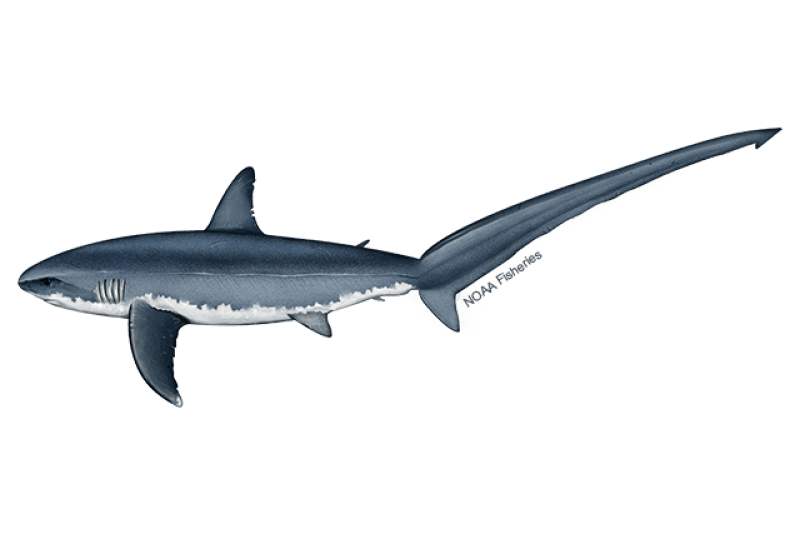
- Thresher sharks are brown, gray, blue-gray, or blackish on the back and underside of their snout.
- They are lighter on the sides, and fully white below.
- Their pectoral, pelvic, and dorsal fins are blackish, and there are sometimes white dots on the tips of the pectoral, pelvic, and tail fins.
- Their tail fin is sickle-shaped, and the upper part is extremely long, about half the length of their body.
- Biology Common thresher sharks live a long time (19 to 50 years), reproduce late in life, and have only a few young at a time.
- They grow slowly, but can reach up to 20 feet long.
Where to see them around Ocean City
- Most reliable views are from head boats and private sportfish day trips when bluewater is close—watch for birds, bait, and surface activity from the rail.
- Shore viewers rarely see canyon pelagics; use the Inlet and Assateague for coastal species instead, then treat offshore sightings as trip bonuses.
- Keep a respectful distance if a vessel approaches whales, sharks, or rays—follow NOAA approach guidelines and captain instructions.
- Atlantic Common Thresher Shark sightings are usually brief—watch for a fin, wing, or dark shape rather than lingering surface shows.
When to look
- Peak bluewater viewing usually tracks summer and early fall when warm water and bait move onto the shelf.
- Weather windows matter more than calendar weeks—canceled canyon days mean fewer offshore sightings for visitors.
- Winter and early spring sightings are possible but less predictable from a typical vacation schedule.
Viewing tips & etiquette
- Use binoculars or a long lens; do not enter the water to corner fish, rays, or sharks for photos.
- Respect beach nesting closures, stay off dunes, and keep dogs leashed where required.
- If you find a stranded or injured animal, contact official wildlife responders—do not attempt rescue yourself.
- For harvest rules or shark fishing trips, use the Fishing profile for Atlantic Common Thresher Shark or the shark fishing guide.
Sources
- NOAA Fisheries species profile (biology reference)
- OCEANCITY.MD Fishing species profile