Giant Manta Ray
Mobula birostris
The giant manta ray is the world’s largest ray with a wingspan of up to 26 feet. They are filter feeders and eat large quantities of zooplankton. Giant manta rays are slow-growing,
This is a Nature Guide page (viewing and ID). Shark fishing seasons, tackle, and regs live on the separate Fishing species profile and shark fishing guide.
Quick facts
| Group | Protected species · Mid-Atlantic |
|---|---|
| Viewing lane | Offshore / bluewater |
| Likelihood nearby | ★★★☆☆ |
| Length | Disc width up to 26 feet |
| Lifespan | Up to 45 years |
| Region | New England/Mid-Atlantic, Pacific Islands, Southeast, West Coast |
How to recognize them
- The giant manta ray is a migratory species and seasonal visitor along productive coastlines with regular upwelling, in oceanic island groups, and near offshore pinnacles and seamounts. The timing of these visits varies by region and seems to correspond with the movement of zooplankton, current circulation and tidal patterns, seasonal upwelling, seawater temperature, and possibly mating behavior.
- Although the giant manta ray tends to be solitary, they aggregate at cleaning sites and to feed and mate. Manta rays primarily feed on planktonic organisms such as euphausiids, copepods, mysids, decapod larvae, and shrimp, but some studies have noted their consumption of small and moderately sized fish as well. When feeding, mantas hold their cephalic fins in an “O” shape and open their mouths wide, creating a funnel that pushes water and prey through their mouth and over their gill plates. Manta rays use many different types of feeding strategies, such as barrel rolling (doing somersaults over and over again) and creating feeding chains with other mantas to maximize prey intake.
- Giant manta rays also appear to exhibit a high degree of plasticity or variation in terms of their use of depths within their habitat. During feeding, giant manta rays may be found aggregating in shallow waters at depths less than 10 meters. However, tagging studies have also shown that the species conducts dives of up to 200 to 450 meters and is capable of diving to depths exceeding 1,000 meters. This diving behavior may be influenced by season and shifts in prey location associated with the thermocline.
- Where They Live The giant manta ray is found worldwide in tropical, subtropical, and temperate bodies of water and is commonly found offshore, in oceanic waters, and in productive coastal areas. The species has also been observed in estuarine waters, oceanic inlets, and within bays and intercoastal waterways. As such, giant manta rays can be found in cool water, as low as 19°C, although temperature preference appears to vary by region. For example, off the U.S. East Coast, giant manta rays are commonly found in waters from 19 to 22°C, whereas those off the Yucatan peninsula and Indonesia are commonly found in waters between 25 to 30°C.
- World map providing approximate representation of the giant manta ray's range Lifespan & Reproduction Manta rays have among the lowest fecundity of all elasmobranchs (a subclass of cartilaginous fish), typically giving birth to only one pup every two to three years. Gestation is thought to last around a year. Although manta rays have been reported to live at least 45 years, not much is known about their growth and development.
- Threats Overfishing and Bycatch The most significant threat to the giant manta ray is overutilization for commercial purposes. Giant manta rays are both targeted and caught as bycatch in a number of global fisheries throughout their range, and are most susceptible to artisanal/small-scale fisheries and commercial fisheries, particularly purse seines, gill nets, longlines, and trawls.
- Efforts to address overutilization of the species through current regulatory measures are inadequate, as targeted fishing and illegal retainment of the species still occurs despite prohibitions in a significant portion of the species’ range. Also, measures to address and minimize bycatch of the species in commercial fisheries are rare.
- Harvest for International Trade Demand for the gill plates of manta and other mobula rays has risen dramatically in Asian markets. With this expansion of the international gill plate market and increasing demand for manta ray products, estimated harvest of giant manta rays, particularly in many portions of the Indo-Pacific and Eastern Pacific, has led to massive declines in manta ray populations and fishery collapse.
- Other potential threats that should be monitored include entanglement, vessel strikes, marine debris/pollution, climate change , recreational fishing interactions, tourism, and the aquarium trade.
Biology notes
- The giant manta ray is found worldwide in tropical, subtropical, and temperate bodies of water and is commonly found offshore, in oceanic waters, and in productive coastal areas. The species has also been observed in estuarine waters, oceanic inlets, and within bays and intercoastal waterways. As such, giant manta rays can be found in cool water, as low as 19°C, although temperature preference appears to vary by region. For example, off the U.S. East Coast, giant manta rays are commonly found in waters from 19 to 22°C, whereas those off the Yucatan peninsula and Indonesia are commonly found in waters between 25 to 30°C.
- World map providing approximate representation of the giant manta ray's range Lifespan & Reproduction Manta rays have among the lowest fecundity of all elasmobranchs (a subclass of cartilaginous fish), typically giving birth to only one pup every two to three years. Gestation is thought to last around a year. Although manta rays have been reported to live at least 45 years, not much is known about their growth and development.
- Threats Overfishing and Bycatch The most significant threat to the giant manta ray is overutilization for commercial purposes. Giant manta rays are both targeted and caught as bycatch in a number of global fisheries throughout their range, and are most susceptible to artisanal/small-scale fisheries and commercial fisheries, particularly purse seines, gill nets, longlines, and trawls.
- Efforts to address overutilization of the species through current regulatory measures are inadequate, as targeted fishing and illegal retainment of the species still occurs despite prohibitions in a significant portion of the species’ range. Also, measures to address and minimize bycatch of the species in commercial fisheries are rare.
- Harvest for International Trade Demand for the gill plates of manta and other mobula rays has risen dramatically in Asian markets. With this expansion of the international gill plate market and increasing demand for manta ray products, estimated harvest of giant manta rays, particularly in many portions of the Indo-Pacific and Eastern Pacific, has led to massive declines in manta ray populations and fishery collapse.
- Other potential threats that should be monitored include entanglement, vessel strikes, marine debris/pollution, climate change , recreational fishing interactions, tourism, and the aquarium trade.
Habitat & range
- See the NOAA species profile for habitat detail for this entry.
- The giant manta ray is found worldwide in tropical, subtropical, and temperate bodies of water and is commonly found offshore, in oceanic waters, and in productive coastal areas. The species has also been observed in estuarine waters, oceanic inlets, and within bays and intercoastal waterways. As such, giant manta rays can be found in cool water, as low as 19°C, although temperature preference appears to vary by region. For example, off the U.S. East Coast, giant manta rays are commonly found in waters from 19 to 22°C, whereas those off the Yucatan peninsula and Indonesia are commonly found in waters between 25 to 30°C.
- World map providing approximate representation of the giant manta ray's range Lifespan & Reproduction Manta rays have among the lowest fecundity of all elasmobranchs (a subclass of cartilaginous fish), typically giving birth to only one pup every two to three years. Gestation is thought to last around a year. Although manta rays have been reported to live at least 45 years, not much is known about their growth and development.
Population status
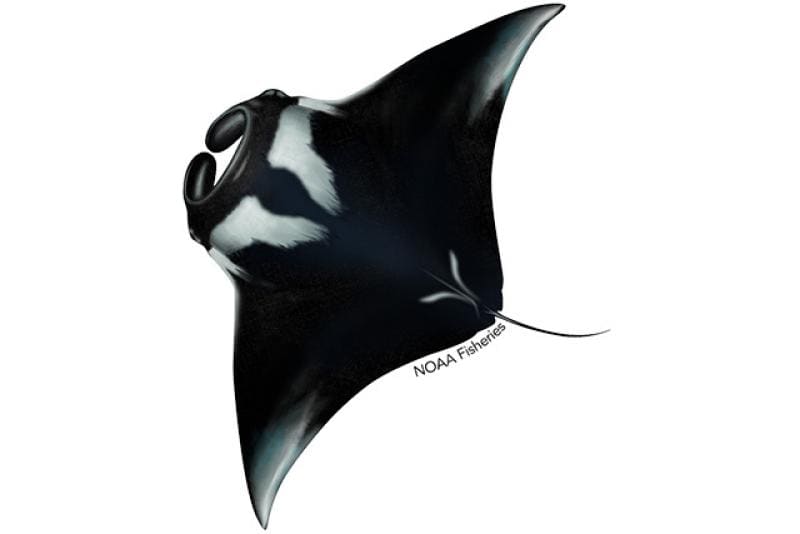
- Manta rays are recognized by their large diamond-shaped body with elongated wing-like pectoral fins, ventrally-placed gill slits, laterally-placed eyes, and wide, terminal mouths. In front of the mouth, they have two structures called cephalic lobes which extend and help to channel water into the mouth for feeding activities (making them the only vertebrate animals with three paired appendages).
- Manta rays come in two distinct color types: chevron (mostly black back and white belly) and black (almost completely black on both sides). They also have distinct spot patterns on their bellies that can be used to identify individuals. There are two species of manta rays: giant manta rays ( Mobula birostris ) and reef manta rays ( Mobula alfredi ). Giant manta rays are generally larger than reef manta rays, have a caudal thorn, and rough skin appearance. They can also be distinguished from reef manta rays by their coloration.
- Behavior and Diet The giant manta ray is a migratory species and seasonal visitor along productive coastlines with regular upwelling, in oceanic island groups, and near offshore pinnacles and seamounts. The timing of these visits varies by region and seems to correspond with the movement of zooplankton, current circulation and tidal patterns, seasonal upwelling, seawater temperature, and possibly mating behavior.
- Although the giant manta ray tends to be solitary, they aggregate at cleaning sites and to feed and mate. Manta rays primarily feed on planktonic organisms such as euphausiids, copepods, mysids, decapod larvae, and shrimp, but some studies have noted their consumption of small and moderately sized fish as well. When feeding, mantas hold their cephalic fins in an “O” shape and open their mouths wide, creating a funnel that pushes water and prey through their mouth and over their gill plates. Manta rays use many different types of feeding strategies, such as barrel rolling (doing somersaults over and over again) and creating feeding chains with other mantas to maximize prey intake.
- Giant manta rays also appear to exhibit a high degree of plasticity or variation in terms of their use of depths within their habitat. During feeding, giant manta rays may be found aggregating in shallow waters at depths less than 10 meters. However, tagging studies have also shown that the species conducts dives of up to 200 to 450 meters and is capable of diving to depths exceeding 1,000 meters. This diving behavior may be influenced by season and shifts in prey location associated with the thermocline.
- Where They Live The giant manta ray is found worldwide in tropical, subtropical, and temperate bodies of water and is commonly found offshore, in oceanic waters, and in productive coastal areas. The species has also been observed in estuarine waters, oceanic inlets, and within bays and intercoastal waterways. As such, giant manta rays can be found in cool water, as low as 19°C, although temperature preference appears to vary by region. For example, off the U.S. East Coast, giant manta rays are commonly found in waters from 19 to 22°C, whereas those off the Yucatan peninsula and Indonesia are commonly found in waters between 25 to 30°C.
Where to see them around Ocean City
- Most reliable views are from head boats and private sportfish day trips when bluewater is close—watch for birds, bait, and surface activity from the rail.
- Shore viewers rarely see canyon pelagics; use the Inlet and Assateague for coastal species instead, then treat offshore sightings as trip bonuses.
- Keep a respectful distance if a vessel approaches whales, sharks, or rays—follow NOAA approach guidelines and captain instructions.
When to look
- Peak bluewater viewing usually tracks summer and early fall when warm water and bait move onto the shelf.
- Weather windows matter more than calendar weeks—canceled canyon days mean fewer offshore sightings for visitors.
- Winter and early spring sightings are possible but less predictable from a typical vacation schedule.
Viewing tips & etiquette
- Use binoculars or a long lens; do not enter the water to corner fish, rays, or sharks for photos.
- Respect beach nesting closures, stay off dunes, and keep dogs leashed where required.
- If you find a stranded or injured animal, contact official wildlife responders—do not attempt rescue yourself.
- For harvest rules or shark fishing trips, use the Fishing profile for Giant Manta Ray or the shark fishing guide.
Sources
- NOAA Fisheries species profile (biology reference)
- OCEANCITY.MD Fishing species profile