Winter Skate
Leucoraja ocellata · Also known as: Skate, Big skate, Spotted skate, Eyed skate
Winter skate is managed as a part of the Northeast Skate Complex along with six other skate species in the same fishery management plan. Of these species, winter skates are the pri
This is a Nature Guide page (viewing and ID). Shark fishing seasons, tackle, and regs live on the separate Fishing species profile and shark fishing guide.
Quick facts
| Group | Shark / ray · Mid-Atlantic |
|---|---|
| Viewing lane | Bay & offshore |
| Likelihood nearby | ★★★★☆ |
| Region | New England/Mid-Atlantic, Southeast |
How to recognize them
- Winter skates have large bodies and can grow up to 5 feet in length.
- They can live for about 20 years.
- They reproduce at a late age, when they’re approximately 11 years old and 2.5 feet long.
- Skates lay eggs year-round but have few offspring.
- Their eggs are enclosed in a hard leathery case called a “mermaid’s purse.” The eggs incubate for 6 to 12 months, and young skates have the adult form when they hatch.
- Skates feed on a variety of organisms such as crustaceans, mollusks, worms, squids, and fish.
- Where They Live Range Winter skates range from the Gulf of Saint Lawrence in Canada to Cape Hatteras, North Carolina.
- Habitat Winter skate live on sand and gravel bottoms in the northwest Atlantic, most commonly in southern New England and on Georges Bank.
- They are occasionally found in the Gulf of Maine, on the Scotian Shelf, in the Gulf of Saint Lawrence, and in the Mid-Atlantic.
- Skates are not known to migrate far, but they do move with the seasons as water temperature changes.
- They are generally offshore during the summer and early autumn and inshore during winter and spring.
- Fishery Management NOAA Fisheries and the New England Fishery Management Council manage the winter skate fishery.
- Managed under the Northeast Skate Complex Fishery Management Plan : Valid open access permit is required to catch, possess, transport, or sell skate.
- Annual catch limits for winter, little, clearnose, and rosette skates, as well as response measures if the catch limits are exceeded.
- Winter skates are the only species targeted for human consumption.
- Little skate is used as bait for lobster fisheries and clearnose and rosette skates are usually discarded.
- Fishermen are prohibited from retaining smooth (Gulf of Maine only), barndoor, and thorny skates.
- Fishermen and dealers must report their catch by species.
- Management measures in other fisheries also indirectly aid in the recovery of the overfished skate species and conserve the resource.
- Harvest Commercial fishery: In 2024, commercial landings totaled 17 million pounds and were valued at $6 million, according to the NOAA Fisheries commercial fishing landings database .
- More than half of skate landings come from Massachusetts and Rhode Island.
- Skates are harvested in two different fisheries, one for wings for human consumption and one for lobster bait.
- In the bait fishery, vessels from southern New England target mostly little skates (more than 90 percent) and, to a much lesser extent, juvenile winter skates (less than 10 percent).
- Juvenile winter skates are difficult to differentiate from little skates because they look nearly identical.
- The wing fishery is labor-intensive because the wings need to be cut into fillets, but participation has grown recently due to increasing restrictions on other, more profitable groundfish species.
- In the wing fishery, mainly trawlers and gillnetters harvest winter skates when targeting other species such as groundfish, monkfish, and scallops.
- Fishermen keep the skates if the price is profitable.
- Gear types, habitat impacts, and bycatch: Most skates are caught incidentally in otter trawl fisheries targeting other more valuable species, such as groundfish, monkfish, and scallops.
- Otter trawls can impact habitat depending on where they are used.
- They can also interact with marine mammals (e.g., whales, harbor porpoises, and seals) and sea turtles.
- Management measures including closed areas, restrictions on gear and fishing effort, and modifying fishing gear to reduce contact with habitat help reduce these impacts and interactions.
- Skates are also caught in bottom gillnet fisheries, which have less of an impact on habitat.
- Skates are caught and discarded as bycatch in numerous fisheries, but the rate of discards has decreased in recent years as the value of skate products has increased.
- Scientific Classification Kingdom Animalia Phylum Chordata Class Chondrichthyes Order Rajiformes Family Rajidae Genus Leucoraja Species ocellata Last updated by NOAA Fisheries on 06/30/2026
Biology notes
- Winter skates range from the Gulf of Saint Lawrence in Canada to Cape Hatteras, North Carolina.
- Habitat Winter skate live on sand and gravel bottoms in the northwest Atlantic, most commonly in southern New England and on Georges Bank.
- They are occasionally found in the Gulf of Maine, on the Scotian Shelf, in the Gulf of Saint Lawrence, and in the Mid-Atlantic.
- Skates are not known to migrate far, but they do move with the seasons as water temperature changes.
- They are generally offshore during the summer and early autumn and inshore during winter and spring.
- Fishery Management NOAA Fisheries and the New England Fishery Management Council manage the winter skate fishery.
- Managed under the Northeast Skate Complex Fishery Management Plan : Valid open access permit is required to catch, possess, transport, or sell skate.
- Annual catch limits for winter, little, clearnose, and rosette skates, as well as response measures if the catch limits are exceeded.
- Winter skates are the only species targeted for human consumption.
- Little skate is used as bait for lobster fisheries and clearnose and rosette skates are usually discarded.
- Fishermen are prohibited from retaining smooth (Gulf of Maine only), barndoor, and thorny skates.
- Fishermen and dealers must report their catch by species.
- Management measures in other fisheries also indirectly aid in the recovery of the overfished skate species and conserve the resource.
- Harvest Commercial fishery: In 2024, commercial landings totaled 17 million pounds and were valued at $6 million, according to the NOAA Fisheries commercial fishing landings database .
- More than half of skate landings come from Massachusetts and Rhode Island.
- Skates are harvested in two different fisheries, one for wings for human consumption and one for lobster bait.
- In the bait fishery, vessels from southern New England target mostly little skates (more than 90 percent) and, to a much lesser extent, juvenile winter skates (less than 10 percent).
- Juvenile winter skates are difficult to differentiate from little skates because they look nearly identical.
- The wing fishery is labor-intensive because the wings need to be cut into fillets, but participation has grown recently due to increasing restrictions on other, more profitable groundfish species.
- In the wing fishery, mainly trawlers and gillnetters harvest winter skates when targeting other species such as groundfish, monkfish, and scallops.
- Fishermen keep the skates if the price is profitable.
- Gear types, habitat impacts, and bycatch: Most skates are caught incidentally in otter trawl fisheries targeting other more valuable species, such as groundfish, monkfish, and scallops.
- Otter trawls can impact habitat depending on where they are used.
- They can also interact with marine mammals (e.g., whales, harbor porpoises, and seals) and sea turtles.
- Management measures including closed areas, restrictions on gear and fishing effort, and modifying fishing gear to reduce contact with habitat help reduce these impacts and interactions.
- Skates are also caught in bottom gillnet fisheries, which have less of an impact on habitat.
- Skates are caught and discarded as bycatch in numerous fisheries, but the rate of discards has decreased in recent years as the value of skate products has increased.
- Scientific Classification Kingdom Animalia Phylum Chordata Class Chondrichthyes Order Rajiformes Family Rajidae Genus Leucoraja Species ocellata Last updated by NOAA Fisheries on 06/30/2026
Habitat & range
- NOAA Fisheries and the New England Fishery Management Council manage the winter skate fishery.
- Managed under the Northeast Skate Complex Fishery Management Plan : Valid open access permit is required to catch, possess, transport, or sell skate.
- Annual catch limits for winter, little, clearnose, and rosette skates, as well as response measures if the catch limits are exceeded.
- Winter skates are the only species targeted for human consumption.
- Little skate is used as bait for lobster fisheries and clearnose and rosette skates are usually discarded.
- Fishermen are prohibited from retaining smooth (Gulf of Maine only), barndoor, and thorny skates.
Population status
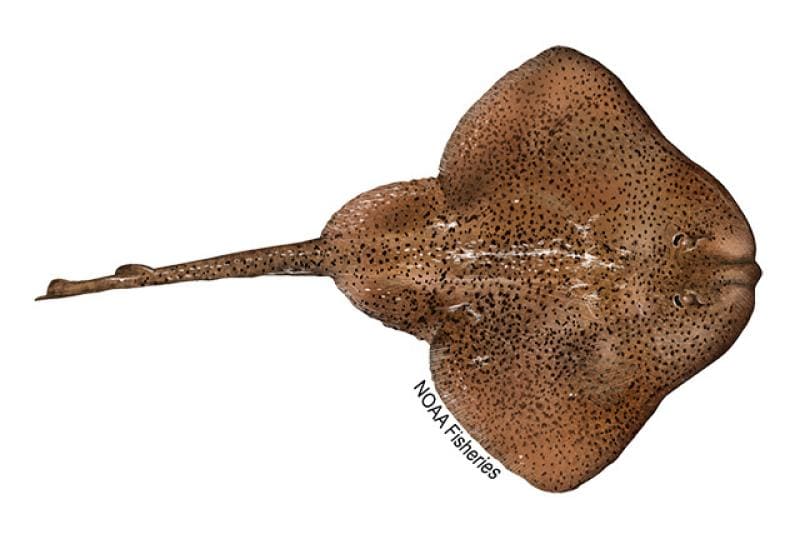
- Skates are a relative of sharks and rays and have a kite-like shape.
- Winter skates are light brown and covered with small dark spots.
- Small spines cover most of their back.
- Biology Winter skates have large bodies and can grow up to 5 feet in length.
- They can live for about 20 years.
- They reproduce at a late age, when they’re approximately 11 years old and 2.5 feet long.
Where to see them around Ocean City
- Nearshore days: Inlet, guarded beaches, and bay overlooks. Farther days: watch for the same species from charter rails when water clarity and bait line up.
- Dawn and dusk often show more surface activity; midday heat can push fish deeper even when they are still in the area.
- Pair a beach walk with a short Inlet stop—two vantage points beat one crowded pier rail.
- Winter Skate sightings are usually brief—watch for a fin, wing, or dark shape rather than lingering surface shows.
When to look
- Expect the richest shore viewing in summer; spring and fall migrations can still light up the Inlet and beaches.
- After storms, wait for water to clear—murky days hide even common species from the beach.
- Likelihood stars on this page reflect how often Maryland visitors can reasonably hope to encounter the species nearby—not fishing success rates.
Viewing tips & etiquette
- Use binoculars or a long lens; do not enter the water to corner fish, rays, or sharks for photos.
- Respect beach nesting closures, stay off dunes, and keep dogs leashed where required.
- If you find a stranded or injured animal, contact official wildlife responders—do not attempt rescue yourself.
- For harvest rules or shark fishing trips, use the Fishing profile for Winter Skate or the shark fishing guide.
Sources
- NOAA Fisheries species profile (biology reference)
- OCEANCITY.MD Fishing species profile